Peristaltic Pump vs. Pressure-Based Flow Control Systems
- adminLVF
- 2457 Views
- Peristaltic Pump, Pressure-Based Flow Controllers
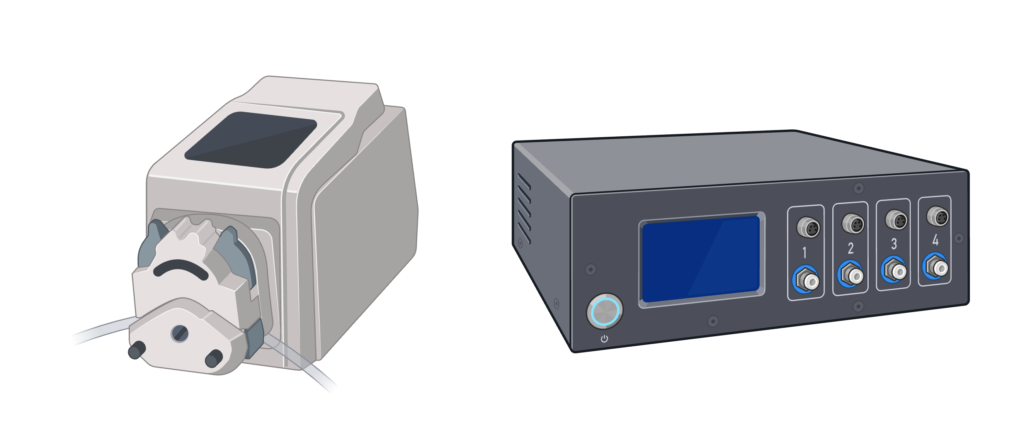
Peristaltic pumps have been widely used for fluid handling applications due to their simplicity and versatility. However, with the advancement of microfluidic technologies, pressure-based flow control systems have emerged as a superior alternative, offering enhanced precision and efficiency. In this blog, we’ll explore what peristaltic pumps are, compare them with pressure-based flow control systems, and discuss why advanced solutions like the OB1 are the preferred choice for achieving a precise flow rate in microfluidic applications.
What is a Peristaltic Pump?
A peristaltic pump operates by compressing and releasing flexible tubing in a sequential manner, mimicking natural peristalsis found in biological systems. This mechanism propels fluids through the tube, making it ideal for applications where the fluid must remain isolated from pump components to prevent contamination. Peristaltic pumps are valued for their ease of use and ability to handle a variety of fluids, including those that are viscous or contain particles.
However, despite their benefits, peristaltic pumps have limitations in applications that demand a stable and precise flow rate, particularly in microfluidic experiments.
Flow Technologies: The Rise of Pressure-Based Flow Control Systems
Traditional peristaltic pumps, while effective for many applications, often introduce pulsations into the flow. This can be a challenge in microfluidic experiments that require steady, pulse-free flow control. Pressure-based flow control systems have emerged as a game-changing solution, offering:
- Pulseless Flow: Unlike peristaltic pumps, pressure-based systems provide steady and smooth flow.
- Fast Response Time: Instantaneous adjustments for dynamic experiments.
- High Precision: Ideal for achieving ultra-low and consistent flow rates required in microfluidic setups.
Pressure-driven flow control systems work by pressurizing a reservoir containing the fluid, which is then pushed through the system in a controlled manner. This technology is particularly beneficial for microfluidic applications requiring precise fluid control, such as lab-on-a-chip devices and biomedical research.
Peristaltic Pump vs. Pressure-Based Flow Control: Key Differences
| Feature | Peristaltic Pump | Pressure-Based Flow Control System |
|---|---|---|
| Flow Stability | Pulsations due to mechanical action | Pulseless, steady flow |
| Response Time | Slow response to flow changes | Fast response, often within milliseconds |
| Flow Rate Precision | Moderate precision, less accurate at low flow rates | High precision, ideal for microfluidic systems |
| Ease of Setup | Simple and user-friendly | Requires initial setup but offers automation |
| Maintenance | Frequent tubing replacement required | Minimal maintenance with proper setup |
| Contamination Risk | Low, as fluid contacts only tubing | Low, with appropriate reservoir and tubing |
| Best For | General liquid transfer, industrial and medical applications | Microfluidics, biomedical research, and precision applications |
Applications of Peristaltic Pumps
Peristaltic pumps are commonly used in various industries where fluid containment and moderate flow control are required. Some key applications include:
- Medical Devices: Used in dialysis machines and infusion pumps where sterile conditions are crucial.
- Food and Beverage Industry: Suitable for transferring food products without contamination.
- Chemical Processing: Effective in handling aggressive chemicals while keeping pump components safe.
- Water Treatment: Dosing precise amounts of chemicals into water systems for purification.
While peristaltic pumps are reliable in these applications, they may not provide the accuracy and stability needed for most microfluidic experiments.
Why Pressure-Based Flow Control Systems Like OB1 Are More Efficient
In microfluidic applications, precision and stability are critical factors. Pressure-based flow control systems such as the OB1 by Elveflow offer numerous advantages over traditional peristaltic pumps, making them the preferred choice for researchers and engineers.
Key benefits of the OB1 system include:
- Unparalleled Precision: Delivers ultra-stable and accurate flow rates, crucial for microfluidic experiments.
- Fast Settling Time: Adjusts flow within milliseconds, allowing dynamic control.
- Automation Compatibility: Easily integrates with lab automation and data acquisition systems.
- Minimal Maintenance: No moving parts in direct contact with fluids, reducing wear and tear.
The OB1 system ensures a consistent and reliable precise flow rate, making it ideal for applications such as cell culture, lab-on-a-chip devices, and chemical synthesis.
Choosing the Right Flow Control Technology for Your Needs
When deciding between a peristaltic pump and a pressure-based flow control system, consider the specific requirements of your application. If your focus is on applications where contamination must be avoided with moderate precision, a peristaltic pump may suffice. However, for microfluidic applications that demand high precision, stability, and automation capabilities, a pressure-based system like the OB1 is the superior choice.
Elveflow is a leader in microfluidic flow control technologies, offering state-of-the-art solutions for researchers worldwide. Whether you’re working on complex lab experiments or industrial processes, Elveflow provides the expertise and cutting-edge equipment to optimize your fluid control needs.
Conclusion
Selecting the right flow control technology is crucial for achieving accurate and reliable results in fluid handling applications. While peristaltic pumps are useful for general applications, pressure-based flow control systems provide superior precision and stability, particularly in microfluidics. Elveflow stands as the ideal partner for your scientific endeavors, offering advanced solutions such as the OB1 to meet the most demanding fluid control challenges.
Explore Elveflow’s cutting-edge solutions today and revolutionize your microfluidic research with the highest level of precision and reliability.

 Job
Job Collaborations
 Customer
 Other
Other