Shaping a Soft Future: Patterning Liquid Metals
Introduction
The review presents a detailed exploration of techniques for controlling and patterning liquid metals, particularly gallium-based alloys. Liquid metals (LMs) combine the fluidity of liquids with the conductivity of metals, making them ideal for applications in stretchable electronics, soft robotics, and other emerging fields. The unique properties of LMs, such as their ability to form non-spherical shapes due to a native oxide layer, allow for innovative uses in various devices.
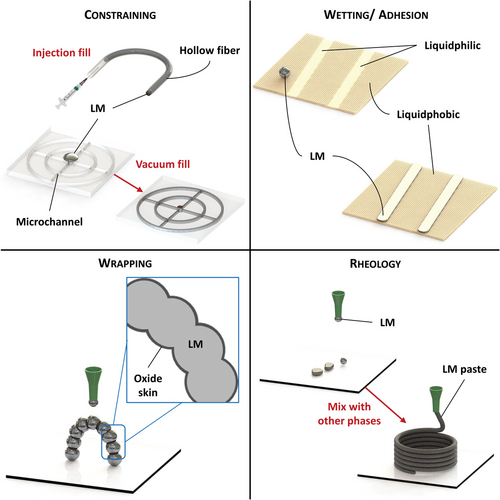
Properties and Behavior of Ga-Based Liquid Metals
Gallium-based liquid metals, particularly eutectic gallium indium (EGaIn), are transforming the fields of stretchable electronics, soft robotics, and microfluidic systems due to their unique properties. Gallium is highlighted for its low toxicity, supercooling ability, and high boiling point, making it a safe and versatile choice for applications.
Stability Through Oxide Layer Formation
A key feature of gallium-based liquid metals is their ability to form a thin, stable oxide layer on their surface when exposed to air. This oxide layer, typically just a few nanometers thick, is crucial in allowing these metals to maintain non-spherical shapes—essential for many advanced applications. Unlike conventional liquids, which tend to form spherical droplets due to surface tension, the oxide layer enables liquid metals to hold shapes like wires, films, and intricate patterns. This characteristic is particularly valuable in applications requiring precise control over the metal’s shape and configuration, such as in stretchable and reconfigurable electronic devices. Additionally, the oxide layer acts as a protective barrier, preventing the metal from reacting with its environment, essential for maintaining its integrity over time.
Methods to Pattern Liquid Metals
Several advanced techniques have been developed to harness the unique properties of gallium-based liquid metals for patterning:
- Injection: Liquid metal is injected into pre-designed microchannels or cavities within elastomeric materials. The oxide layer ensures the metal maintains its shape within the channels, allowing for highly conductive pathways. This method is particularly effective for microfluidic systems.
- Direct Writing: In direct writing, liquid metal is dispensed through a nozzle onto a substrate. The oxide layer helps the metal retain its shape after deposition, allowing for fine, intricate conductive traces. This method is versatile, ideal for creating complex patterns in stretchable electronics and soft robotics.
- Stencil Printing: A stencil is used to define a pattern, which is then filled with liquid metal. Stencil printing is simple and scalable, making it ideal for large-scale production, though it is limited by the stencil’s resolution.
- Selective Adhesion: This method exploits the oxide layer’s adhesive properties, allowing for precise patterning by selectively smoothing or roughening a substrate. This technique is useful for creating intricate, multi-layered structures in advanced microelectronic devices.
- Rheological Modification: The viscosity of liquid metal is altered by adding fillers like metal particles or oxides. This modification enables liquid metals to be extruded or printed into stable shapes, essential for creating robust, three-dimensional structures.
Challenges and Opportunities
Patterning liquid metals presents challenges, particularly in managing the oxide layer, which, while beneficial, can complicate the process. Achieving consistent, reproducible patterns requires careful control over the oxide layer. Scaling these techniques for industrial applications also poses significant challenges. However, the potential applications of patterned liquid metals are vast, from flexible and wearable sensors to reconfigurable circuits and advanced soft robotics. Continued research is essential to overcome these limitations and fully exploit the capabilities of these materials.
Conclusion
Gallium-based liquid metals, with their unique properties and versatile patterning techniques, are at the forefront of a new era in electronic device design. The oxide layer’s critical role in enabling these techniques opens up exciting possibilities in stretchable electronics, soft robotics, and beyond. As these methods are refined and scaled, liquid metals are poised to play a central role in next-generation technologies.
For more detailed information, readers are encouraged to refer to the original article: Ma, J., Krisnadi, F., Vong, M. H., Kong, M., Awartani, O. M., & Dickey, M. D. (2022). Shaping a Soft Future: Patterning Liquid Metals. Advanced Materials.

 Job
Job Collaborations
 Customer
 Other
Other