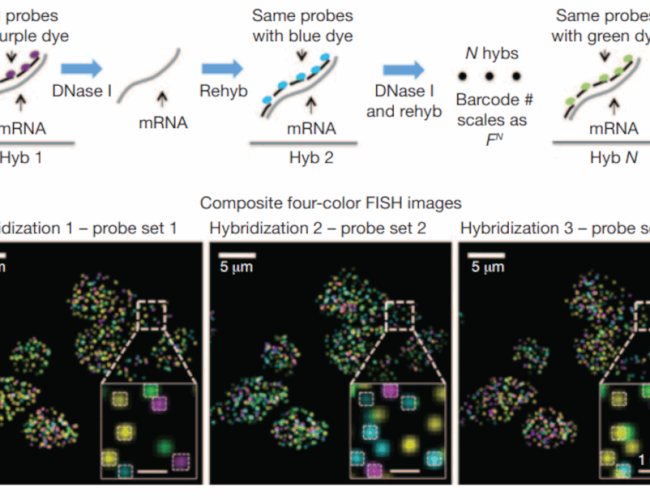
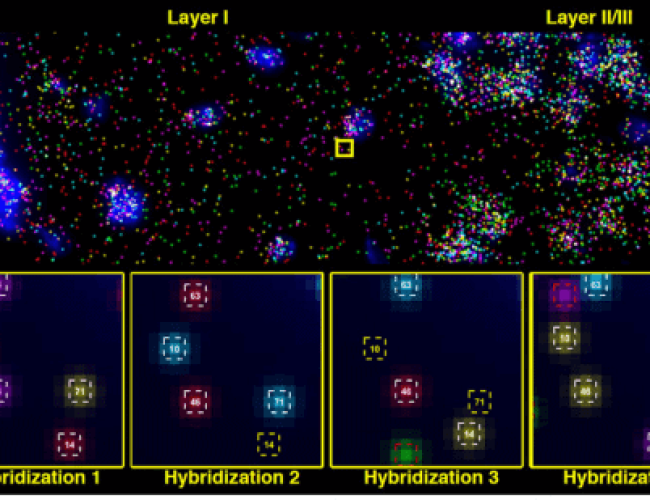


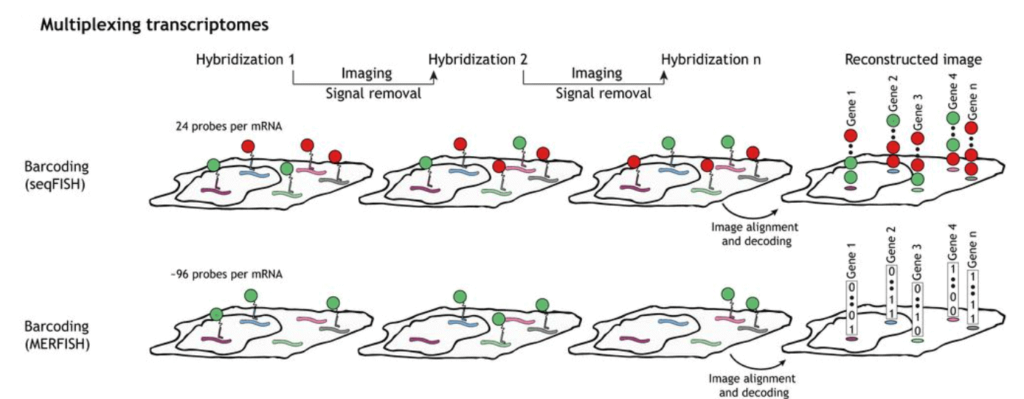
Sequential hybridization figures by Lubeck et al. (2014) and Shah et al. (2016)
AUTOMATED FLUIDIC CONTROL IN SPATIAL TRANSCRIPTOMICS
Simple, plug-and-play fluidic automation for merfish, seqfish, and seqfish+
Devices for spatial transcriptomics
Ideal pack for your setup of fluorescence in situ hybridization
Simple sequential injection
Switch between solutions quickly using just one flow controller
Automation and integration
Use TTL triggers and SDK to automate customized sequences and synchronize microscopes
Highlights
SPATIAL TRANSCRIPTOMICS SYSTEM
Setup
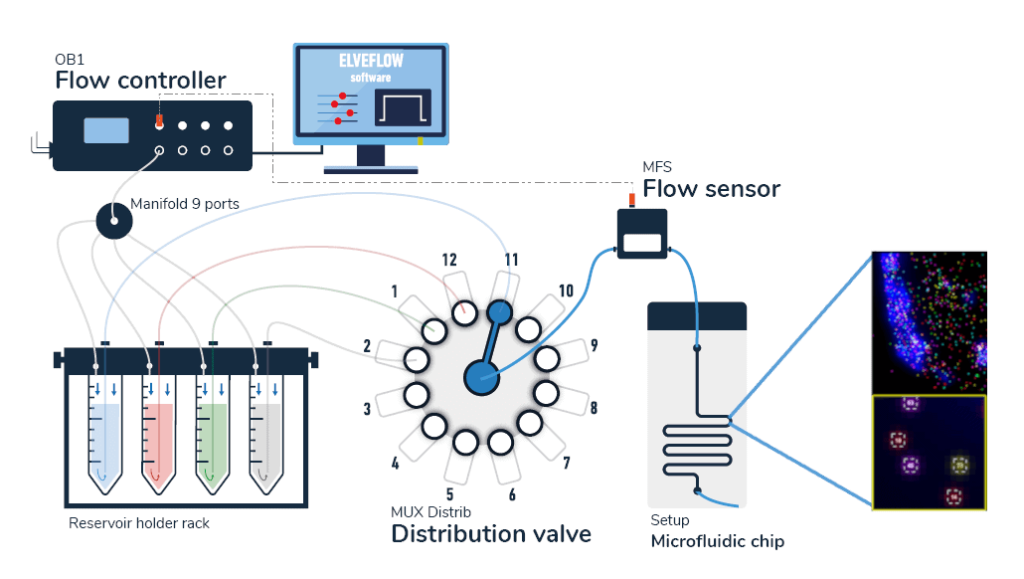
SPATIAL TRANSCRIPTOMICS SYSTEM SETUP
FLUIDIC SETUP
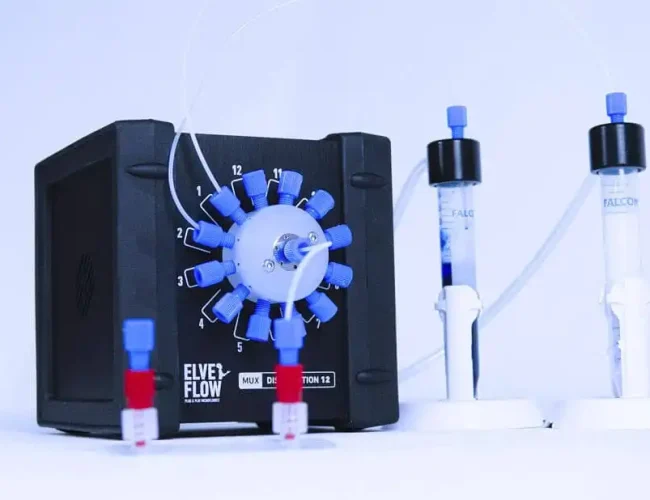
The pack contains:
- OB1 flow controller
- Microfluidic flow sensor
- One or two 12:1 MUX distribution valves depending of the number of dyes you want to inject
- Tubings and luers
- Several Eppendorfs or Falcon reservoirs
- Microfluidic chips
- Microfluidic Software
- A user guide
upcoming Microscope Setup
Applications
SPATIAL TRANSCRIPTOMICS SYSTEM Principle
To improve our understanding of complex multicellular biological systems and their interactions, the study of spatially resolved transcriptomes has garnered attention recently [2]. Additionally, Nature Methods has selected it as the 2020 “Method of the Year” [3].
Through molecular and cellular mechanisms, cells are able to perceive their local environment as well as those of their neighbors. For this reason, it is essential to research complicated biological events in order to quantify the phenotypic and genomic states of individual cells in their different spatial placements [4].
For single-cell spatial transcriptomics, two in situ hybridization encoding techniques that involve probe detection are SeqFISH and MERFISH [5]. They are an enhanced form of the smFISH method, which is employed to investigate changes in gene expression and their implications [6]. In recent years, further techniques for obtaining spatially resolved transcriptomes have also been developed at an increasing rate [7].
A initial in situ hybridization using a single pair of fluorescent FISH probes and a labeled dye is required for seqFISH. After then, the fluorophores are eliminated using DNase. The mRNA is labeled with a different dye and hybridized with the same FISH probes. Many genes can be barcoded in a single cell using multiple colors and rounds of hybridization [8].
By combining seqFISH with a confocal microscope, seqFISH has been enhanced to seqFISH+, which may be used for cell spatial and biological process research. 10,000 genes in a single cell were multiplexed and super-resolution imaging was carried out using this [9].
Error Multiplexed By massively parallelizing and simultaneously identifying hundreds to thousands of RNA species with spatial information, Robust Fluorescence In Situ Hybridization (MERFISH) improves upon the single-molecule Fluorescence In Situ Hybridization (smFISH) approach.
Because unassigned binary barcodes can identify problems that can be fixed, this approach is also error-robust. This is the primary distinction between this technique and color-coded seqFISH [10].
There are numerous advantages to using microfluidic platforms and lab-on-a-chip technologies over seqFISH and MERFISH. primarily to shorten the experimentation period, cut down on costs, which can be somewhat significant for these methods, and automate the procedure [11].
References
- Shah, Sheel & Lubeck, Eric & Zhou, Wen & Cai, Long. (2016). In Situ Transcription Profiling of Single Cells Reveals Spatial Organization of Cells in the Mouse Hippocampus. Neuron. 92. 342-357.
- Asp M., Bergenstrahle J., Lundeberg J., Spatially Resolved Transcriptomes—Next Generation Tools for Tissue Exploration, BioEssays, 2020, 42 (10)
- Marx, V. Method of the Year: spatially resolved transcriptomics. Nat Methods 18, 9–14 (2021).
- Mayr U., Serra D., Liberali P. Exploring single cells in space and time during tissue development, homeostasis and regeneration. Development, 2019, 146(12),
- Zhou Y, Jia E, Pan M, Zhao X, Ge Q. Encoding Method of Single-cell Spatial Transcriptomics Sequencing. Int J Biol Sci 2020; 16(14):2663-2674.
- Raj A, van Oudenaarden A. Nature, nurture, or chance: stochastic gene expression and its consequences. Cell. 2008;135:216–226.
- Asp, M., Bergenstråhle, J., Lundeberg, J., Spatially Resolved Transcriptomes—Next Generation Tools for Tissue Exploration. BioEssays 2020, 42, 1900221.
- Lubeck, E., Coskun, A., Zhiyentayev, T. et al. Single-cell in situ RNA profiling by sequential hybridization. Nat Methods 11, 360–361 (2014).
- Eng, CH.L., Lawson, M., Zhu, Q. et al. Transcriptome-scale super-resolved imaging in tissues by RNA seqFISH+. Nature 568, 235–239 (2019).
- Moffitt, J R, and X Zhuang. “RNA Imaging with Multiplexed Error-Robust Fluorescence In Situ Hybridization (MERFISH).” Methods in enzymology vol. 572 (2016): 1-49.
- Rodriguez-Mateos, P., Azevedo, N.F., Almeida, C. et al. FISH and chips: a review of microfluidic platforms for FISH analysis. Med Microbiol Immunol 209, 373–391 (2020).
Why use it?
uses of microfluidics for fluorecence in situ hybridization
Microfluidics is the most effective way to observe multiple genes and their spatial configuration through MERFISH (Multiplexed Error-Robust Fluorescence In Situ Hybridization) or seqFISH (sequential Fluorescence In Situ Hybridization), as it allows for experimentation with a significantly smaller amount of costly dye and buffer solutions and is compatible with biological applications and microscope observations.
As was already explained, the solutions can be injected into the cell using an automated process. Additionally, the system can be configured to link many chips, making it simple to view multiple samples simultaneously.
Before setting up a fluorescence in situ hybridization system, this pack can also be used in conjunction with other microfluidic procedures; for instance, microfluidic single-cell encapsulation can be used for single-cell isolation [1].
Microfluidics can also be applied to barcoding (DBiT-seq) or the oscillatory flows of diluted probe solutions used in the MA-FISH approach.
Over the course of more than a decade, the Microfluidics Innovation Center acquired competence in microfluidics. It can offer its cutting-edge biological and engineering skills, making it the ideal partner for you as you make the switch to microfluidics.
References
1. Mayr U., Serra D., Liberali P. Exploring single cells in space and time during tissue development, homeostasis and regeneration. Development, 2019, 146(12),
Configuration
Customize your fluidic control in spatial transcriptomics setup
Customize your visualisation
Examine our other use cases for a range of uses.AUTOMATED FLUIDIC CONTROL IN SPATIAL TRANSCRIPTOMICS
Simple, plug-and-play fluidic automation for merfish, seqfish, and seqfish+
Devices for spatial transcriptomics
Ideal pack for your setup of fluorescence in situ hybridization
Simple sequential injection
Switch between solutions quickly using just one flow controller
Automation and integration
Use TTL triggers and SDK to automate customized sequences and synchronize microscopes