Fluid Concentration Gradient
Do-it-yourself fluid concentration gradient using microfluidicsUse the laminarity of microfluidics flow to get quickly a controlled gradient
From linear to logarithmic gradient, more or less smooth, create the specific gradient you need
Can be used for many applications such as cell culture, toxicology, chemical reaction, crystallization
Features & Benefits
Concentration gradient generation
In microfluidics, generating a gradient of concentration involves creating a gradual variation in the concentration of a substance across a microchannel.
Different method can be used to generate a gradient in microfluidics:
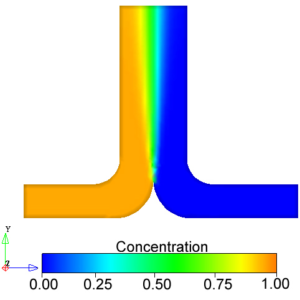
Two inlets directly into one channel:
This method relies on the natural process of diffusion where two or more fluids containing different concentrations of a substance flow adjacent to each other in a microchannel. Over time, diffusion occurs between the streams, creating a smooth gradient of concentration. The design of the channel and the flow rates of the fluids control the steepness and shape of the gradient.
Tree-Like Microfluidic Network:
A microfluidic gradient generator can be designed using a tree-like network of branching channels. In this approach, two or more fluids with different concentrations are split and recombined in a series of junctions, effectively diluting the substances step by step. This allows for a highly controlled gradient over the length of the channel.
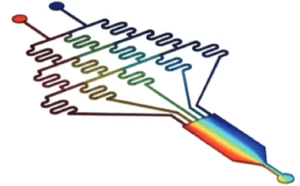
Surface: concentration (mol/m³)
Depending on the initial concentration, flow rate and namely of the geometry for each section the gradient obtained can be totally different. The serpentine design in each section allows the diffusion to occur and to get a uniform concentration before the next section.
Applications of Microfluidics concentration gradient
Gradient concentration can be used in many applications here is a non exhaustive list:
-
Chemotaxis Studies
-
- Application: Investigating the directional movement of cells, such as immune cells or bacteria, toward higher concentrations of chemoattractants.
- Details: Microfluidic devices allow precise control over chemical gradients to study cellular responses to varying concentrations of signaling molecules.
-
Drug Screening
-
- Application: Testing the effects of different drug concentrations on cells or tissues.
- Details: Concentration gradients enable high-throughput drug testing by exposing cells to a range of drug doses in a controlled environment. This helps in identifying the optimal dose and understanding dose-response relationships.
-
Cell Signaling and Differentiation Studies
-
- Application: Exploring how different concentrations of signaling molecules influence cell fate, behavior, or function.
- Details: Microfluidic devices create spatial and temporal gradients of proteins or hormones to study how cells react to environmental changes, providing insights into developmental biology and stem cell research.
-
Antibiotic Resistance Testing
-
- Application: Investigating bacterial resistance by exposing bacteria to a gradient of antibiotics.
- Details: Gradients help determine the minimum inhibitory concentration (MIC) of antibiotics required to suppress or kill bacteria, crucial for understanding resistance mechanisms.
-
Protein Crystallization
-
- Application: Creating gradients of precipitating agents to promote protein crystallization for structural biology studies.
- Details: Gradients in microfluidic chambers allow controlled conditions for protein crystallization, improving the yield and quality of crystals for X-ray crystallography
-
Reaction Studies
-
- Application: Investigating how chemical reactions respond to different substrate concentrations.
- Details: Gradients of substrates allow the study of reaction rates behavior under varying conditions, helping to understand kinetics and catalytic efficiencies.
-
Environmental Toxicology
-
- Application: Testing the effects of pollutants or toxins on cells or organisms under different concentration levels.
- Details: Microfluidic systems create gradients of environmental toxins, enabling precise exposure studies to assess biological effects in toxicology research.
Here an example of a set-up to create concentration gradients using a “Tree-like” device. The flow is generated using an OB1 pressure controller and monitored by two flow sensors that provide two solutions in the gradient generation chip. The third inlet is closed because it is not used in this example.
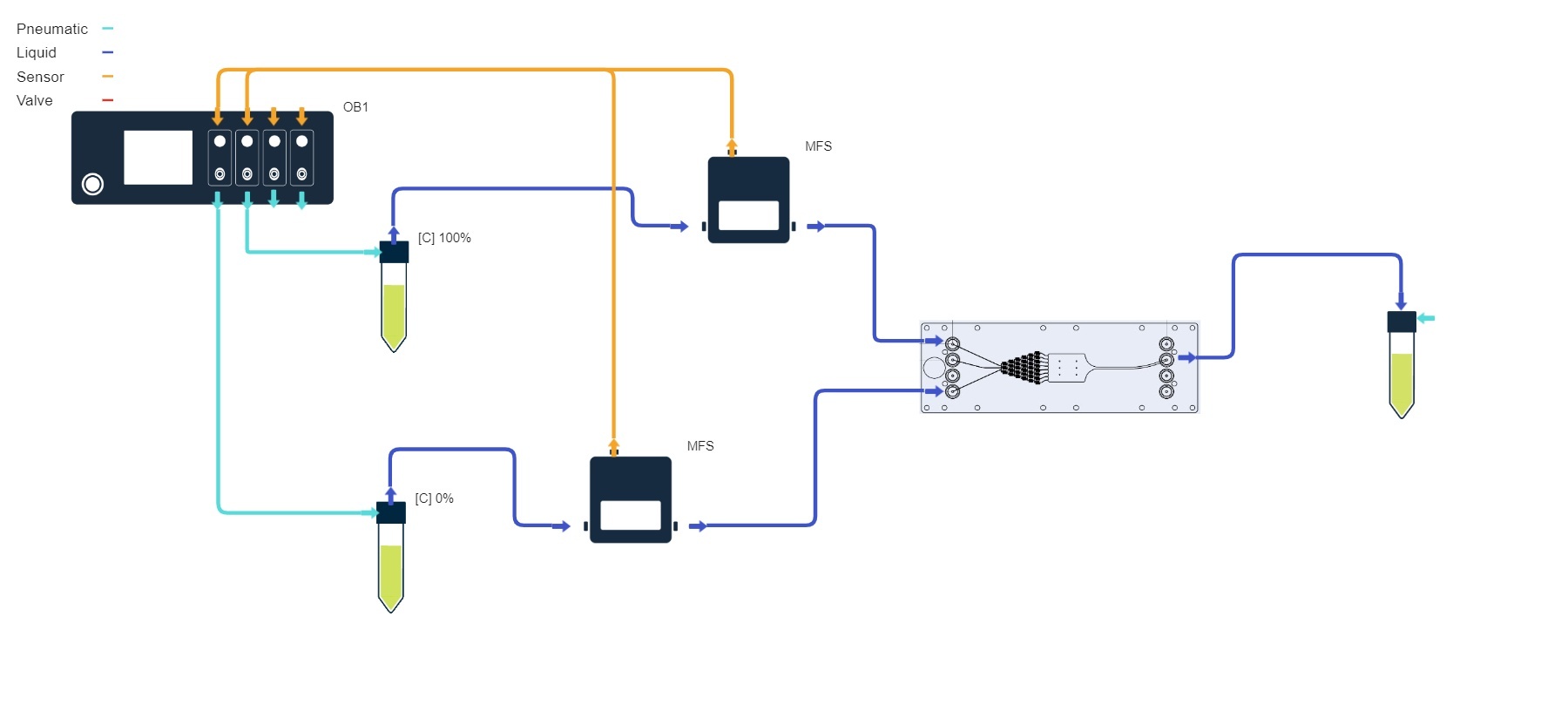
The set-up contains:
- OB1 flow controller
- 2x Microfluidics flow sensors
- Falcon reservoirs
- A gradient chip from microfluidic ChipShop
- All necessary accessories, tubing connectors
Frequently Asked Questions
Don’t hesitate to set up a meeting with one of our microfluidics experts. We’re here to help you explore the wide range of possibilities for your experiment. Our team can guide you through every step, offering insights and support tailored to your research goals. Let’s collaborate to make your experiments a success!
Indeed! Our professionals will determine which tools are most appropriate for your application, including the kind of flow sensor and the quantity of flow controller channels required for your experiment. Use the yellow “talk to our experts” button above to get in touch with us.
You can order our instruments on the product section of our website.


 Job
Job Collaborations
 Customer
 Other
Other