Microfluidics application note
Published on 27 August 2019
Active droplet generation in microfluidics is of high interest for a wide range of applications. It provides an additional degree of freedom in manipulating both the size and the formation frequency of micro-droplets. This additional control is extremely desirable for complex operations which rely on the accurate control of both parameters.
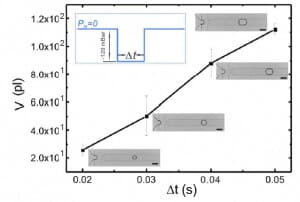
Variation of droplet volume with the pulse duration.
With courtesy of Say Hwa Tan research group
Advantages
Screen a large range of variables. Suited for production.
Ensure a perfectly controlled size
Create your own sequence.
40ms settling: time lowers the loss of expensive samples when priming the system
On-demand formation of droplets can greatly facilitate droplet manipulation when the number and size of droplets need to be controlled. It also facilitates droplets synchronization where the droplets need to be adjusted close to each other for fusion or mixing. This technique also prevents the formation of slugs or satellite droplets that may results in errors.
For instance, droplets in microfluidics can be used as a micro-reactor for various chemical and biological applications. Encapsulated droplets with chemical or biological contents are often detected, sorted and used for different analytical purposes. The encapsulation of biological materials in droplets also requires droplets to be of a suitable size for subsequent sorting using for instance fluorescence-activated droplet sorting.
Check out our microfluidic webinar about introduction to droplet microfluidics!
For more webinars  click here
Application
- Single cell analysis
- Cell encapsulation
- DNA sequencing – RNA sequencing
- Digital PCR
- Rapid chemical detection/analysis
- Rapid biological detection/analysis (biosensors)
- Combinatorial chemistry
- Ratiometric screening for protein crystallization
- 3D cell culture systems
- Polymer synthesis
- Nanoparticle synthesis
- On-chip reagent mixing
- Manufacturing complex multi-wall or hollow spheres
- Drug discovery
- Screening librairies generation
- Immunoassays
Microfluidic setup


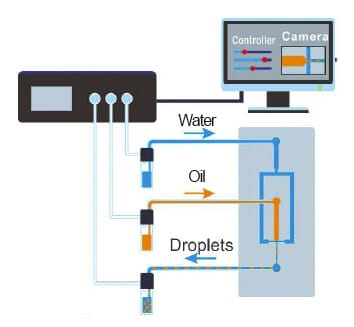
Elveflow© pressure & flow control instrument (OB1 MK3+).
Sample reservoirs (a Small Reservoir, Medium Reservoir or a Large Microfluidic Reservoir), one for each medium sample.
PDMS chip. We use two different ones: T-junction and flow focusing junction.
The generation of monodispersed droplets is controlled by inducing a positive pressure at the inlet of the microfluidic chip.
We first balance the water pressure and oil pressure to obtain a stable interface. Then, a positive pressure applied at the inlet induces droplet formation. Increasing the magnitude of the positive pressure increases the volume of the droplets generated.
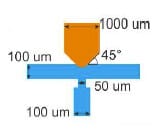
The PDMS chip used in the second part of this application note has the following features with a height of 28µm.
On-demand droplet generation
MONODISPERSED DROPLET ON DEMAND GENERATION USING A PRESSURE PULSE
The generation of monodispersed droplets is controlled by inducing a negative pressure at the outlet of the microfluidic chip.
First step is to balance the water pressure Pw, and oil pressure, P0, to obtain a stable interface. Then, a negative pressure introduced at the outlet induces droplet formation. Increasing the magnitude of the negative pressure increases the size of the droplets generated.
Applying the negative pressure offers the following advantages:
- Droplets can be produced on demand using a series of periodic pulses.
- Negative pressure also enables droplet collection without inconsistencies due to droplet coalescence at the exit. When droplets enter the tubing at the outlet of the chip, a disparity between the size of the micro-channel and tubing can reduce the speed of the droplets and result in collisions or merging. A constant negative pressure at the outlet allows droplets to flow consistently into the tubing/collection tube.
Microfluidic Chip
The microfluidic flow focusing chip used is made of polydimethylsiloxane (PDMS, Dow Corning). The microchannels are treated with Aquapel (PPG Industries, USA) to render the surface hydrophobic.
For the dispersed phase channel, the channel abruptly converges to one small orifice. As a result, the interface between the water and the oil has a high curvature. This creates a pressure difference, the Laplace pressure, that facilitates droplets formation.
Hardware
We connected the OB1 Mk3 pressure controller to induce both positive and negative pressures. The positive pressure balances the fluid interface at the converging channel. A negative pressure at the outlet induces droplet generation.
Samples
Mineral oil and DI water were used as the continuous phase and dispersed phase fluid respectively. The equilibrium interfacial tension between the fluids is about 6.2 mN/m. The dynamic viscosities of both oil and water are 23.8 mPa.s and 1mPa.s respectively.
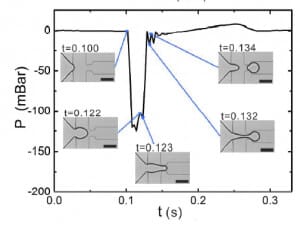
There is a coupling between the droplet formation process and imposed pressure signal. As the liquid finger fills up the orifice, this results in a slight increase of pressure. At this stage, the flow of fluids is restricted and results in a pressure built up at the upstream. Subsequently, as the controller returned back to 0 mBar, the abrupt change results in pressure fluctuations, a consequence of the liquid neck thinning and breakup to form a droplet. This pressure fluctuation is likely to induce instabilities enhancing the droplet breakup process.
Oil and water are fixed at about 107 mBar and 50 mBar respectively, to achieve the stable interface. Ten consecutive square pulses at intervals of Delta t = 0.02 to 0.05 sec are applied to generate 10 droplets. The magnitude of the pulses is fixed at -120 mBar. Experimental results depict an almost linear increase in V as Delta t increases . This result is expected as a higher pulse duration allows more fluids to flow before breakup is induced.
To discover more tips and tricks about droplets generation and manipulation, please check our droplet Userguide!
Elveflow offers a high resolution microfluidic flow controller. Its low response time allows its use as a custom pressure partner and makes it the perfect partner for droplets-on-demand generation.
In comparison to the use of syringe pumps, pressure driven flow generates highly monodispersed droplets due to the absence of pulsation effects induced by the stepper motors. Additionally, this technique of on demand creation with a pulse is not doable using other technologies.
The in-chip drop on demand technique allows for individual dispensing of drops of aqueous reagents or bubbles in a microfluidic chip with a high temporal precision, and very high rates. The ability to precisely trigger the droplet generation time allows the coordination of the generation of drops with events occurring in the chip, such as the detection of chemical reactions or temperature changes, or the transit of biological cells and other particles.
For more insight into pressure-driven flow controlled microfluidics, find below a selection of two videos!
This application note is based on the great work of Say Hwa Tan group.
Negative Pressure Induced Droplet Generation
in a Microfluidic Flow-focusing Device Anal. Chem., Just Accepted Manuscript • DOI: 10.1021/acs.analchem.6b05053 • Publication Date (Web): 03 Feb 2017 Downloaded from https://pubs.acs.org/ on February 5, 2017
How to perform in-chip microfluidic droplet generation?
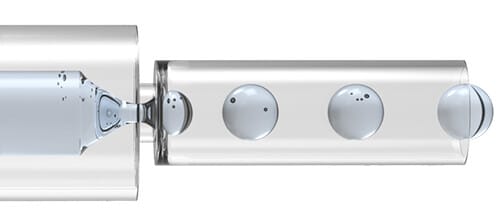
How to generate droplets inside a capillary

Microfluidics knowledge
Do you want tips on how to best set up your microfluidic experiment? Do you need inspiration or a different angle to take on your specific problem? Well, we probably have an application note just for you, feel free to check them out!

 Job
Job Collaborations
 Customer
 Other
Other