Droplet-based microfluidics is an emerging technology based on hydrodynamics principles: fluids are handled in a precise and reliable manner, providing essential tools to miniaturize and automatize assays.
Why use microfluidics to make droplets?
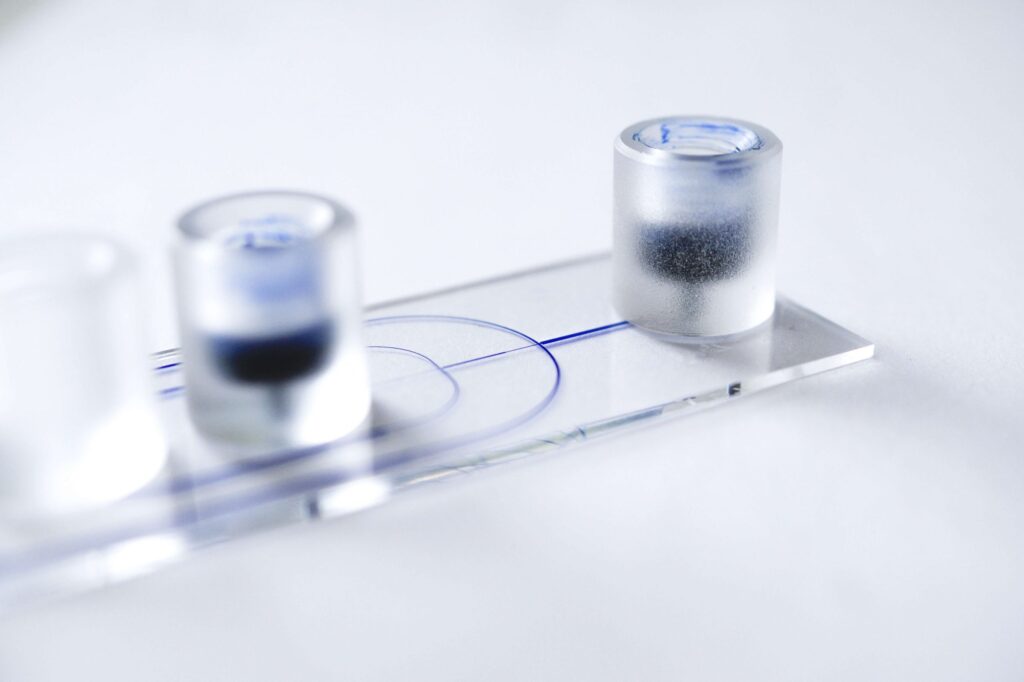
Traditionally, particles, nanoparticles and emulsions are formed by batch method: eg. using high shear methods such as sonication or homogenizers. These methods can produce large amounts of material, and can be quite simple to use. However, particles are (very) polydisperse, so filtering etc. is often needed. High shear stress can also cause problems, eg. with encapsulated payload.
Droplets formed within microfluidic channels often serve as microreactors containing different chemical or biological compounds, allowing massive numbers of independent reactions to be performed rapidly using a minimal amount of total reagent.
Microfluidic methods offer a number of significant advantages:
- Highly monodisperse (typically 1 to 5%)
Tunable to any particle size below 1mm - Consistent and reproducible
- Wide range of particle formation methods
- Complex particles can also be produced
- Amenable to real time Quality Control
- Better encapsulated payload
- 1MHz or 10kg/day of droplets/ particles is feasible by a very compact system
To learn more about droplet-based microfluidics, watch this video!
(better enjoyed with your sound on)
Can your research benefit from droplet-based microfluidics?
What do you need for droplets-based microfluidics?
To make droplets in microfluidics, you will need:
- Immiscible fluids: droplets can only be formed by one fluid in suspension in another one, eg. water-in-oil or oil-in-water
- Chip with micro-size features: for maintaining laminar flow and high surface tension
- Surfactants: chemicals that are added to either the continuous or the dispersed phase
- Flow control system
What is the best flow control system for droplet microfluidics?
For historical reasons, a syringe pump is the most used system in microfluidics. However, researchers are starting to switch to pressure control systems because their unique performances enhance experiments. Pressure-driven flow control allows pulseless flow within subsec response time. It consists in using a gas input pressure within a hermetic liquid tank in order to flow liquid from the tank to your microfluidic device.
In conclusion, droplet-based microfluidics is revolutionizing the way researchers handle fluids, enabling precise, efficient, and scalable production of monodisperse droplets for a wide array of applications. By leveraging hydrodynamics principles, this technology overcomes many limitations of traditional batch methods, such as polydispersity and damage to encapsulated payloads, offering a more controlled and reproducible alternative. Its ability to perform independent reactions in parallel, coupled with the potential for real-time quality control, makes it a powerful tool for researchers across various fields, from chemical synthesis to biological assays. As advancements in flow control systems, like pressure-driven methods, continue to enhance the precision and speed of droplet formation, the impact of microfluidics in scientific research is set to grow exponentially, driving innovation and opening new possibilities for high-throughput experimentation and automation. Elveflow stands out as the ideal scientific partner for researchers exploring droplet-based microfluidics. With their expertise and advanced flow control systems, Elveflow offers reliable and cutting-edge solutions, ensuring that experiments are conducted with the highest levels of precision, reproducibility, and efficiency.
Check out our multi channel pressure & vacuum controller for microfluidics
Get started with microfluidics and master droplet making with Elveflow’s Droplet Pack

Based on our best-selling OB1 Flow Controllers, this complete solution contains all the required parts for all researchers’ needs, to start making droplets and emulsions out of the box.
It brings the many benefits of microfluidics, such as excellent monodispersity, reproducibility and scalability, to your daily work in order to achieve great science.
For more information or Technical discussion

Microfluidics knowledge
Do you want tips on how to best set up your microfluidic experiment? Do you need inspiration or a different angle to take on your specific problem? Well, we probably have an application note just for you, feel free to check them out!

 Job
Job Collaborations
 Customer
 Other
Other