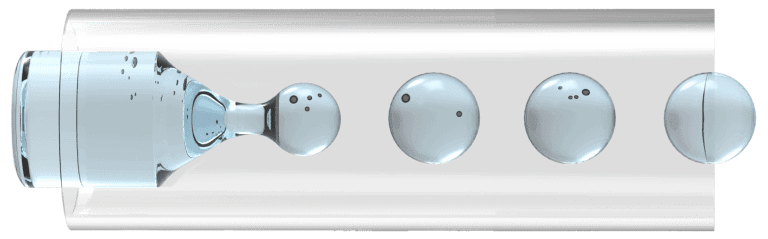
Digital microfluidics using pressure driven flow is the generation of droplets in a capillary or microfluidic device with pressure driven flow instead of syringe pumps. Pressure driven flows do not oscillate and change almost instantaneously, allowing almost instantaneous stabilization of flow rate and droplet uniformity. Syringe pump oscillations come from step motor vibrations, and slow stabilization comes from the elasticity of the syringe, tubing and device.
Observed result
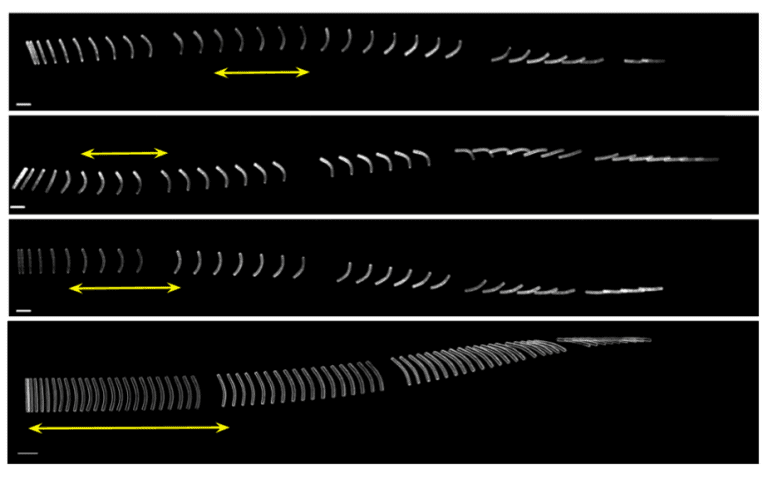
Water pressure changed from 80 mbar to 90 mbar: a new homogeneous droplet trail after six seconds
Challenges
Syringe pumps: stabilization can take several minutes or hours, depending on system elasticity and flow rate
Limitations
Pressure regulators need a compressed air line or an air compressor
Introduction to digital microfluidics using pressure driven flow
Making droplets in a capillary or in a microfluidic device is often met with two problems:
Droplets need an equilibration time to become stable in size.
Droplets size oscillates depending on the imposed flow rate and the materials used.
These effects are due to the combination between the flow rates’ driven flow and the elasticity of materials (tubing, syringe, device…). Those problems can be overcome by using pressure driven flow instead of syringe pumps, since pressure driven flows do not oscillate and shift almost instantaneously.
Most of the researchers actually use syringe pumps since pressure regulators need the installation of a compressed air line or an air compressor. For this reason, we now propose intuitive and stand-alone instruments which both generate pressure and regulate it with a precision as low as 100µbar.
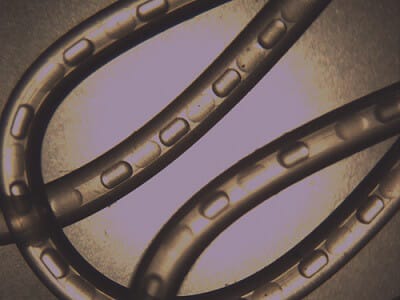
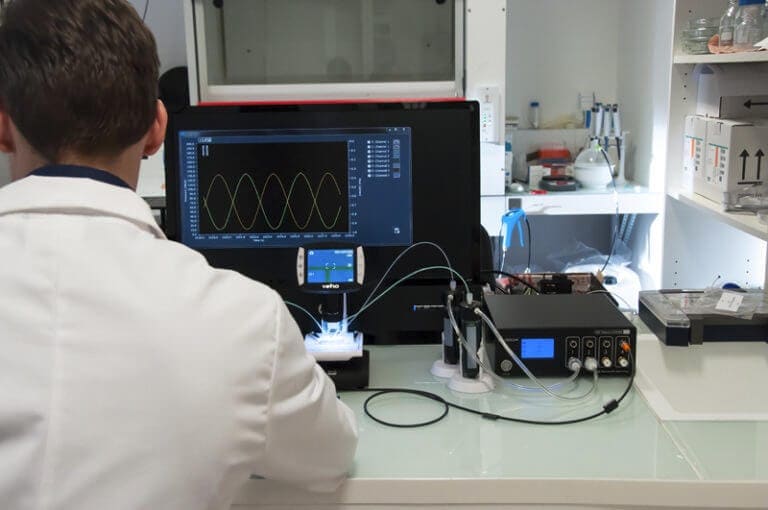
As an example, the media below shows a simple droplets generator setup using pressure driven flow.
Microfluidic droplets generation by Elveflow pressure source: Demonstration of time response
Fast response of droplets size to pressure driven flow instruction change
Six seconds after pressure instruction change (Pwater from 80mbar to 90 mbar), droplets sizes have changed and form another homogenous trail of drops:
Why droplet size and speed oscillate when using a syringe pump to control flow?
The step motor which allows the rotation of the infinite screw of the syringe pump produces periodic vibrations. Those vibrations are transmitted to the syringe piston translation and then generate periodic variations of the flow rate. Those periodic variations of the flow rate induce variations in size and displacement speed of the droplets.
Contrary to syringe pumps, pressure generators do not generate vibrations since pressure is regulated through a pressure controller.
Why does droplets generation need some equilibration time to become stable when changing flow rate of the syringe pump?
When changing the flow rate of your syringe pump, the pressure in the device slowly changes. The increase of pressure is partly absorbed by deformation of the fluidic system (syringe, tube, device…). Then, the flow rate in the capillary stabilizes only after complete deformation of the fluidic system. Depending on the system elasticity and the flow rate, the stabilization can take several minutes or hours.
With the pressure driven flow, the pressure almost instantaneously changes all over the fluidic system leading to almost instantaneous stabilization of the flow rate and droplet uniformity.
Another solution to decrease the stabilization time of the flow when using syringe pumps is to decrease the elasticity of the fluidic system. For example you can use a glass syringe and a glass capillary. This method reduces the stabilization time of the flow rate since the fluidic system has a lower elasticity; but increases the oscillating effect of the syringe pump on the flow rate since the fluidic system do not act anymore as a Syringe Pump Flow Stabilizer Microfluidic Kit.
Authors: F. Bertholle, G. Velvé Casquillas
For more information or Technical discussion
Microfluidics knowledge
Do you want tips on how to best set up your microfluidic experiment? Do you need inspiration or a different angle to take on your specific problem? Well, we probably have an application note just for you, feel free to check them out!
This review gathers a collection of information regarding liposome and lipid nanoparticle from their use and applications to how to generate them by bulk
Droplets formed within microfluidic channels often serve as microreactors containing different chemical or biological compounds, allowing massive numbers of independent reactions to be performed rapidly using a minimal amount of total reagent.
Brief overview of the numerous advantages of confined particles like bubbles, droplets and fibers and how confinement can be used for various applications
Microfluidic technologies offer an efficient means of producing highly uniform droplets and bubbles, and also a convenient mechanism for manipulating their downstream motion.
Digital microfluidics is an alternative technology for microfluidic systems based on the design, composition and manipulation of discrete droplets and/or bubbles.
Drop-Seq is a strategy based on the use of microfluidics for quickly profiling thousands of individual cells simultaneously by encapsulating them in tiny droplets for parallel analysis. This review presents the techniques and applications of Drop-Seq.
Contacting for a job application?
We are happy that you are interested in Elveflow. You can apply to our open jobs or send us your open application.
Over here!
For more information or Technical discussion
Need customer support?
For more information or Technical discussion
Talk to an expert
For more information or Technical discussion
Manage Consent
To provide the best experiences, we use technologies like cookies to store and/or access device information. Consenting to these technologies will allow us to process data such as browsing behavior or unique IDs on this site. Not consenting or withdrawing consent, may adversely affect certain features and functions.
Functional
Always active
The technical storage or access is strictly necessary for the legitimate purpose of enabling the use of a specific service explicitly requested by the subscriber or user, or for the sole purpose of carrying out the transmission of a communication over an electronic communications network.
Preferences
The technical storage or access is necessary for the legitimate purpose of storing preferences that are not requested by the subscriber or user.
Statistics
The technical storage or access that is used exclusively for statistical purposes.The technical storage or access that is used exclusively for anonymous statistical purposes. Without a subpoena, voluntary compliance on the part of your Internet Service Provider, or additional records from a third party, information stored or retrieved for this purpose alone cannot usually be used to identify you.
Marketing
The technical storage or access is required to create user profiles to send advertising, or to track the user on a website or across several websites for similar marketing purposes.
 Making droplets in a capillary or in a





 Job
 Collaborations
 Customer
 Other