Microfluidics application note
Published on 20 May 2022

This application note explains how to set up a robust and reproducible microfluidic platform for liposome assembly with improved encapsulation efficiency and reduced polydispersity in size.
The work was performed and kindly provided by Chang Chen, Dr Siddharth Deshpande and his research group.
Introduction to liposomes and assembly techniques
Liposomes are microscopic aqueous compartments confined by a lipid bilayer that separates them from the surrounding aqueous environment. Over the years, liposomes have become an important and versatile tool in science, medicine, and industry; a non-exhaustive list of applications includes:
- a minimalistic model system of living cells;
- bioreactors with a diffusive transport across the membranes;
- efficient carriers for drug and gene delivery;
- analytical tools in immunoassays and biosensors.
Bulk techniques including hydration, extrusion, and electroformation have been extensively utilized for liposome production, but these approaches are limited by high polydispersity in size, low encapsulation efficiency, and strict working conditions over key parameters such as lipid composition and salt content.
In the last decade, a variety of microfluidic techniques have emerged that have utilized fluid dynamics at microscale to produce liposomes in a highly controlled and reproducible fashion. Here we demonstrate a robust microfluidic technique – the octanol-assisted liposome assembly (OLA) [1, 2] – to form unilamellar, monodisperse, cell-sized liposomes. Akin to a bubble-blowing process, OLA is greatly facilitated by a precise control over the flow rates using the pressure pumps from Elveflow.
Principle of OLA liposome assembly
By controlling three distinct fluid streams using highly sensitive and responsive pressure pumps, OLA takes place at a six-way junction in a lab-on-a-chip setting. As can be seen in step I of Fig. 1, stable and monodisperse double-emulsion droplets are formed in a single step. Once formed, the LO phase is distributed asymmetrically across its surface, forming a distinct crescent-shaped volume at one side (Fig. 1, step II).
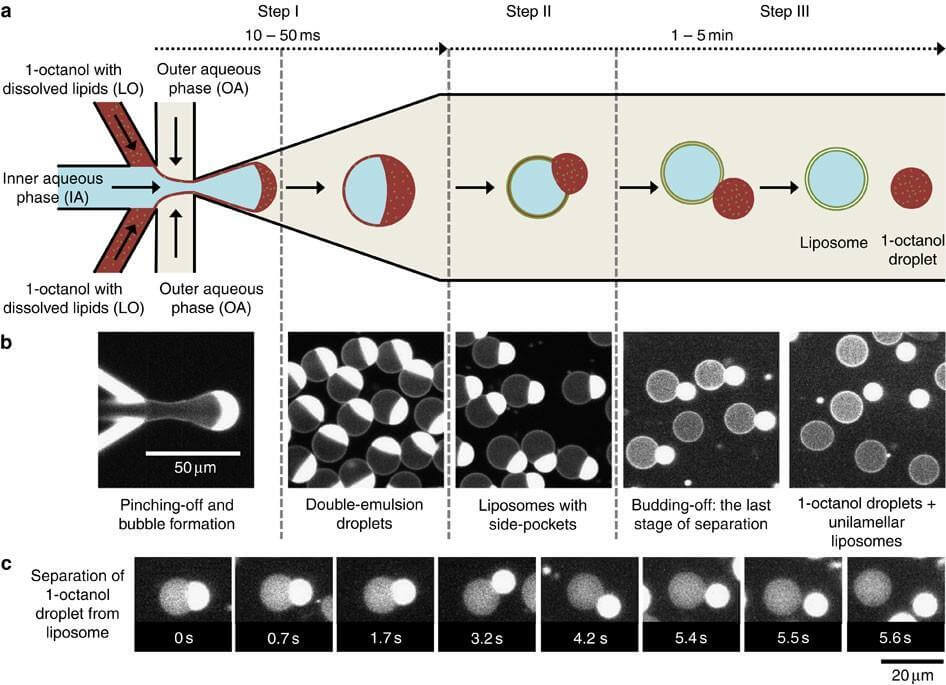
As a result, within a few seconds after its formation, the double-emulsion droplet develops into an intermediate complex containing two distinct phases: a prominent pocket of 1-octanol (containing excess lipids) and an inner aqueous lumen surrounded by a lipid bilayer.
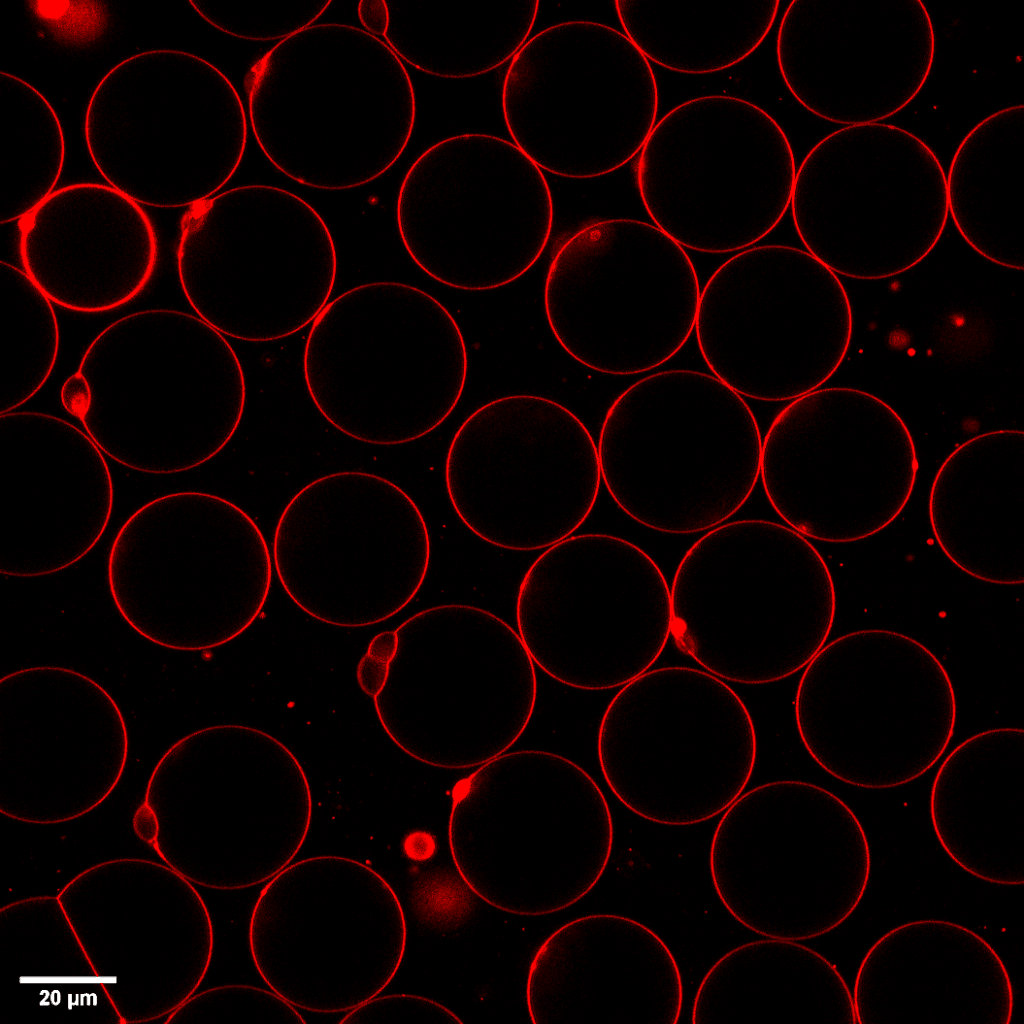
The 1-octanol pocket continues to protrude outwards with time; the interfacial area between the encapsulated inner aqueous phase and the pocket continuously reduces and, within a few minutes, the 1-octanol droplet completely buds off to form a fully assembled liposome (Fig. 1, step III). Compared to traditional methods, the liposomes produced by OLA have a uniform and controllable size distribution (Fig. 2).
Materials
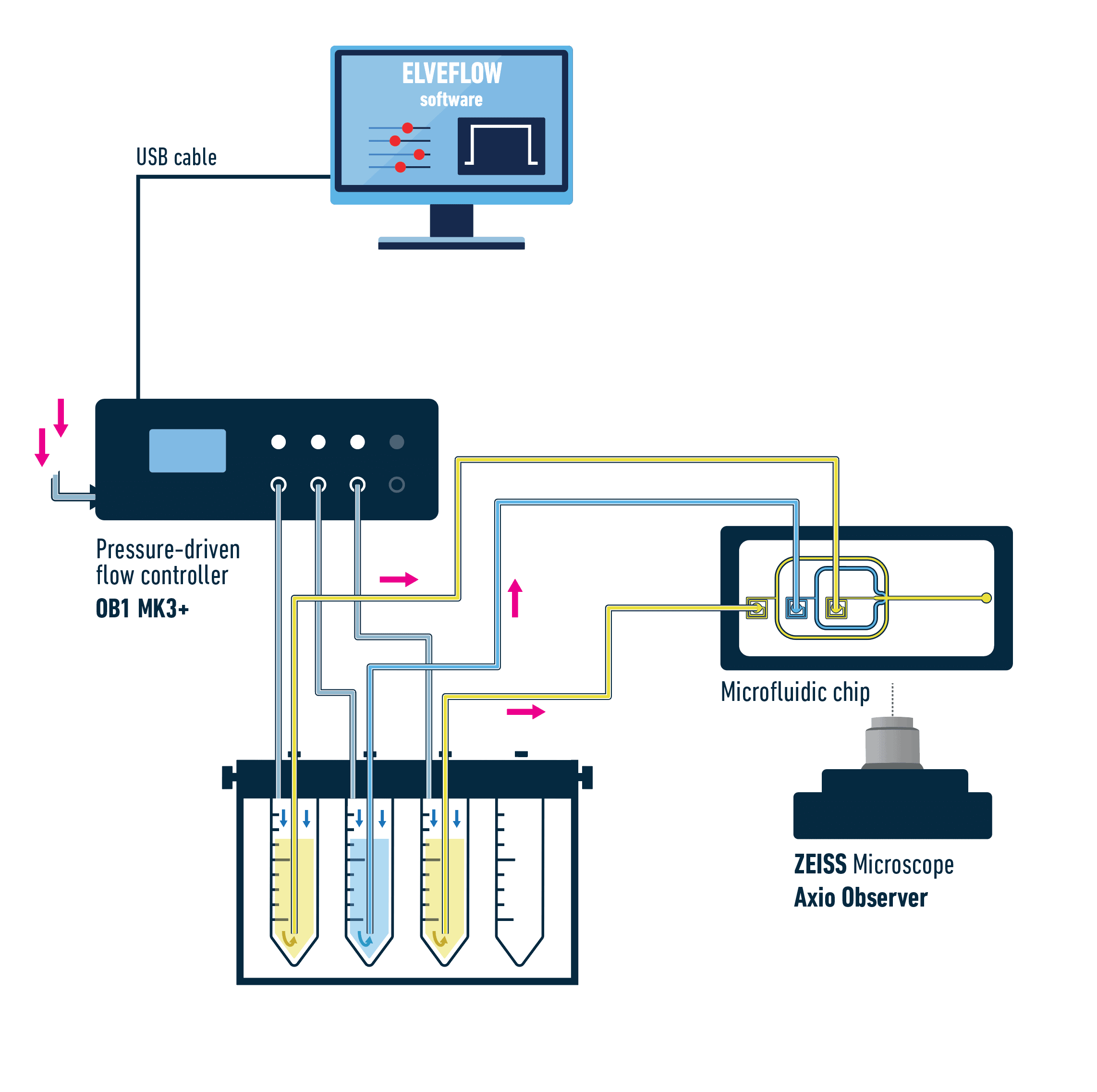
1. This protocol can be reproduced using the OB1 flow controller with three channels 0/2000 mbar
2. 1 X Kit starter pack Luer Lock
3. 4 tubes holder
4. Microfluidic chip
5. ZEISS Microscope Axio Observer and ZEN 3.4 software
6. Hamamatsu EM-CCD digital camera
OLA is an effective microfluidic technique to form unilamellar, monodisperse, and cell-sized liposomes. The key benefits are:
- adjustable liposome size made easy by a precise control over the input pressures (we routinely make liposomes that are 10 µm in diameter);
- works for a wide variety of lipids, pH range, and ionic strength;
- circumvents time-consuming solvent extraction steps and relies on physical dewetting that often goes to completion within a minute;
Excellent encapsulation of complex mixtures of biomolecules.
A glimpse of OLA in microfluidics platform
Video 1. The demonstration of OLA’s capability to efficiently produce monodisperse samples in a high-throughput manner and with excellent encapsulation. The inner aquae was stained with Yellow fluorescent protein. The middle aquae phase was stained with a mixture of DOPC and Lis Rhod PE in a 1000:1 ratio. The excitation wavelength was 488.
Conclusion
We employ highly sensitive pressure pumps from Elveflow to stably produce unilamellar, monodisperse, cell-sized liposomes.
The liposome size as well as the membrane composition and encapsulated solution are widely adjustable. OLA technology provides a versatile tool in science, especially in synthetic biology to build cell-like objects from individual components, to understand cellular modules, and to create synthetic cells with diverse functionalities[3-6].
If you are interested in OLA, artificial cells, or liquid-liquid phase separation, feel free to contact us: [email protected].

Microfluidics knowledge
Do you want tips on how to best set up your microfluidic experiment? Do you need inspiration or a different angle to take on your specific problem? Well, we probably have an application note just for you, feel free to check them out!

 Job
Job Collaborations
 Customer
 Other
Other