Published on 23 January 2025
Water-In-Oil Droplet Generation under Microscopy Monitoring
Droplet Microfluidics: Precise Control for Reliable Research
Droplet microfluidics, a key subfield of microfluidics, focuses on the manipulation of tiny, discrete droplets within microchannels. These droplets, typically ranging from picoliters to nanoliters in volume, are essential for various scientific and industrial applications. Examples include drug delivery, food processing, cosmetics, and cutting-edge microfluidic research.
Challenges in Droplet Formation
Consistent and precise droplet generation is vital yet challenging. Key hurdles include controlling the size, frequency, and uniformity of droplets, which depend on factors like pressure, flow rate, and fluid viscosity. Fine-tuning these parameters is crucial for optimizing processes and achieving reproducibility.
A Reliable Solution for Droplet Formation
Using our OB1 MK4 Pressure Controller paired with an OpenFrame Microscope provides a robust, easy-to-implement solution for overcoming droplet formation complexities. This setup offers researchers unparalleled accuracy and control, streamlining the creation of droplets for advanced research and industrial processes.
Why Choose the OB1 MK4 Pressure Controller?
The OB1 MK4 stands out for its high-resolution pressure control and rapid response time (down to 10ms). These features ensure precise manipulation of fluid flow, enabling stable and repeatable droplet formation. Researchers can achieve superior reliability in their experiments, paving the way for consistent results.
Droplet generation Pack
Enhancing Precision with the OpenFrame Microscope
The OpenFrame Microscope complements the OB1 MK4 by offering high-resolution imaging in a customizable platform. This allows researchers to:
- Monitor droplet formation in real-time.
- Adjust experimental setups immediately for optimal results.
- Improve the overall accuracy and efficiency of their workflows.
By combining the OB1 MK4 and OpenFrame Microscope, researchers can overcome the traditional challenges of droplet microfluidics with a system designed for precision and reproducibility.
Applications of Droplet Microfluidics
Droplet microfluidics plays a transformative role in biological, chemical, and industrial research. It enables the creation of uniform and controlled microenvironments, making it indispensable for studying cellular behaviors, biochemical reactions, and drug screening. Here are key applications across various fields:
Biomedical Applications
- High-Throughput Screening: Rapidly test thousands of drug compounds or biological reactions in parallel.
- Single-Cell Analysis: Study individual cells within isolated droplets for precise biological insights.
- Diagnostics: Develop advanced lab-on-chip systems for accurate, point-of-care medical diagnostics.
Material Science
- Nanoparticle Synthesis: Create uniform nanoparticles for use in drug delivery, imaging, and electronics.
- Microcapsules: Design encapsulated materials for controlled release applications.
- Emulsions: Develop stable emulsions for chemical and cosmetic applications.
Food Science
- Food Emulsions: Enhance texture, flavor, and nutritional profiles of food products using uniform droplet-based emulsions.
Environmental Applications
- Pollutant Monitoring and Analysis: Detects and analyzes environmental pollutants with high sensitivity and accuracy.
Droplet generation under Microscope monitoring
To successfully form droplets, it is essential to accurately define the ratio of pressures (or flow rates) applied to the two immiscible phases. The experimental setup mainly includes a pressure controller (OB1, MK4), flow sensors (MFSD2 and MFSD3) for precise regulation, and an OpenFrame microscope for visualizing and characterizing the droplet formation process.
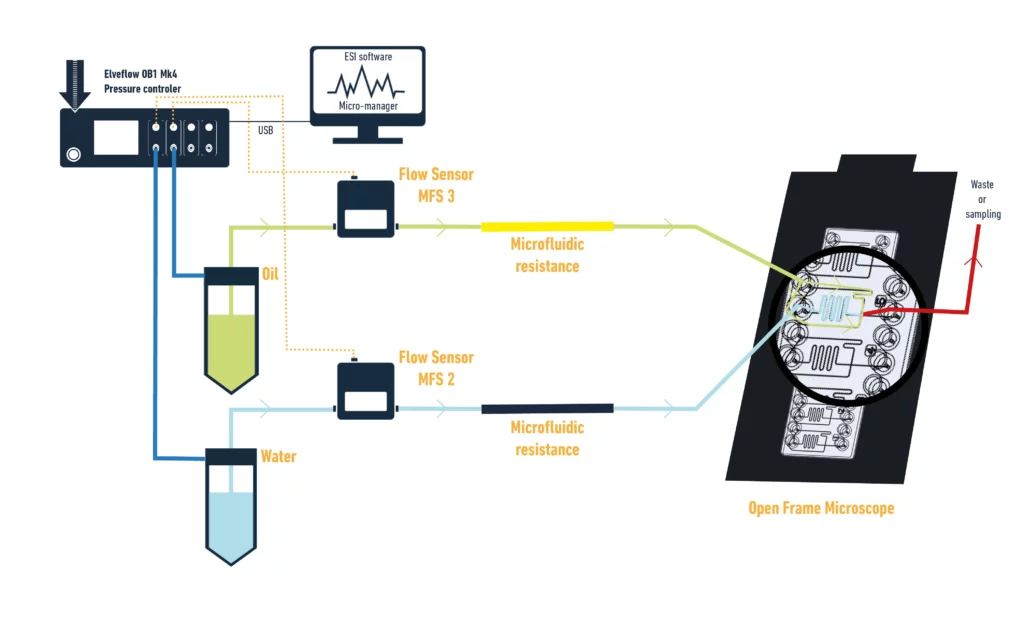
Materials for microfluidic droplet generation
- Microfluidic chip : Fluidic 440 (Microfluidic ChipShop)
- OB1 MK4 flow controller with 2 control channels (0 – 2bar)
- Pressure source (0 – 2bar)
- Two flow rate sensors : MFSD2 ; MFSD3
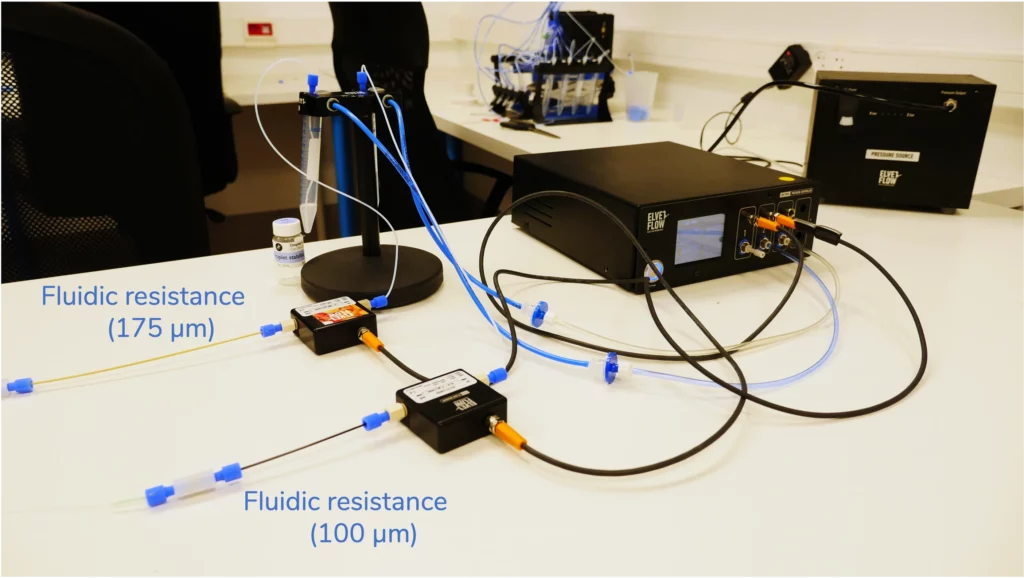
- Two fluidic resistances : 100µm ; 175µm ID (1/16’’ OD PEEK tubings)
- Reservoir holder with 2 push-in connectors
- 2 pressurized reservoirs (15mL)
- OpenFrame Microscope (10x objective, Retiga E7 camera)
- Distilled water
- Droplet stabilization oil from Droplet Genomics
Water-in-Oil droplet generation protocol
- Connect the pressure source to the OB1 using polyurethane tubing (6mm, push-in)
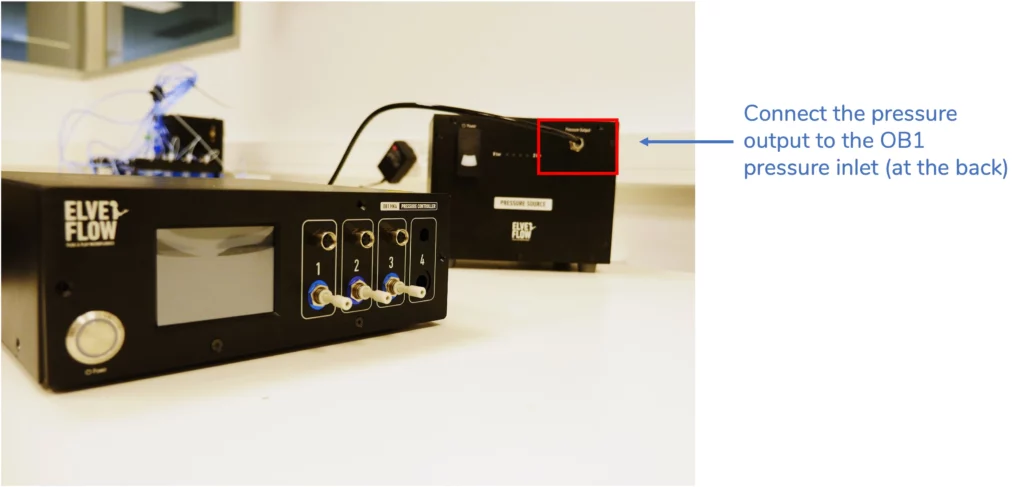
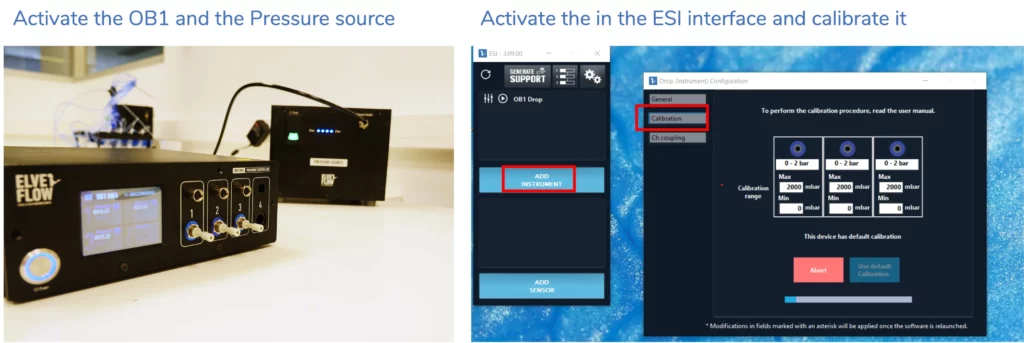
2. Connect the OB1 to the computer with a USB cable, open the ESI software, add the OB1 as an instrument, activate the pressure source, and calibrate the OB1.
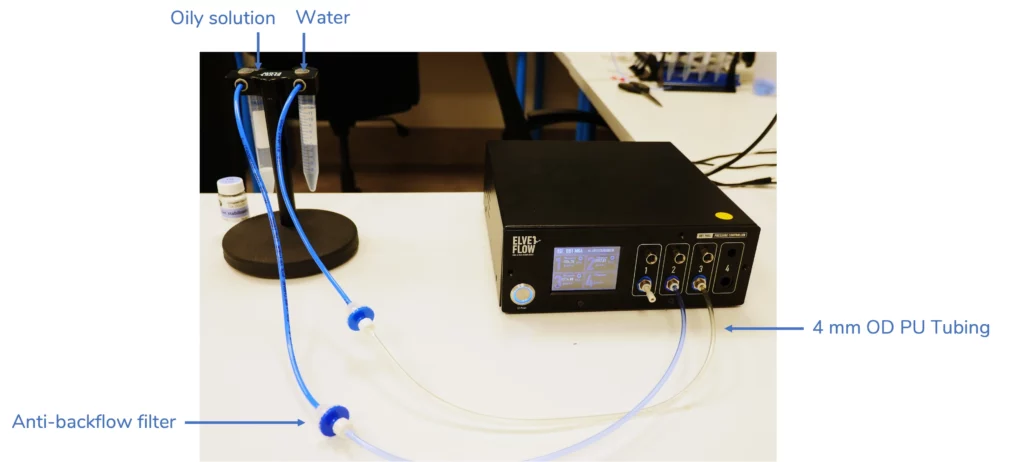
3. Fill the reservoirs with distilled water or the oily phase, and connect them to the OB1 using 4mm (OD) polyurethane tubing.
4. Connect the flow rate sensors to the OB1 with the M8-4 cable (water: MFSD 2, oil: MFSD 3), and add them as sensors in the ESI software.
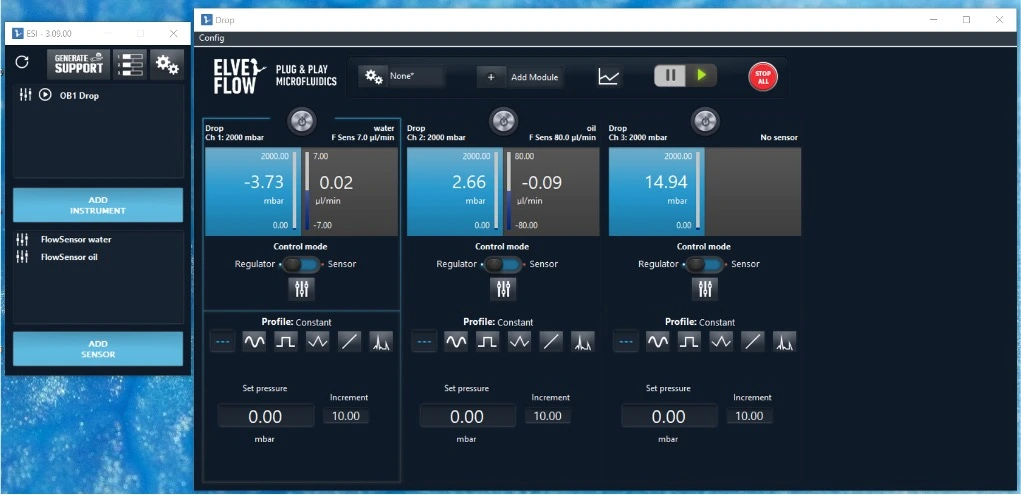
5. Connect the reservoirs to the flow sensors using 1/16” (OD) PTFE tubing. Secure the 6-40 to 1/4-28 PEEK adapter to the sensor, then connect the 1/4-28 fitting.
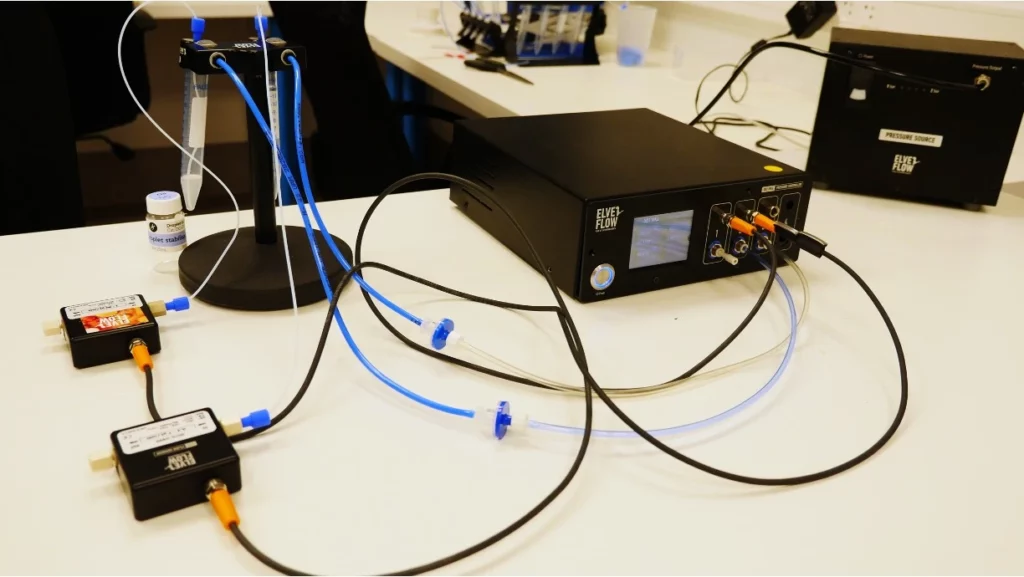
6. Integrate fluidic resistances into the setup to stabilize flow control (100µm ID for water injection, 175µm ID for oil injection).
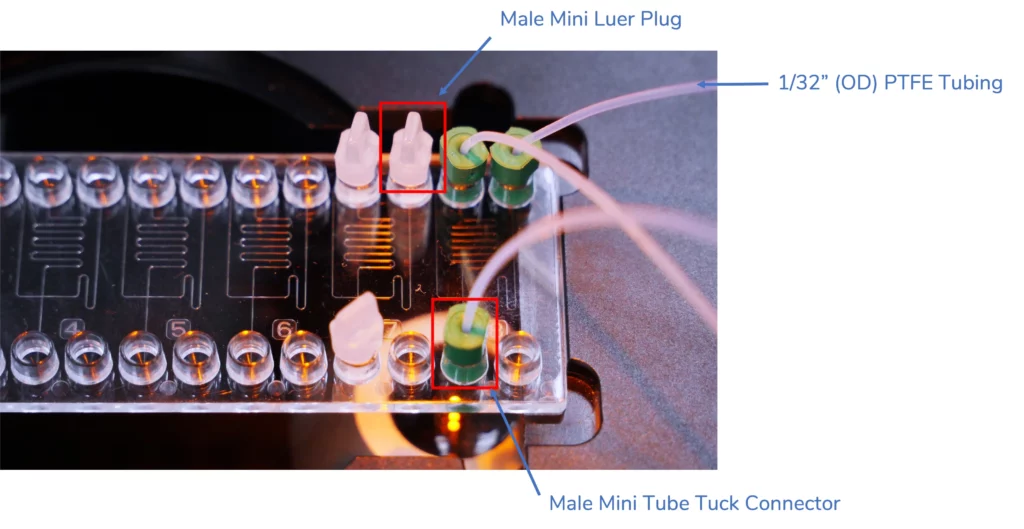
7. Position the microfluidic chip on the microscope stage, and use 1/32” (OD) PTFE tubing to connect the chip to the setup.
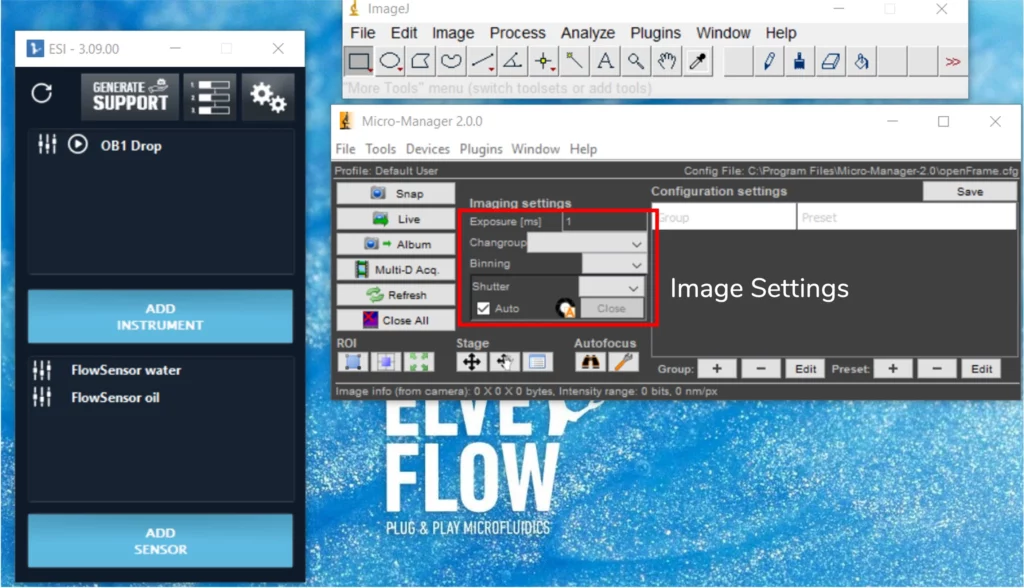
8. Start the Micro-Manager software to control the microscope and adjust the exposure settings.
9. Adjust the pressure (or flow rates) to inject water and oil into the microchip. Droplets will form after reaching a specific ratio.
10. To optimize camera speed, use the ROI (Region of Interest) module to focus on a specific area of interest.
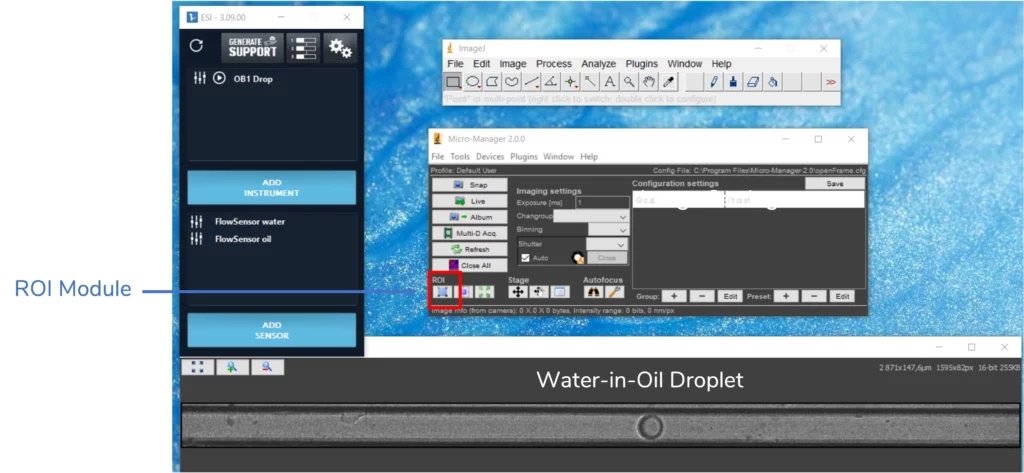
11. Process images and videos using ImageJ software.
Key results for microfluidic droplet generation under microscopY monitoring
The droplet size and production frequency can be adjusted by varying the flow rates of the dispersed and continuous phases, as well as the nozzle size. In this case, by setting the pressure to 370 mbar for the oil channel and 120 mbar for the water channel, droplets with an average diameter of 92 ± 2 µm were produced. The ROI module was used by focusing on the outlet channel to maximize camera speed.
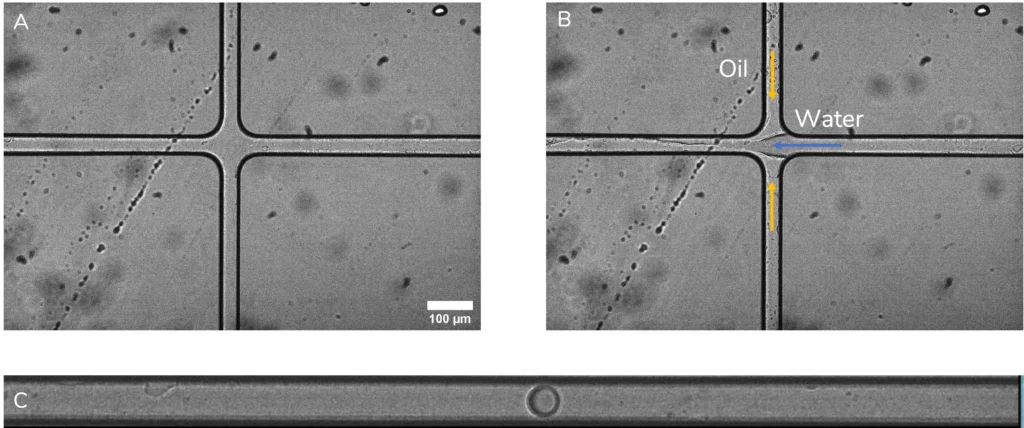
Microscopic images in bright field (Objective : 10x, time exposure : 0.5ms). A. Microfluidic chip filled with water. B. Cross-section showing the two immiscible phases. C. Droplet generation (camera speed : 7 fps)
Conclusion: Advancing Droplet Microfluidics with Precision and Ease
This study showcases a straightforward and reproducible method for synthesizing water-in-oil droplets. By leveraging the OB1 MK4 Pressure Controller and the OpenFrame Microscope (operating at a camera speed of 7 fps), droplets with a diameter of 92 ± 2 µm were successfully generated and characterized.
The ability to fine-tune experimental parameters, such as applied pressure and nozzle size, allows precise control over both droplet size and frequency. This versatile approach can be seamlessly adapted to a variety of applications, ranging from biomedical research to materials science, paving the way for innovation and enhanced precision in droplet microfluidics.
Explore how this powerful system can transform your microfluidic workflows today.
Acknowledgements
The study was conducted using Elveflow equipment for droplet generation, and the synthesis process was monitored through imaging with the Cairn Research OpenFrame microscope.
Written and reviewed by Amina Hamidou, PhD, and Louise Fournier, PhD. For more content about microfluidics, you can have a look here.
Get Started with the OB1

Microfluidics knowledge
Do you want tips on how to best set up your microfluidic experiment? Do you need inspiration or a different angle to take on your specific problem? Well, we probably have an application note just for you, feel free to check them out!

 Job
Job Collaborations
 Customer
 Other
Other