Microfluidics application note
Published on 17 December 2020

This microfluidic resistance calculator application note describes:
- How to calculate the microfluidic resistance at stake in your device
- The related flow rates & shear stresses in your microfluidic channel.
Elveflow’s online microfluidic calculator has been designed to help researchers and especially non-specialists of the microfluidics field.
Check out our dedicated tutorial with Kalyan Veerendra!
The hydraulic resistance describes the resistance to flow that occurs as a result of a volume flow through hydraulic elements such as tubings, valves and… microfluidic channel! It is defined as the ratio of pressure drop to volume flow and needs to be estimated for any items of your microfluidic system.
The microfluidic channel or tubing resistance results in pressure drop within the microfluidic circuit. Indeed, each component of the microfluidic system is likely to counteract the volume flow of your solution as soon as it is being injected.
Nevertheless, it should be noted that a huge discrepancy of microfluidic resistance between the tubing and the channel could impact the final flow rate obtained in your microfluidic channel and the precision of the flow control.
It should be noted that every microfluidic chip and setup are different. Those differences will likely have an impact on the calculations performed using the tool.
It is likely that the actual parameters would vary based on the real world experimental conditions.
Therefore, each time you make adjustments to your parameters, make sure to recalculate the results.
Here, we use a generic microfluidic system to give you a basic understanding of the parameters to select the right components for your setup.
Here are some of the many applications made easier by this calculator:
How to use the microfluidic resistance calculator?
Reminder: important experimental parameters
- The pump or pressure source
Exp: OB1 Mk3+ pressure-driven flow controller. - The microfluidic device
- The tubings
For more understanding of the working principle of pressure-driven flow controlled microfluidics, watch the following video.
All those elements will impact the calculation of your flow rate and the microfluidic resistance of your system. For more insight into those parameters, please refer to this application note.
In the following, the microfluidic hydraulic resistance of your system will be estimated for each part of your microfluidic setup from the tubing to the channel resistance.
Detailed protocol for the microfluidic resistance calculator
1/ Enter your fluid properties
Please refer to the application note: how to implement/convert the fluid properties inside my reservoir.
Either you can select from the drop down menu of the commonly used fluids in microfluidics or custom parameters for viscosity and density.
For the sake of this demo, we will use medium with 10% serum, commonly used.


2/ Compute the tubing resistance
In the former application note, the tubing resistance was considered as negligible and small compared to the channel microfluidic resistance. Our tool compares the resistance in the channel and the tubing to determine which is the most resistive.
Tubing microfluidic resistance
To calculate the microfluidic resistance of the tubing:
- Select high tubing resistance
- Enter the tubing inner diameter (ID)
- The length of your smallest tubing section.
In the case you are using or intend to use different tubing diameters in your experiment, it makes sense to enter details about the tubing with the smallest inner diameter to have the highest hydraulic resistance.
The hydraulic resistance of your channel will be estimated with the channel geometry that needs to be detailed in the Part 3, calculator results.
3/ Compute your channel resistance
- Choose your model geometry
The third part of the calculation is related to the geometry of the channel inside the chip. Theses parameters play an important role in the calculation of the shear stress within the channel.
The channels are most commonly circular or rectangular.
- Select the channel type you are using.
In this demonstration, the IBIDI chip has a rectangular geometry.:
- Width: 5000 um
- Height: 400 um
- Length: 50 mm


4/ … Calculate the microfluidic resistance!
You can chose to enter the targeted flow rate for your chip, pressure, or shear stress at the wall of your microfluidic channel.
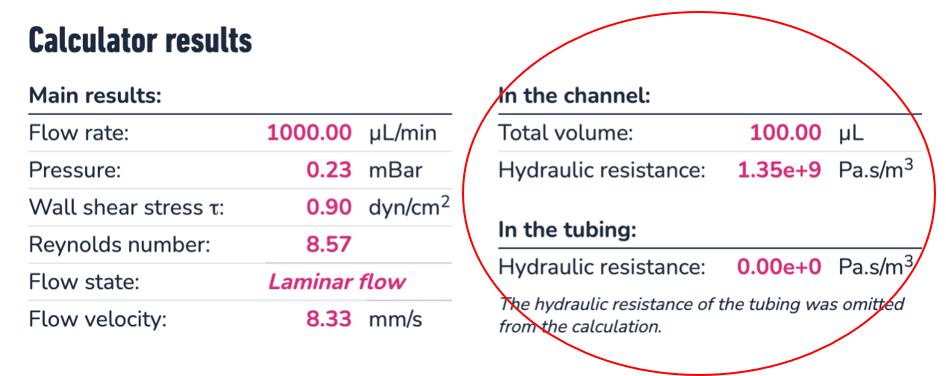
Here, a fixed flow rate: 1000 µL/min (1 mL/min) was entered and automatically, we have results for the pressure to apply and the shear stress.
Reciprocally, you can enter the pressure and estimate the resulting flow rate!
The OB1 pressure controller is commonly configured to work in ranges of 0-200 or 0-2000 mbar.
Warning! As you can see, 0.23 mbar is very low. A steady flow rate will be hard to achieve without adding resistance.
5/ Get additional advice!
In the advice section, the calculator recommends to add microfluidic resistance to have a higher pressure to apply and a more stable flow.
Different inner diameter values are proposed and the related length of it to achieve 100 mBar.
Here, we will use a 250 um ID (Inner Diameter) with 8 cm before the chip. We will enter theses resistance values into the Part 2 section.


We can see the calculator automatically updates the calculations with data from Part 2.
The shear stress result is in accordance with the experimental data given by the IBIDI datasheet.
- To discover how to adjust your flow rate, please read our related application note!
- Click here to convert your microfluidic units with our dedicated application note!
Also, the calculator gives you recommendations on:
- flow sensor (Gas or liquid flow sensors)
- pressure-driven flow controller

For the full Elveflow microfluidic product line, please watch the following video !
You can save your data and send it to your own inbox!
Get started and calculate now the microfluidic resistance in your chip!
Need more information? Contact our team of experts!


Microfluidics knowledge
Do you want tips on how to best set up your microfluidic experiment? Do you need inspiration or a different angle to take on your specific problem? Well, we probably have an application note just for you, feel free to check them out!

 Job
Job Collaborations
 Customer
 Other
Other