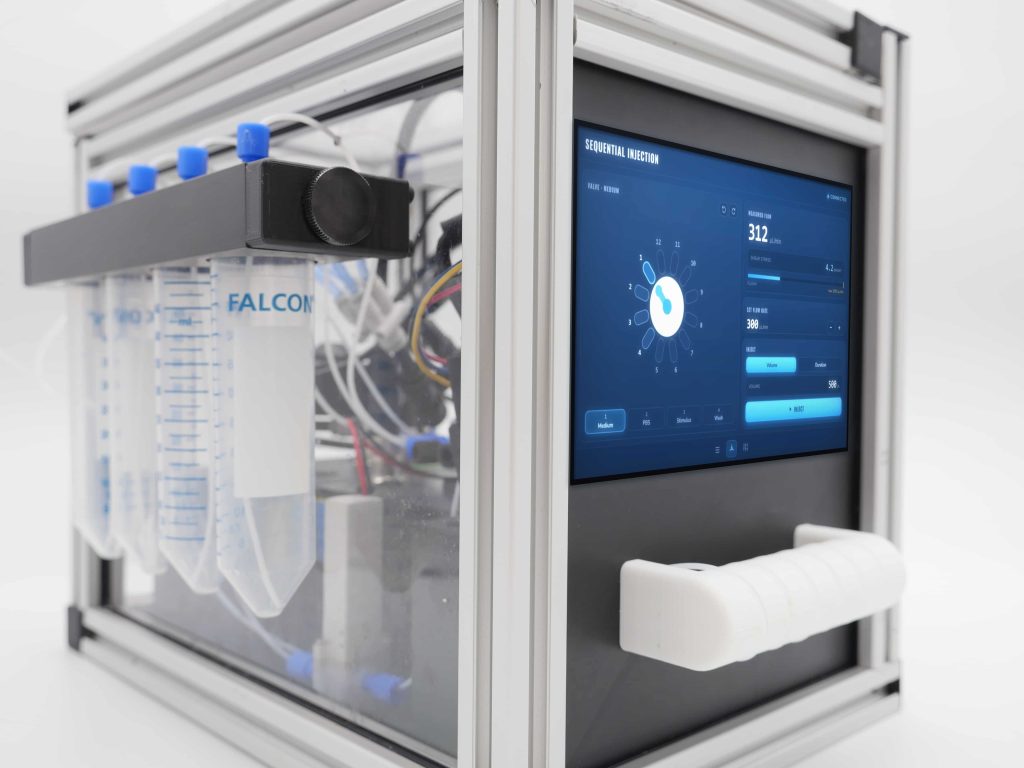
Cyclic FISH Platform
Every round of your codebook, none by hand.34 solutions and more, no reload mid-run.
One stored sequence, triggered with your imaging.
A rinse between solutions keeps each bit clean.
Any flow cell or chamber, your own chemistry.
A multiplexed FISH run becomes one loaded sequence: 34 solutions and more, delivered in the order you set, each at a controlled flow rate and for a volume you choose, with the microscope triggered at every imaging step.
Features & Benefits
Automating the rounds of a multiplexed FISH run
A multiplexed FISH experiment is the same protocol run again and again. Readout probes in, incubate, stringency wash, imaging buffer, image, then strip the signal and start the next bit of the codebook. Ten to twenty solution steps, fourteen to forty times over, and every one of them has to land on the same field of view as the last. By that point the biology is settled: the panel, the codebook, the number of bits. What decides whether the run finishes is the liquid handling underneath it. The routes open to you differ in how well they hold that up over days.
Manual pipetting. Where most runs start, and still the honest baseline. Every solution change puts a hand on the sample under the objective, so the flow cell can shift, the recorded field positions drift, and one bubble across the chamber can end the experiment. A fifty-step protocol spread over a weekend also means being there for it, including the 3 a.m. wash nobody wants to be awake for. Signal intensity varies with how each step was pipetted, and that is the part that hurts, because decoding a codebook depends on cycles being comparable.
A syringe pump with a rotary valve. The usual first build, and it does automate the sequence. Its ceiling is volume. A syringe carries a fixed amount. A multi-round run gets through litres of wash and imaging buffer. So someone comes back to refill it, in the middle of the run the automation was meant to cover. Each refill stops the flow and opens a way in for air. One bubble across the section can end an experiment that has already taken two days. At the low rates a section tolerates, the plunger advances in discrete steps. The seal and the tubing take up the first part of that movement. The flow then arrives in steps, and later than the setting suggests. Reagent left in the barrel at the end of a step is volume you do not recover, which stings most with a readout mix.
A peristaltic pump with a rotary valve. It answers the volume problem: it draws from a bottle for as long as the run lasts. And it brings its own. Rollers squeeze the tubing to move liquid, so the flow reaches the section as a train of pulses. The shear rises and falls with every roller that passes. Over forty rounds, that is forty opportunities to lift a section off its coverslip, and during an acquisition a pulse shifts the liquid in the field. The tubing is also a consumable under mechanical fatigue. Compressed thousands of times across a multi-day run, it drifts. The rate on day three sits off the one you calibrated on day one. Early and late rounds of a codebook then stop being comparable. In both builds, the positions on the rotary valve cap how many solutions the run can hold. Sequencing the pump, the valve and the microscope together also becomes a script you write and maintain yourself.
An integrated platform. Solutions are held on the platform and moved by air pressure, so nothing mechanical touches the liquid and no volume waits in a barrel. Thirty-four solutions and more sit ready, so the count grows with your codebook. The platform holds the flow rate you set, clears air out of the line, rinses between two solutions, and stops the flow for acquisition. Cycle one and cycle forty then arrive the same way. Your flow cell, your probes and your microscope stay yours.
Deliver every solution your codebook needs.
The round count is the hard constraint on this protocol, and it comes from the biology. A fourteen-bit barcode scheme needs fourteen readout hybridizations, HCR-based schemes have run to forty cycles, and each round needs its own probe mix on top of the buffers around it. The platform carries 34 solutions and more, so a sequence steps through the whole set before anyone opens the setup. A longer codebook is a matter of configuration, and we size it with you. Load the readout mixes and the buffers once, program the order, and the whole codebook is on the platform.
Hold the same exposure from the first cycle to the last.
Decoding a barcode depends on cycles being comparable, so what reaches the sample in cycle one should reach it the same way in cycle forty. That is a flow-rate question. You set the flow rate, and the platform holds it there, checking what actually flows and correcting itself as the run proceeds. The delivery stays the same from cycle one to cycle forty, so an incubation begins when you say it begins and a stringency wash arrives at the strength you set. Steady, pulseless delivery also keeps the wall shear stress on a tissue section low and predictable, which counts when that section has to come through forty rounds still attached to its coverslip.
Rule out cross-contamination between readouts.
A readout probe still sitting in the line when the next one arrives shows up as signal in the wrong bit. That is cross-contamination, and afterwards there is no way to separate it from biology. The platform rinses the line to your sample between two solutions of interest, so every probe mix travels a clean line on its way in. You decide where a rinse belongs: between each readout hybridization, or only at the steps your chemistry cares about. It runs as a programmed step like any other.
Load an expensive probe mix in a small volume.
On the platform, the reservoir’s volume has no bearing on the injection. A 2 mL tube of readout mix injects at the same flow rate as a litre of wash buffer, and swapping one for the other changes nothing in the settings. The two ends of this protocol sit far apart: probe mixes are the expensive reagent and belong in small aliquots close to the sample, while stringency and imaging buffers go through in volume across a multi-day run. Both run on the same platform, on the reservoirs you choose. You set the flow rate for a step, then choose what ends it: the volume you want injected, or how long the injection lasts. A readout step ended by volume stops once that volume has passed, so an expensive mix is spent on the sample and nowhere else.
Start a run without a laptop at the microscope.
A front-panel touchscreen sets the flow rates and builds the sequence, so a run starts with no computer to connect first. In a dark imaging room, where a bright screen is unwelcome next to a sensitive detector, that is worth something. Build the sequence once, store it on the platform, and recall it for the next sample, or load a pre-defined one. The order, the volumes and the incubation times then repeat exactly, whoever starts the run.
Protect the sample, and the next one.
A section can represent weeks of work, and sometimes clinical material that cannot be replaced, so committing it to a run of several days means trusting the fluid path. The platform makes that check itself. Every run opens with an initialization step it performs on its own, at every use. Nothing for you to launch, nothing to inspect. The setup is verified before anything reaches your sample. Air is the other thing that ends a run of this length. The platform removes bubbles from the line on its own. A bubble that forms overnight is dealt with when it forms. The run then primes the lines. The first solution reaches your sample through a filled path, on the same terms as every solution after it. From there the sequence you built or loaded proceeds on its own. It closes with a cleaning step that clears the reagents out, so the next experiment starts on a clean platform. Everything the run did comes out as data you can export.
Keep imaging and solution changes on one clock.
A cycle only works if the two halves agree on the timing: the image is taken once the imaging buffer is in and the flow has stopped, and the next solution starts moving once the acquisition is finished. A trigger line carries that. The platform signals the microscope to acquire at the imaging step, and holds the sequence while the acquisition runs, so a fourteen-cycle experiment proceeds as one sequence, with no one timing each step by hand. Where a protocol needs the liquid completely still for acquisition, the platform can close the line at the imaging step, so nothing drifts in the field while the camera integrates.
Reproducible multiplexed imaging.
Most spatial experiments fail not only on the biology, also on the setup: a wash that ran short, a probe mix that reached the sample at a different rate, a cycle someone did at the end of a long day. A stored sequence and a held flow rate take that variable out. The protocol expertise stays yours; what changes is that the same protocol delivers the same exposure on Tuesday and on Saturday, so a reviewer’s question about reproducibility has an answer in the run record.
A traceable record for regulated work.
As a sequence proceeds, the platform logs its full history, every step it ran and every value it held, with a timestamp. That log is a 21 CFR Part 11-compliant record, meeting the FDA rule for electronic records and audit trails, so what reached your sample is captured and holds up to review. For a pharmaceutical lab or a facility running work for others, the reagent exposure becomes documented, auditable data, ready for a validation file.
Application
Barcoded seqFISH and MERFISH readout cycles
A codebook of N bits becomes N repetitions of one chain of steps: readout probes in, incubate, stringency wash, imaging buffer, image, remove the fluorophore, next bit. The platform holds the readout mixes and the buffers, steps through them in the order you programmed, and triggers the acquisition at the imaging step. It controls the delivery and the timing; the panel, the codebook and the imaging stay yours.
cycleHCR and other HCR-based multiplexing
HCR-based schemes add an amplification step and tend to run more cycles, up to forty in published protocols. Reagent economy and cycle-to-cycle consistency dominate at that length. Amplifier and readout solutions have to arrive the same way every round, and the sequence has to proceed for two or three days without someone timing each step by hand.
Iterative immunolabeling and cyclic immunofluorescence
Antibody in, image, bleach or strip, next antibody, and a protein panel builds up on one section. The structure matches a FISH codebook with different chemistry, and it makes the same demand on the fluid path: a clean switch between antibodies, and a sample that stays exactly where it was. Protein and RNA rounds can run on the same platform and the same flow cell.
DNA-PAINT and single-molecule localisation multiplexing
Multiplexing here is imager-strand exchange: one imager sequence in, acquire, exchange, next target. The acquisition is long and the localisation precision depends on nothing moving, so what the method asks of its fluid path is a solution change that leaves the sample untouched and a line that starts clean for the next imager.
Sequential smFISH without barcoding
One or a few genes per round, a handful of rounds, no barcode to decode: the entry protocol for a lab adding multiplexing to a microscope it already owns. The same sequence structure applies with fewer solutions to load, which makes it a straightforward first run on the platform.
| Elvebio Cyclic FISH Platform | |||||
|---|---|---|---|---|---|
| Solutions and sequences | |||||
| 34 different solutions and more in one sequence, each delivered as many times as the sequence needs. | |||||
| Each step runs at a set flow rate, ended by an injected volume or by an injection time. | |||||
| Line rinse between two solutions, placed wherever the protocol needs it. | |||||
| Flow held still for acquisition where a protocol needs it. | |||||
| Input profiles | static hold, ramp, sine, triangle, square, and custom. | ||||
| Build, store and recall sequences on the front-panel touchscreen, or load pre-defined ones, with no computer required. | |||||
| Flow control | |||||
| Flow rate held to your setpoint for the length of a run. | |||||
| Precision | down to 5% (m.v) for aqueous solutions. | ||||
| Response time | down to 40 ms. | ||||
| Flow rate ranges available from 7 nL/min to 40 mL/min, matched to your protocol. | |||||
| Automatic checks | |||||
| Initialization check at every use, before anything reaches the sample. | |||||
| Priming of the lines before a sequence starts. | |||||
| Air bubbles removed from the line while a sequence proceeds. | |||||
| Cleaning step at the end of a run. | |||||
| Fluids | |||||
| Aqueous and biological reagents | readout and encoding probe mixes, hybridization and stringency buffers, cleavage or displacement buffers, imaging buffer. | ||||
| Reservoirs from about 1 mL to several litres, and larger with adapted reservoirs. | |||||
| Records and synchronisation | |||||
| Trigger line for synchronising the sequence with a microscope. | |||||
| Full timestamped history log to a 21 CFR Part 11-compliant record. | |||||
| Run data exportable. | |||||
Frequently Asked Questions
The Elvebio Cyclic FISH Platform is an automated fluidics system for multiplexed imaging. It holds your solutions, delivers them to your flow cell in the order you programmed, at a controlled flow rate and for a volume or a time you set, and triggers your microscope at each imaging step. For a seqFISH or MERFISH run, that means the whole codebook proceeds as one loaded sequence, readout mixes, stringency washes, imaging buffer and stripping solution, cycle after cycle, with the pipetting done once when you load it.
Thirty-four different solutions as standard, and more where a codebook calls for it. What counts is the number of distinct solutions loaded on the Elvebio Cyclic FISH Platform, since each one can be delivered as many times as the sequence needs. A stringency buffer used in every round occupies one position, whether the run has fourteen rounds or forty. A fourteen-bit or sixteen-bit scheme therefore fits with its readout mixes and all of its buffers, and the sequence itself can run to hundreds of steps. Reservoir size is your choice as well: a small aliquot of readout mix and a litre of wash buffer run on the same platform, with no fixed barrel volume to work around. For a longer scheme, tell us your round count and the buffers you reuse, and we will look at the configuration with you.
Yes. The Elvebio Cyclic FISH Platform delivers liquid through tubing to whatever sits at the end of it, so it drives a commercial flow cell, an imaging chamber, a microfluidic chip, or a device you build yourself, on the microscope you already own. Nothing in the platform assumes a particular sample holder or a particular set of optics. Send us your flow cell’s connections and internal volume, the volume between the last valve and your sample, and the way your microscope handles triggering, and we will confirm the configuration and accessories you need.
With a rinse between them. The Elvebio Cyclic FISH Platform rinses the line that runs to your sample, so a rinse solution clears it between two solutions of interest. You place the rinse where your chemistry needs it, between every readout hybridization or only at the steps that matter, and it runs as a programmed step like any other. Each probe mix then travels a clean line to the sample, which rules out cross-contamination as an explanation for a bit’s signal.
No. The Elvebio Cyclic FISH Platform is configured for the device you image in, so the pressure it can apply stays inside what that device tolerates. It also works from the flow rate down: you ask for a flow rate, and the platform applies only what that flow rate needs on your device, which for a flow cell or a bonded coverslip is low. Send us the device and the pressure it is rated for, and we will confirm the configuration before you order.
Yes, through a trigger line. The Elvebio Cyclic FISH Platform signals the microscope to acquire at the imaging step of each cycle, once the imaging buffer is in place and the flow has stopped, and it holds the sequence while the acquisition runs. Where your acquisition needs the liquid completely still, the platform can close the line for the duration of the imaging step. Imaging and liquid handling then keep the same order across fourteen or forty cycles with nobody arbitrating between them, and every image ties back to a known step in the sequence and a recorded flow rate.
Yes, and that is what loading the whole sequence at once is for. You build the sequence on the front-panel touchscreen, store it, load your solutions, and start it. The Elvebio Cyclic FISH Platform then steps through the solutions, the incubations and the rinses on its own, triggering the microscope at each imaging step, so a run of several days proceeds overnight and across a weekend. Sized reservoirs mean a long sequence runs on the volumes you loaded.
Both are steps the platform runs. The Elvebio Cyclic FISH Platform checks itself at the start of every run, on its own, with nothing for you to launch or inspect, so a section goes onto a multi-day sequence with the fluid path already verified. The sequence then primes the lines and proceeds at the flow rate you set. Air is handled the same way: bubbles are removed from the line automatically while the sequence proceeds, so the most common cause of a lost run is taken care of without you. It ends with a cleaning step that clears the probe mixes and buffers out, so the next experiment starts on a clean platform. The run data can be exported afterwards for your own records.
By never touching the sample. Every solution change on the Elvebio Cyclic FISH Platform happens inside the fluid path, with nothing opened or moved on the stage, so the flow cell stays clamped where you left it and the field positions you recorded stay valid from the first cycle to the last. Registration between cycles then stays a software step, done on images that already overlap. Steady, pulseless delivery also keeps a tissue section from lifting or shifting during a wash.
Yes. Any protocol built on repeated solution changes under a microscope fits the same sequence structure, and the Elvebio Cyclic FISH Platform is indifferent to the chemistry it delivers. Iterative immunolabeling, cycleHCR and other HCR-based schemes, DNA-PAINT imager exchange, sequential smFISH without barcoding, and protein and RNA rounds on the same section all run as programmed sequences of solutions, incubations, rinses and triggers. What changes between them is the number of solutions to load and where the rinses go.
Yes. The Elvebio Cyclic FISH Platform logs the full history of a run, every step it ran and every value it held, with timestamps, to a record that meets 21 CFR Part 11, the FDA rule for electronic records and audit trails. For a pharmaceutical lab, or a facility running samples for other groups, what reached the sample and when becomes traceable and audit-ready, which weighs in a validation file as much as the image data. You extract the run data yourself, and how you store and back it up fits into your own data-integrity workflow.
Contact us through the form and tell us about your protocol: the number of cycles, the solutions you need to load, the flow cell or chamber you image in, and how your microscope handles triggers. We will match an Elvebio Cyclic FISH Platform configuration and its accessories to your run, and answer setup questions before you buy.

 Job
Job Collaborations
 Customer
 Other
Other