Flow Control for Drug Development
Steady, repeatable flow for controlled drug exposure, from the binding assay to the delivery device.Pulseless flow, about 10 ms to its setpoint.
A flow rate held by feedback, run to run.
Push to release the dose, pull to retract and repeat.
Up to four parallel lines, and more in sequence.
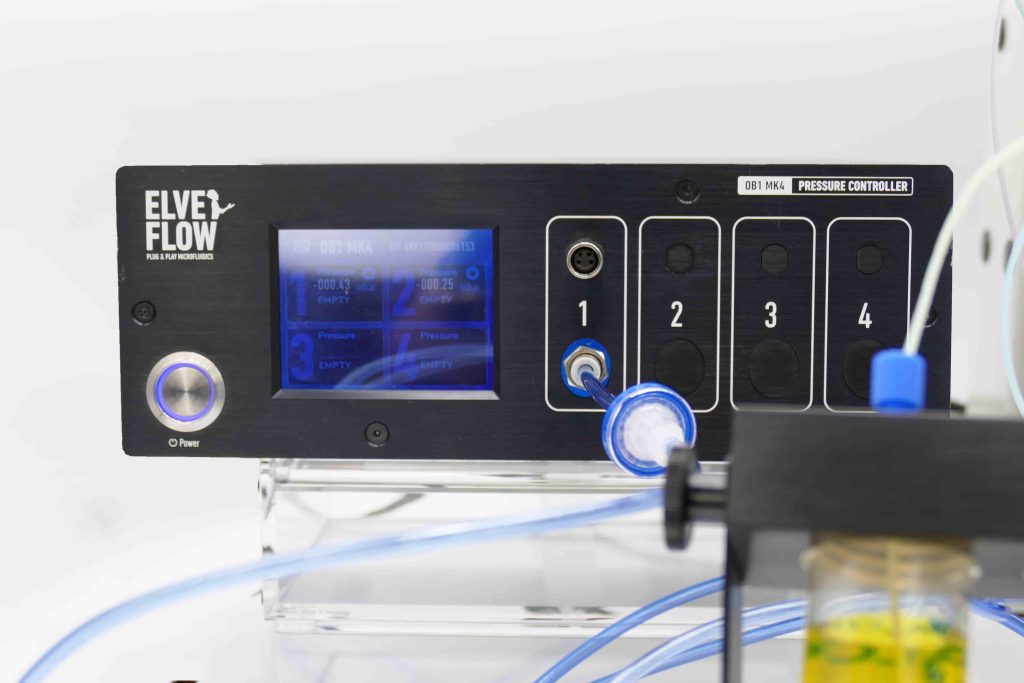
Pressure-driven flow control presents drug solutions at a steady, repeatable flow rate, steps through them on a timed sequence across up to four parallel conditions, and applies pressure and vacuum to actuate a delivery device or drive an injection.

-

Seongjin Park, Senior Engineer
Department of Physics, Syracuse University
We use Elveflow instrument in several projects and they are great to work with. The LabVIEW implementation was also very successful. I hope more people can get to know the OB1 system -

Dr. Pushparani Micheal Raj
Max Planck Institute of Quantum Optics, MAX IV Laboratory
I have extensively used Elveflow systems in the world's most brilliant X-ray source. Elveflow systems are precise, controlled and adaptive to many samples under adverse conditions. -

Dr. Hayden Taylor
University of California, Berkeley, United States
We are using the device extensively at the moment and I have been quite impressed by its capabilities -

Dr. Arne Lüken
Chemical Process Engineering at RWTH Aachen
The Elveflow OB1 enables us precise pressure and flow control and measurement in various microfluidic and lab scale projects from tissue engineering to membrane filtration analysis. -

Dr. Nelson BC Serre & Dr. Matyáš Fendrych
Cell Growth Lab, Department of Experimental Plant Biology, Charles University, Czech Republic
After an easy installation, we are now using the OB1 and flow sensors routinely and are very satisfied by both the flow stability and the software user-friendly interface.
Features & Benefits
Pressure-driven flow control across the drug pipeline
Whether you work in discovery, screening or delivery, one requirement holds at the bench: getting your drug solutions to a biological system at a steady, repeatable flow, and switching them on the time course you need. Beyond that, the needs differ: clean solution changes for a binding assay, a dose-response across many conditions for a screen, and driving an injection or actuating a release device for a delivery study. The flow control underneath decides how well each of these works. Syringe and peristaltic pumps are the usual starting point, and each has a weak point here.
Syringe pump. A motor advances a plunger at a set speed, so you dial in a flow rate directly, which is why it is the usual first pump. Two limits show up in drug work. At a low flow rate the delivery turns pulsatile, moving in small steps that shear-sensitive cells feel. And the syringe holds a fixed volume, so it stops to refill partway through a run: a wash-in/wash-out or a timed concentration step breaks at that moment, and reopening the line to reload risks a bubble or contamination.
Peristaltic pump. For a long exposure it earns its place because it recirculates, returning a costly solution to its reservoir for reuse. The cost is pulsation: the rollers squeeze the tubing in turn, so the flow pulses with each one, and the pulsation grows with the flow rate. A clean dose-response reads that pulsation as noise. Over a long run the repeated squeezing also wears the tubing, so the volume moved per turn changes and the flow rate drifts, and with it the exposure you meant to hold.
Pressure controller. A pressure controller acts on the solution from the gas side, with no moving part in the liquid, so the flow is continuous from the first second and reaches its setpoint in about ten milliseconds. It never touches your drug or your medium, so it adds no contamination of its own. That stability and speed hold at every scale, from a single binding chamber to a multi-condition screen.
A clean dose-response, and clean solution changes
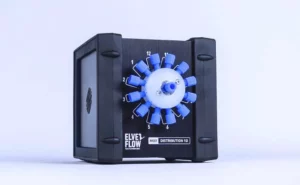
Dose-response and binding work depend on the concentration presented and how cleanly you change it. The concentration itself comes from the solutions you prepare, and for a range, from a concentration-gradient chip; the OB1 controls the inlet flow rates that shape the gradient. To step through solutions in time, a drug, a wash, then the next drug, an Elveflow MUX distribution valve sends each through the same line in turn, so a full sequence runs without rebuilding the setup. Because the flow reaches its setpoint fast, each change lands as a clean step, and the exposure stays steady between changes.
One system for perfusion and actuation
A delivery study often needs more than steady flow. Because our pressure controller can deliver both pressure and vacuum on programmable waveforms, one unit can perfuse a model and drive a pneumatic actuation. For instance, it can compress a soft delivery device to release its contents on demand, or drive an injection through a microneedle at a controlled flow rate. You program the profile and the fast response reproduces it.
Reproducible exposure, run to run
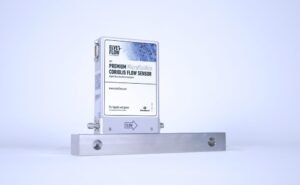
Most experiments that fail in drug work do not fail only on the biology. They fail on the setup: a flow that was not quite steady, a solution change that lagged, an exposure that shifted between one replicate and the next. Add a flow sensor and the controller reads the real flow rate and trims its pressure to hold it at your setpoint, so the same flow profile repeats identically whoever launches it, and each replicate sees the same exposure. That repeatability matters more as non-animal methods gain ground, with the FDA Modernization Act and its roadmap to reduce animal testing, where a standardizable flow setup helps functional data count.
Run conditions in parallel, in sequence, or both
One to four independent lines run from a single interface, so you can run several conditions at once, each with its own solution and flow rate, and compare them in a single experiment. Matching that in parallel with syringe pumps would take one per line. A distribution valve lets a line step through a series of solutions in turn, and the two combine: several lines, each running its own sequence. A single line can also supply many identical assays in parallel for replicates.
Automate a run and sync it to imaging
You program the flow sequence and any solution changes once, and the run proceeds on its own, so a long or overnight exposure does not need someone at the bench. TTL triggers (0/5 V) start a microscope acquisition at a chosen point in the sequence, or step through a series of conditions. For custom automation the SDK covers Python, MATLAB, LabVIEW and C++, and the software logs the flow data to CSV as it runs.
Application
Ligand binding at a membrane receptor
Early drug discovery often turns on how a molecule binds its target, and on catching the fast, early binding steps that bulk measurements cannot resolve. Patel and colleagues introduced a way to observe individual ligands binding a cyclic nucleotide-gated ion channel one molecule at a time, with the channel kept in its native membrane inside cell-derived nanovesicles, an environment purified-protein assays cannot reproduce [Nature Communications, 2021, 1]. They perfused and switched nucleotide solutions across a range of concentrations over the immobilised vesicles with our pressure controller and a distribution valve, so each concentration reached the target as a clean step. Tracking binding one event at a time resolved not only the binding but a conformational change that precedes the channel’s opening, and found the binding sites to act more independently than earlier ensemble measurements implied, an approach the authors show extends to other membrane receptors.
Drug response in a tumour-on-chip
A screen predicts better when the cells meet the drug the way the body delivers it, as a pharmacokinetic exposure that rises and clears rather than a flat concentration. Petreus and colleagues built a tumour-on-chip to test how colorectal cancer spheroids respond to a drug, and to a drug combination, at exposures matching real plasma levels [Communications Biology, 2021, 2]. They reproduced each drug’s pharmacokinetic profile over the spheroids with our pressure controller and a distribution valve, stepping through the timed sequence of concentrations that mimics a mouse plasma exposure. Spheroid volume and viability, read alongside pharmacodynamic markers, tracked the response, and the chip predicted the in vivo efficacy of both irinotecan and its combination with an ATM inhibitor, pointing to the right regimen while reducing the need for animal studies.
Controlled release from an implantable device
A delivery device is only useful if it releases its contents when and where you want. Wallace and colleagues developed a soft-robotic drug-delivery device holding a mechanoresponsive hydrogel, to release a therapeutic protein on demand [Advanced Science, 2025, 3]. They drove its pneumatic actuation, pressure and vacuum on a programmed waveform, with our pressure controller, compressing the hydrogel to push out its payload. This released a therapeutic protein (VEGF) in a spatiotemporal pattern, and in a diabetic rodent model the actuated device improved the delivery outcome over a passive one.
Transdermal injection through microneedles
Getting a drug into the skin reliably means understanding how the tissue takes up the fluid. Shrestha and colleagues asked how skin absorbs an intradermal injection delivered through hollow microneedles [Scientific Reports, 2018, 4]. They drove the injection, and measured its flow rate and pressure, with our pressure controller and a flow sensor, while optical coherence tomography imaged the tissue live. The skin absorbed the fluid by expanding locally rather than tearing, and the volume of tissue expansion matched the volume injected, the first real-time microscale view of an intradermal injection.
| OB1 MK4 | |||||
|---|---|---|---|---|---|
| PNEUMATIC SPECIFICATION | |||||
| Channel pressure range | 0 to 200 mbar(1) (0 to 2.9 psi) |
0 to 2,000 mbar(1) (0 to 29 psi) |
0 to 8,000 mbar(1) (0 to 116 psi) |
-900 to 1,000 mbar(1) (-13 to 14.5 psi) |
-900 to 6,000 mbar(1) (-13 to 87 psi) |
| Pressure stability(2) | 0.015 % FS(1) 0 µbar (0.0004 psi) |
0.005 % FS(1) 100 µbar (0.0014 psi) |
0.006 % FS(1) 500 µbar (0.007 psi) |
-900 to 500 mbar | -900 to 2,000 mbar |
| 0.005 % FS(1) 100 µbar (0.0014 psi) |
0.005 % FS(1) 350 µbar (0.005 psi) |
||||
| 500 to 1,000 mbar | 2,000 to 6,000 mbar | ||||
| 0.007 % FS(1) 150 µbar (0.0021 psi) |
0.007 % FS(1) 525 µbar (0.0076 psi) |
||||
| Response time(3) | Down to 10 ms | ||||
| Setting time(4) | Down to 50 ms | ||||
| Minimum pressure increment | 0.006 % FS(1) 12 µbar (0.00017psi) |
0.006 % FS(1) 120 µbar (0.0017 psi) |
0.006 % FS(1) 480 µbar (0.007 psi) |
0.0064 % FS(1) 120 µbar (0.0017 psi) |
0.0064 % FS(1) 420 µbar (0.006 psi) |
| Pressure supply | 1.5 bar (or Max pressure + 0.5 bar) to 10 bar Non corrosive, non explosive, dry and oil-free gases, e.g. air, argon, N2, CO2, … |
||||
| Input vacuum(5) | / / |
Any value from -0.7 to -1 bar Compatible with vacuum pump or vacuum line |
|||
| Input pneumatic connector | 6 mm push-in | ||||
| Output pneumatic connector | 4 mm push-in | ||||
| Liquid compatibility | Non contact pump Any aqueous, oil, or biological sample solution. |
||||
| FLOW CONTROL | |||||
| Flow sensor compatibility | Compatible with the whole MFS and BFS range Monitoring and feedback loop flow control available | ||||
| Flow sensor compatibility | From 0,1 µL/min to 500 mL/min (indicative, please refer to the MFS and BFS series) | ||||
| Flow sensor compatibility | Non-contact pump Any aqueous, oil, or biological sample solution. | ||||
| CONTROL & MONITORING | |||||
| Software control | Elveflow Smart Interface – Windows 10, 11, both 32 and 64 bit versions supported | ||||
| Software Development Kit | Libraries available: Matlab, Python, LabView, C++ | ||||
| Flow sensor compatibility | Non-contact pump Any aqueous, oil, or biological sample solution. – Windows 10, 11, both 32 & 64 bit versions supported Serial/UART communication protocol on request | ||||
| Data management | Possibility to log and extract data (CSV), channel and sensor detailed information using ESI | ||||
| Input profiles | Possibility to load profiles: ramp, sine, triangle, square, or custom | ||||
| Automation | Generate step-by-step sequences using the ESI built-in sequence management Log and export custom configurations (CSV) | ||||
| Screen | LCD screen showing pressure and sensor flow rate in real time | ||||
| ELECTRICAL SPECIFICATIONS | |||||
| Voltage | 24V | ||||
| Typical power | 12W | ||||
| Power connection | DC power connector, Plug, 3A, 2.1mm, 12mm | ||||
| Interface | USB Type B | ||||
| Communication type | Serial | ||||
| Sensor connection | M8 4-pins, one connector per channel | ||||
| Compatibilit | Elveflow sensors: MFS, BFS, MPS, MFP, MBD Custom sensors: 5 to 24V supply voltage, 0 to 10V readout voltage | ||||
| Triggers | Input and Output TTL signal 0V or 5V | ||||
| Supply Voltage Range (V) | 100 to 240 VAC | ||||
| Supply AC Frequency (Hz) | 50 to 60 Hz | ||||
| Maximum Output Current (A) | 1.67 A | ||||
| Maximum Output Power (W) | 40 W | ||||
| MECHANICAL SPECIFICATIONS | |||||
| Dimensions (length x width x height) | 240 x 223 x 83 mm | ||||
| Weight | 1.4 kg to 2.9 kg | ||||
(1) Max pressure value might vary by +/- 2.5% (2) Pressure stability (standard deviation) measured over the full pressure range with an external high accuracy pressure sensor (Druck DPI150) (3) Time required to reach 5% of the setting point. Depending on your computer’s operating system (4) Time required to reach 95% of the set point. Volume dependent – Measurement was done on 12 mL reservoir for a set point from 0 to 200 mbar (5) A vacuum source is mandatory for calibration and use of dual channels even if the channels are to be used in pressure only.
Frequently Asked Questions
Throughout the drug pipeline, the Elveflow OB1 controls how a compound reaches your cells or your device. It perfuses cells, a chip, or a 3D model from a sealed reservoir at a flow rate you set, pulseless and responding in about ten milliseconds, and an Elveflow flow sensor holds that flow rate through the run. With an Elveflow MUX distribution valve it switches between solutions in sequence, so a binding assay or a screen can step through drugs, washes and concentrations. Because it also delivers pressure and vacuum, it can actuate a delivery device or drive an injection. So it presents compounds under controlled, repeatable flow for discovery and screening, and drives the device or route for delivery.
The concentration comes from the solutions you prepare, and for a range of concentrations, from a concentration-gradient chip. What the Elveflow OB1 controls is the flow that delivers them. Enter a target flow rate, an Elveflow MFS or BFS sensor reads the real flow, and the OB1 trims its pressure until the two match, so the flow stays steady and the exposure is repeatable. To change solutions in time, a drug, a wash, then the next drug, an Elveflow MUX distribution valve routes each one through the same line in turn, up to twelve solutions, and combining several distribution valves extends this beyond twelve. So you control the concentration through your solutions and the chip, and the steadiness and timing of the exposure through the OB1.
Combine the OB1 with a concentration-gradient chip. The OB1 drives the inlet flows, and the chip turns one stock into a range of concentrations across its chambers, so a single run exposes cells to a spread of concentrations at once. Because the flow is steady and reaches its setpoint fast, the gradient holds across the chip, which is what makes the dose-response comparable from one chamber to the next.
Yes, and the two are worth separating. In parallel, one OB1 drives up to four independent lines from a single interface, each with its own solution and flow rate, so you run and compare several conditions at once; matching that with syringe pumps would take one per line, and a single line can also supply many identical assays for replicates. In sequence, an Elveflow MUX distribution valve steps one line through a drug, a wash, then the next drug. The OB1’s edge here is the parallel independent lines, and the two combine when a screen needs both.
For steady, reproducible flow, pressure-driven control fits drug work best. A syringe pump pulses at low flow and stops to refill, so a wash-in/wash-out breaks when it reloads and shear-sensitive cells feel the pulses. A peristaltic pump recirculates but its rollers pulse, and the pulsation is tied to the flow rate. The Elveflow OB1 delivers a continuous flow from a non-contact pump, reaches its setpoint in about ten milliseconds, drives up to four lines, and never touches your drug. Those independent lines let you run several conditions in parallel and compare them in a single experiment.
Yes. Because the OB1 delivers pressure and vacuum on programmable profiles, it can actuate a delivery device or drive an injection. In one study it actuated a soft-robotic device, compressing a hydrogel to release a therapeutic protein on demand. In another it drove intradermal injection through hollow microneedles while the flow rate and pressure were measured with Elveflow sensors. You program the waveform and the fast response reproduces it, whether that is a slow rise or a series of pulses.
Yes. A programmed, sensor-held flow rate takes the pump out as a source of run-to-run variation, since the same flow profile repeats identically each time and the same solution changes land at the same points whoever launched the run, so each replicate sees the same exposure. That reproducibility matters more as non-animal methods gain ground, with the FDA Modernization Act and its roadmap to reduce animal testing, where a standardizable flow setup helps functional drug data count.
Yes. The OB1 is chip-agnostic. It pushes medium into any reservoir and through standard tubing, so it drives a commercial assay chip or your own device the same way, with any aqueous or biological solution. If your setup is unusual, tell us the vessel and your target flow rate and we will confirm the configuration.
The OB1 is a non-contact pump, so the instrument never touches your drug or your medium. The fluid path is only the reservoir, tubing and vessel, which means fewer parts to prepare and one less route for contamination. The reservoirs, caps and tubing Elveflow supplies are autoclavable, so you sterilize them before each run and prepare the wetted path as you would for any sterile assay. No sterility certification is claimed for the instrument itself, since it stays outside the fluid path.
Yes. You program the flow sequence and any solution changes once, and the run proceeds on its own, so a long or overnight exposure runs without someone at the bench. TTL triggers (0/5 V) let the OB1 start a microscope acquisition at a chosen point in the run, or step through a series of conditions. For custom automation the SDK covers Python, MATLAB, LabVIEW and C++, and the software logs the flow data to CSV as it runs.
Contact us through the form and tell us your assay, the chip or device you use, and the flow or delivery profile you need. We will help you match the OB1 configuration, sensors and accessories to your drug-development workflow, and answer setup questions before you buy.


 Job
Job Collaborations
 Customer
 Other
Other