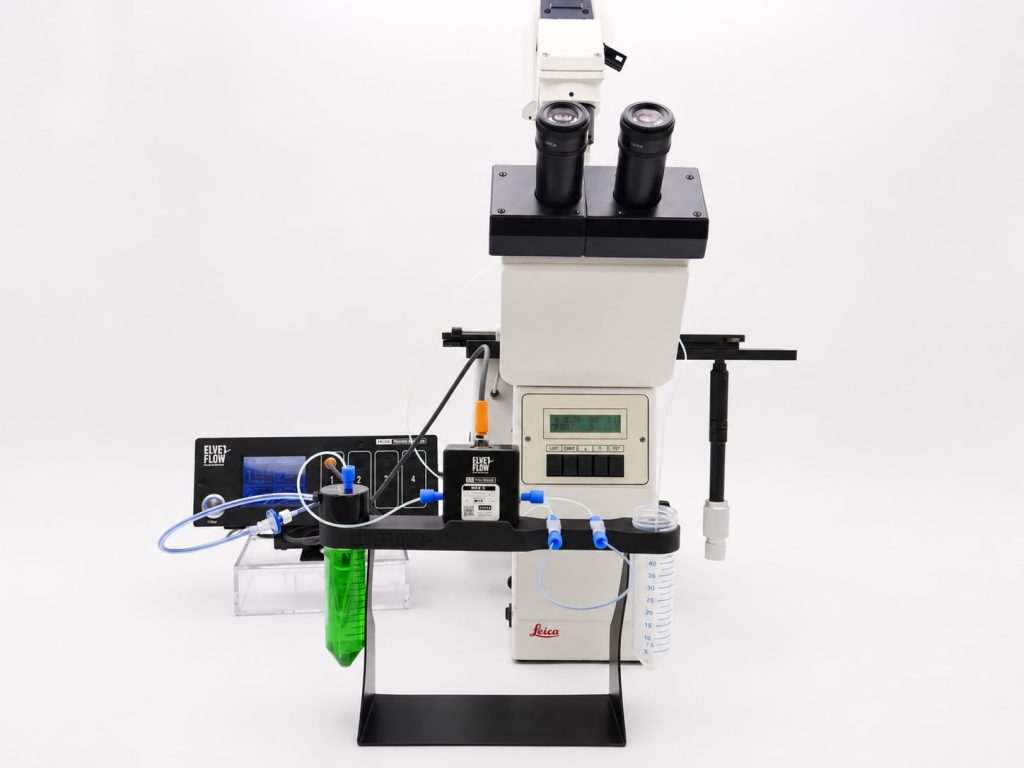
Perfusion System for Cell Culture and Analysis
Pulseless, stable flow for sustained cell viability and live-cell imaging.Up to 20× steadier than syringe or peristaltic pumps.
Continuous medium renewal, no manual changes.
Same flow rate and shear, run to run.
Sterility stays simple; only tubing and vessels to clean.
Pressure-driven flow control keeps cultured cells viable under continuous medium renewal, at a set flow rate from 0.1 µL/min to 500 mL/min, while you image them live or measure what they consume and secrete.

-

Seongjin Park, Senior Engineer
Department of Physics, Syracuse University
We use Elveflow instrument in several projects and they are great to work with. The LabVIEW implementation was also very successful. I hope more people can get to know the OB1 system -

Dr. Pushparani Micheal Raj
Max Planck Institute of Quantum Optics, MAX IV Laboratory
I have extensively used Elveflow systems in the world's most brilliant X-ray source. Elveflow systems are precise, controlled and adaptive to many samples under adverse conditions. -

Dr. Hayden Taylor
University of California, Berkeley, United States
We are using the device extensively at the moment and I have been quite impressed by its capabilities -

Dr. Arne Lüken
Chemical Process Engineering at RWTH Aachen
The Elveflow OB1 enables us precise pressure and flow control and measurement in various microfluidic and lab scale projects from tissue engineering to membrane filtration analysis. -

Dr. Nelson BC Serre & Dr. Matyáš Fendrych
Cell Growth Lab, Department of Experimental Plant Biology, Charles University, Czech Republic
After an easy installation, we are now using the OB1 and flow sensors routinely and are very satisfied by both the flow stability and the software user-friendly interface.
Features & Benefits
Pressure-driven flow control vs syringe and peristaltic pumps
Most cell culture is static: cells grow in a well or dish, and you exchange the medium by hand. Under perfusion you renew the medium continuously, clear metabolic waste, and hold the microenvironment steady, which is what keeps cells viable and behaving consistently under flow. Two things then decide whether it works for culture and analysis: how stable and controlled the flow is, and how cleanly it fits live imaging and sampling. Syringe and peristaltic pumps are the usual starting point, and each has a weak point here.
Reactivity. In a soft, elastic setup at low flow rate, a syringe pump can take minutes, sometimes an hour or more, to build enough pressure to move the liquid at all. The display reads “running”, but the sample hasn’t left the tube, and researchers log data on flow that never started. A pressure controller applies pressure directly, in milliseconds, so the flow reaches steady state almost at once, without the slow build-up a syringe pump fights through in soft tubing and chambers.
Pulseless flow. Peristaltic pumps pulse on every roller; syringe pumps step. That fluctuating flow subjects cells to a variable wall shear stress, which can reduce viability, detach adherent cells, or shift their phenotype, and it appears as drift and vibration in live imaging. A pressure-driven system has no moving part in the liquid, so the flow carries no pulse, up to 20× steadier than either pump, holding cells at a steady shear and keeping images clean.
No dead volume, no contamination. The pump sits on the gas side and never touches your medium, so it adds no dead volume and introduces no contamination of its own. The only fluid in the path is your reservoir, tubing and culture vessel, so the instrument itself is never a contamination route, whatever the run length.
No volume limit. A syringe holds a fixed amount. Pressure drives medium from a reservoir of any size, a milliliter or several liters, and injects just as fast whichever you use. A larger reservoir extends how long you can run while the injection speed stays the same.
Study cells under controlled conditions
Hold a defined flow rate, and through it a defined wall shear stress, or switch the medium and add reagents at set times, then study the cellular response. Because the flow is steady and repeatable, the condition is the variable you are testing, not a source of noise. You add a flow sensor to lock the flow rate: enter a target, the sensor measures the real flow, and the pump trims its pressure until the two match, anywhere from 0.1 µL/min to 500 mL/min.
Image cells live, under continuous perfusion
Non-contact, pulseless delivery suits live-cell microscopy. The culture stays under continuous medium renewal and controlled conditions while you image, with no pump vibration in the field. The software sends a TTL trigger to start acquisition the moment the flow changes, or takes a trigger from the microscope to start an injection, so your images and your medium changes stay on one clock.
Monitor cellular activity in real time
Place an inline assay downstream of the culture and follow what the cells consume or secrete as it happens, a metabolite like glucose or a secreted factor, with no discrete sampling. A steady flow keeps that measurement quantitative and comparable across the whole run.
Automate medium changes, stimulation, and imaging
Program your medium exchanges, timed reagent additions, and imaging triggers once, and the software runs the whole protocol hands-off, so a multi-day experiment runs the same way whether or not someone is at the bench.
- Long runs, unattended: set the flow and scheduled medium exchanges over hours or days and walk away.
- Timed reagent injection: switch solutions on a schedule, including the 2 a.m. step nobody wants to be there for.
- Microscope sync: trigger image acquisition on a flow change, or start an injection on a trigger from the microscope.
- Sampling: collect fractions at set intervals for a downstream assay.
And if you’d rather build it into a bigger setup, there are SDKs for Python, MATLAB, LabVIEW and C++.
Reproducible cell-culture results
Most experiments that fail in biology don’t fail only on the biology. They fail on the setup: a flow that wasn’t quite steady, a sample that never really moved in a soft circuit, a condition that shifted between one replicate and the next. Cells feel that. A swing in pressure or shear changes how they behave. The feedback loop holds the same flow rate, and the same shear, from one run to the next: set 5 µL/min today and you get 5 µL/min next week. Once the run is scripted, the same volumes arrive at the same times whether it’s you or a colleague who launched it, so technical variability drops and the protocol survives a change of hands. That means more comparable biological replicates.
Application
Real-time analysis of a perfused culture
A perfused culture lets you measure cellular activity while the cells stay viable, and a steady flow keeps that measurement reliable. Adams and colleagues followed how liver cells consume glucose, continuously and without discrete sampling, perfusing the culture with our perfusion pump and routing its output straight into an inline enzymatic assay [Analytical Chemistry, 2019, 1]. The assay tracked glucose in real time, on a timescale of roughly a hundred seconds, and caught the rise in consumption after an insulin dose. The culture remained viable for up to ten days.
Live-cell imaging of functional responses
A pulseless, non-contact flow keeps the imaging field free of vibration, so you can watch cells respond to a change as it happens. Zamir and colleagues imaged calcium signalling in a monolayer of endothelial cells under controlled shear, driving the flow with our pressure controller and a flow sensor and recording every cell at single-cell resolution [Cell Systems, 2022, 2]. Each cell’s calcium response scaled with the shear it felt, and they tracked how those single-cell signals synchronised across the monolayer once the flow began.
Studying cell behaviour under controlled conditions
When the culture conditions are steady and repeatable, you can change one on purpose and study the cellular response. Babaliari and colleagues asked whether flow alters how neuronal cells differentiate, culturing neuroblastoma cells on laser-patterned grooves and holding a defined shear with our pressure controller, a flow sensor and a bubble trap [Micromachines, 2025, 3]. They read differentiation from confocal images of the cytoskeleton, scoring neurite outgrowth: under flow the cells stopped extending neurites, the first demonstration that shear can inhibit differentiation in this model.
Single-cell mechanical phenotyping
Precise, stable flow can also carry cells through a measurement one at a time, so you phenotype each cell instead of a bulk average. Kim and colleagues measured the viscoelastic properties of breast epithelial cells at single-cell resolution, driving each cell through a sensing channel with our pressure controller so it deformed as it passed [iScience, 2019, 4]. The readout distinguished malignant from non-malignant cells by their mechanical signature, cell by cell.
| OB1 MK4 | |||||
|---|---|---|---|---|---|
| PNEUMATIC SPECIFICATION | |||||
| Channel pressure range | 0 to 200 mbar(1) (0 to 2.9 psi) |
0 to 2,000 mbar(1) (0 to 29 psi) |
0 to 8,000 mbar(1) (0 to 116 psi) |
-900 to 1,000 mbar(1) (-13 to 14.5 psi) |
-900 to 6,000 mbar(1) (-13 to 87 psi) |
| Pressure stability(2) | 0.015 % FS(1) 0 µbar (0.0004 psi) |
0.005 % FS(1) 100 µbar (0.0014 psi) |
0.006 % FS(1) 500 µbar (0.007 psi) |
-900 to 500 mbar | -900 to 2,000 mbar |
| 0.005 % FS(1) 100 µbar (0.0014 psi) |
0.005 % FS(1) 350 µbar (0.005 psi) |
||||
| 500 to 1,000 mbar | 2,000 to 6,000 mbar | ||||
| 0.007 % FS(1) 150 µbar (0.0021 psi) |
0.007 % FS(1) 525 µbar (0.0076 psi) |
||||
| Response time(3) | Down to 10 ms | ||||
| Setting time(4) | Down to 50 ms | ||||
| Minimum pressure increment | 0.006 % FS(1) 12 µbar (0.00017psi) |
0.006 % FS(1) 120 µbar (0.0017 psi) |
0.006 % FS(1) 480 µbar (0.007 psi) |
0.0064 % FS(1) 120 µbar (0.0017 psi) |
0.0064 % FS(1) 420 µbar (0.006 psi) |
| Pressure supply | 1.5 bar (or Max pressure + 0.5 bar) to 10 bar Non corrosive, non explosive, dry and oil-free gases, e.g. air, argon, N2, CO2, … |
||||
| Input vacuum(5) | / / |
Any value from -0.7 to -1 bar Compatible with vacuum pump or vacuum line |
|||
| Input pneumatic connector | 6 mm push-in | ||||
| Output pneumatic connector | 4 mm push-in | ||||
| Liquid compatibility | Non contact pump Any aqueous, oil, or biological sample solution. |
||||
| FLOW CONTROL | |||||
| Flow sensor compatibility | Compatible with the whole MFS and BFS range Monitoring and feedback loop flow control available | ||||
| Flow sensor compatibility | From 0,1 µL/min to 500 mL/min (indicative, please refer to the MFS and BFS series) | ||||
| Flow sensor compatibility | Non-contact pump Any aqueous, oil, or biological sample solution. | ||||
| CONTROL & MONITORING | |||||
| Software control | Elveflow Smart Interface – Windows 10, 11, both 32 and 64 bit versions supported | ||||
| Software Development Kit | Libraries available: Matlab, Python, LabView, C++ | ||||
| Flow sensor compatibility | Non-contact pump Any aqueous, oil, or biological sample solution. – Windows 10, 11, both 32 & 64 bit versions supported Serial/UART communication protocol on request | ||||
| Data management | Possibility to log and extract data (CSV), channel and sensor detailed information using ESI | ||||
| Input profiles | Possibility to load profiles: ramp, sine, triangle, square, or custom | ||||
| Automation | Generate step-by-step sequences using the ESI built-in sequence management Log and export custom configurations (CSV) | ||||
| Screen | LCD screen showing pressure and sensor flow rate in real time | ||||
| ELECTRICAL SPECIFICATIONS | |||||
| Voltage | 24V | ||||
| Typical power | 12W | ||||
| Power connection | DC power connector, Plug, 3A, 2.1mm, 12mm | ||||
| Interface | USB Type B | ||||
| Communication type | Serial | ||||
| Sensor connection | M8 4-pins, one connector per channel | ||||
| Compatibilit | Elveflow sensors: MFS, BFS, MPS, MFP, MBD Custom sensors: 5 to 24V supply voltage, 0 to 10V readout voltage | ||||
| Triggers | Input and Output TTL signal 0V or 5V | ||||
| Supply Voltage Range (V) | 100 to 240 VAC | ||||
| Supply AC Frequency (Hz) | 50 to 60 Hz | ||||
| Maximum Output Current (A) | 1.67 A | ||||
| Maximum Output Power (W) | 40 W | ||||
| MECHANICAL SPECIFICATIONS | |||||
| Dimensions (length x width x height) | 240 x 223 x 83 mm | ||||
| Weight | 1.4 kg to 2.9 kg | ||||
(1) Max pressure value might vary by +/- 2.5% (2) Pressure stability (standard deviation) measured over the full pressure range with an external high accuracy pressure sensor (Druck DPI150) (3) Time required to reach 5% of the setting point. Depending on your computer’s operating system (4) Time required to reach 95% of the set point. Volume dependent – Measurement was done on 12 mL reservoir for a set point from 0 to 200 mbar (5) A vacuum source is mandatory for calibration and use of dual channels even if the channels are to be used in pressure only.
Frequently Asked Questions
A perfusion system keeps fresh medium flowing over cultured cells, so nutrient supply and waste removal continue the way they would in living tissue. In a pressure-driven setup like the Elveflow OB1, clean gas pressurizes a sealed reservoir and pushes the medium through your culture vessel. No moving part touches the liquid, so the flow is stable and pulseless from the first second. Set a pressure and medium flows; add a flow sensor and the OB1 holds an exact flow rate for you.
Three reasons a biologist notices. The flow is pulseless, up to 20× steadier than a syringe or peristaltic pump, so shear-sensitive cells stay attached and live imaging stays free of vibration. It reaches steady flow in milliseconds, where a syringe pump can take minutes in a soft setup. And it feeds from a large reservoir, so a run goes for days without a refill. The Elveflow OB1 also drives up to four lines at once and never touches the medium, which keeps sterility simple.
Yes. The Elveflow OB1 has no moving part in contact with the liquid, so it delivers a smooth, continuous flow with none of the pulsing you get from a peristaltic or syringe pump. Pulsation matters because your cells feel it. A fluctuating flow means a fluctuating wall shear stress, which can reduce viability, detach a monolayer, or shift phenotype. And in live imaging it shows up as drift and vibration. Steady flow takes that variable off the table, so what changes in your dish is the biology, not the pump.
Yes, and this is one of the OB1’s strengths for cell analysis. The pump sits off the fluid path and delivers a pulseless flow, so there is no vibration in the field and the culture stays under continuous medium renewal while you image. The Elveflow Smart Interface sends a TTL trigger to start acquisition the moment the flow changes, or takes a trigger from your microscope to start an injection, so your images and your medium changes stay on one clock.
Yes. Place an inline assay downstream of the culture and the OB1’s steady flow lets you follow what the cells consume or secrete as it happens, with no discrete sampling. In one published setup, a perfused liver-cell culture on an Elveflow OB1 was tracked for glucose consumption in near real time [Analytical Chemistry, 2019, 1]. Because the flow held steady, the glucose consumption could be quantified across the whole run.
You set it through the flow rate. Wall shear stress comes from the flow rate and your channel geometry, so you calculate the flow that gives your target shear, then hold that flow. With Elveflow’s pressure-driven control, you enter a target flow rate, an MFS or BFS sensor reads the real flow, and the OB1 trims its pressure until the two match, from 0.1 µL/min to 500 mL/min. Because the loop reacts in milliseconds and stays steady, the shear your cells see holds constant across the run, so it is the variable you test rather than a source of noise.
It can, and the limit is your reservoir, not the pump. The OB1 feeds from reservoirs holding a milliliter to several liters, so the medium lasts and the flow never breaks for a refill. A perfused liver-cell culture on an Elveflow OB1 remained viable for up to ten days in one study [Analytical Chemistry, 2019, 1], and longer runs are a matter of reservoir size and protocol. Over runs like these, automation keeps the result clean: you program the flow and any solution changes once, and the same steps land at the same times no matter who started the run.
Two safeguards cover it. You can cap the volume to inject, so the OB1 delivers a set amount and then stops, which suits a run you have budgeted to the milliliter. Or add an inline bubble detector, which senses a change in the fluid, such as air reaching the line when a reservoir empties, and has the software stop the run on that signal. Either way an overnight or multi-day experiment protects itself, so an empty reservoir ends the run cleanly instead of pushing air through your cells.
Open chambers and multiwell plates lose medium to evaporation, most of all at the edges, the well-known edge effect. As the volume falls, osmolarity and pH shift, nutrients deplete faster, and the oxygen tension changes, and any of these can reduce cell viability and skew your results. To hold the level steady, run the Elveflow OB1 in push–pull: one line pushes fresh medium in at a set flow rate while a second pulls spent medium out at the same rate. The volume in the chamber stays constant, so the culture gets continuous medium renewal while osmolarity, pH and nutrient levels hold steady.
The OB1 is a non-contact pump, so the instrument never touches your medium. The fluid path is only your reservoirs, tubing, and culture vessel, which means fewer parts to sterilize and one less route for contamination. Use autoclavable reservoir adapters and sterile tubing, and prepare the wetted parts as you would for any sterile culture. No sterility certification is claimed for the instrument itself, since it stays outside the sterile path.
Two things do most of the work. Feeding from a sealed reservoir avoids the air a syringe swap pushes in, and an inline bubble trap catches any bubble that forms before it reaches the cells. Worth designing out early: one bubble through a culture can strip a monolayer or ruin an imaging session in seconds. Elveflow’s bubble remover sits in the line for exactly this.
Yes. Run the perfusion as a recirculation loop and the medium returns to its reservoir, so you reuse costly or conditioned medium over long runs. There are a few ways to build the loop; our medium-recirculation workflow walks through the options.
The OB1 runs one to four independent channels. You can perfuse up to four different conditions at once, each with its own medium and flow rate, from a single interface, which makes it a screening tool: compare conditions side by side in one run instead of one after another. And because the flow is pressure-driven, a single channel can feed many identical cultures in parallel, so you run dozens of replicates of the same condition in one setup. Each channel is set on its own, so the conditions stay independent.
With an MFS or BFS flow sensor, the OB1 covers roughly 0.1 µL/min to 500 mL/min, feeding from about a milliliter to ten liters of medium, and more with larger reservoirs. The pump drives any aqueous or biological solution, so standard culture media, buffers, and reagents all work. Which cells you run is a question for your culture vessel and protocol, not the controller.
Almost certainly. The OB1 connects to standard tubing and fittings and drives flow into a culture chamber, a microfluidic slide, or a perfused dish. Published work with it spans liver, endothelial, and neuronal cell models, among others. If your setup is unusual, tell us the vessel and your target flow rate and we will confirm the configuration.


 Job
Job Collaborations
 Customer
 Other
Other