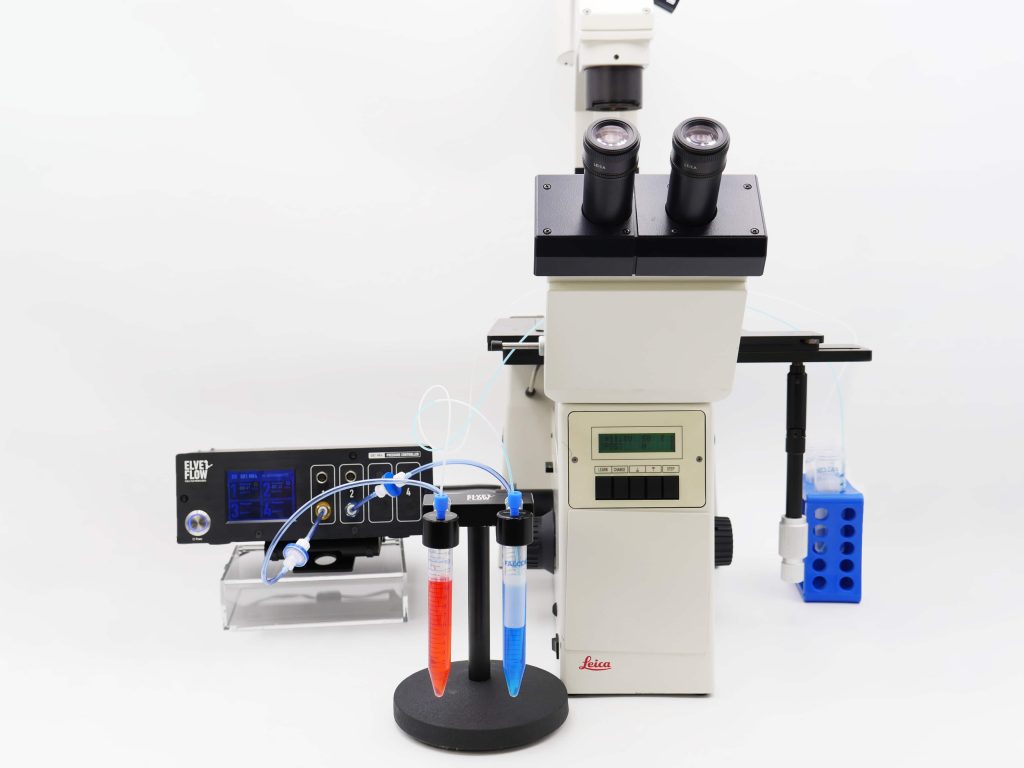
Flow Control for Organ-on-Chip
Stable, reproducible flow for dynamic tissue models.Programmed stretch or pulses, 10 ms response.
One to four flows, same or opposite directions.
Flow rate holds the shear; pressure drives the strain.
Commercial organ-on-chip or your own device.
One system drives an organ-on-chip two ways: pressure-driven flow perfuses one to four compartments at a defined shear or strain, while pressure and vacuum on programmed waveforms apply mechanical strain like a breathing motion.

-

Dr. Hayden Taylor
University of California, Berkeley, United States
We are using the device extensively at the moment and I have been quite impressed by its capabilities -

Dr. Arne Lüken
Chemical Process Engineering at RWTH Aachen
The Elveflow OB1 enables us precise pressure and flow control and measurement in various microfluidic and lab scale projects from tissue engineering to membrane filtration analysis. -

Dr. Nelson BC Serre & Dr. Matyáš Fendrych
Cell Growth Lab, Department of Experimental Plant Biology, Charles University, Czech Republic
After an easy installation, we are now using the OB1 and flow sensors routinely and are very satisfied by both the flow stability and the software user-friendly interface. -

Seongjin Park, Senior Engineer
Department of Physics, Syracuse University
We use Elveflow instrument in several projects and they are great to work with. The LabVIEW implementation was also very successful. I hope more people can get to know the OB1 system -

Dr. Pushparani Micheal Raj
Max Planck Institute of Quantum Optics, MAX IV Laboratory
I have extensively used Elveflow systems in the world's most brilliant X-ray source. Elveflow systems are precise, controlled and adaptive to many samples under adverse conditions.
Features & Benefits
Pressure-driven flow control for organ-on-chip
An organ-on-chip is more than cells under flow. The tissue is mechanically stimulated the way its organ is, it usually has more than one compartment, and a vessel or barrier inside it needs a defined shear. Whatever drives it has to do all three. A syringe pump pulses at low flow rate, so shear-sensitive cells feel every stroke, and it stops to refill, cutting the perfusion mid-run. A peristaltic pump recirculates, which suits a long culture, but its rollers pulse too, and that pulsation rises and falls with the flow rate, so smoothing it means changing the flow the cells see. A rocker keeps cells fed and is easy to set up, but it rocks medium back and forth without a flow rate you set, so the shear on the cells is left to chance. Pressure-driven flow control covers all three.
Recreate the forces a real organ feels
Real organs are always in motion. A lung stretches, a heart pulses, a gut squeezes. Steady inflow leaves that out. Because a pressure controller delivers both pressure and vacuum on programmable waveforms, it can perfuse the tissue and apply the mechanical strain it needs, both at once. Push air against a thin chip membrane and it bends; oscillate the pressure and the membrane stretches like an alveolus inflating. The same waveforms can shape a pulsatile flow, closer to a heartbeat than a steady stream. You program the profile, a slow rise, a series of pulses, a breathing rhythm, and the fast response reproduces it accurately.
Drive more than one compartment
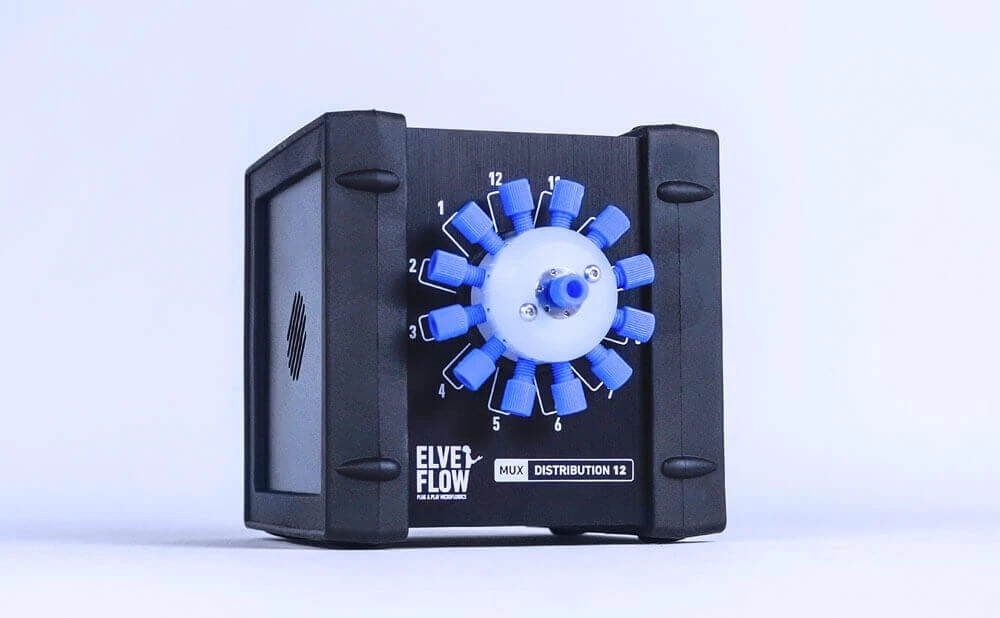
Many organ-on-chips have two sides: a blood side and a tissue side, a lumen and a basal compartment. Each side needs its own flow, sometimes running the opposite way. You can drive one to four independent lines from a single interface, so a tissue interface sees the flows it would see in the body, each set and held separately. And with a distribution valve, you can send a series of solutions through the same compartment in turn, a treatment, a wash, a stain, without rebuilding the setup. One syringe pump gives you one line.
How do you maintain a defined wall shear stress?
You set it through the flow rate, which your chip geometry turns into a wall shear stress you can calculate. Holding it is the hard part, because flow drifts as tubing warms or a reservoir empties. Add a flow sensor and the controller reads the actual flow rate and adjusts its pressure to hold it at your setpoint, a feedback loop in the software. The shear you calculated then stays constant across a long dynamic culture, so a barrier keeps its integrity and an endothelium sees the shear you meant rather than a drifting one.
Any chip, commercial or custom
It runs on any chip. The controller pushes medium into any reservoir and out through standard tubing, so it drives a commercial organ-on-chip or your own PDMS device the same way, with any aqueous or biological medium.
Long runs and reproducible results
Two more things matter over a full organ-on-chip run. Medium is expensive, so a recirculation loop lets you reuse conditioned medium across a multi-day run instead of pushing it to waste; there are a few ways to build the loop, depending on your chip and volumes. And because a programmed flow repeats identically from one run to the next, the setup stops being a source of run-to-run scatter, which counts for more now that the FDA is opening the door to non-animal data.
Application
Breathing motion in a lung-on-chip
Real lungs stretch with every breath, and steady flow can’t reproduce that. Hajari and colleagues built an alveoli-on-chip to put patient-derived alveolar epithelial cells under the cyclic stretch of breathing [Lab on a Chip, 2025, 1]. They deformed the chip’s membrane with our pressure controller, a sinusoidal 0.25 Hz pressure cycle that stretched the alveolar epithelium by roughly 10%, applied for 24 hours. RNA sequencing then showed the stretch reshaped gene expression across the epithelium, turning up stress-response and adaptation pathways that stay quiet under static culture.
Two-sided flow in a kidney tubule
A kidney tubule has two sides, blood and urine, each needing its own flow. Petit and colleagues set up a proximal-tubule-on-chip to see how kidney epithelial cells handle drugs [Scientific Reports, 2025, 2]. They pushed medium in opposite directions along the tubule’s two sides with our pressure-driven flow control, a flow sensor holding each flow constant, so the cells felt blood-side and urine-side flow at once. Under this flow the epithelium polarised its drug transporters to their basal and apical sides and moved metformin one way, efflux above influx and switched off by an OCT2 inhibitor, validating the chip for drug-transporter work.
Long-term perfusion of a vascularised tissue
A vascularised 3D tissue needs low-shear perfusion held steady over a long culture. Dai and colleagues assembled a vascularised endometrial complex, endometrial organoids with stromal and endothelial cells, on an endometrium-on-chip [Bioactive Materials, 2025, 3]. They perfused it through the whole culture with our perfusion pump, a slow sinusoidal profile (10-second cycle, 1 to 10 µL/min) giving a low, dynamic flow. The perfused complex showed better regenerative potential, with stronger mitochondrial function and paracrine signalling, and in a mouse model of endometrial injury it improved repair and pregnancy rates.
| OB1 MK4 | |||||
|---|---|---|---|---|---|
| PNEUMATIC SPECIFICATION | |||||
| Channel pressure range | 0 to 200 mbar(1) (0 to 2.9 psi) |
0 to 2,000 mbar(1) (0 to 29 psi) |
0 to 8,000 mbar(1) (0 to 116 psi) |
-900 to 1,000 mbar(1) (-13 to 14.5 psi) |
-900 to 6,000 mbar(1) (-13 to 87 psi) |
| Pressure stability(2) | 0.015 % FS(1) 0 µbar (0.0004 psi) |
0.005 % FS(1) 100 µbar (0.0014 psi) |
0.006 % FS(1) 500 µbar (0.007 psi) |
-900 to 500 mbar | -900 to 2,000 mbar |
| 0.005 % FS(1) 100 µbar (0.0014 psi) |
0.005 % FS(1) 350 µbar (0.005 psi) |
||||
| 500 to 1,000 mbar | 2,000 to 6,000 mbar | ||||
| 0.007 % FS(1) 150 µbar (0.0021 psi) |
0.007 % FS(1) 525 µbar (0.0076 psi) |
||||
| Response time(3) | Down to 10 ms | ||||
| Setting time(4) | Down to 50 ms | ||||
| Minimum pressure increment | 0.006 % FS(1) 12 µbar (0.00017psi) |
0.006 % FS(1) 120 µbar (0.0017 psi) |
0.006 % FS(1) 480 µbar (0.007 psi) |
0.0064 % FS(1) 120 µbar (0.0017 psi) |
0.0064 % FS(1) 420 µbar (0.006 psi) |
| Pressure supply | 1.5 bar (or Max pressure + 0.5 bar) to 10 bar Non corrosive, non explosive, dry and oil-free gases, e.g. air, argon, N2, CO2, … |
||||
| Input vacuum(5) | / / |
Any value from -0.7 to -1 bar Compatible with vacuum pump or vacuum line |
|||
| Input pneumatic connector | 6 mm push-in | ||||
| Output pneumatic connector | 4 mm push-in | ||||
| Liquid compatibility | Non contact pump Any aqueous, oil, or biological sample solution. |
||||
| FLOW CONTROL | |||||
| Flow sensor compatibility | Compatible with the whole MFS and BFS range Monitoring and feedback loop flow control available | ||||
| Flow sensor compatibility | From 0,1 µL/min to 500 mL/min (indicative, please refer to the MFS and BFS series) | ||||
| Flow sensor compatibility | Non-contact pump Any aqueous, oil, or biological sample solution. | ||||
| CONTROL & MONITORING | |||||
| Software control | Elveflow Smart Interface – Windows 10, 11, both 32 and 64 bit versions supported | ||||
| Software Development Kit | Libraries available: Matlab, Python, LabView, C++ | ||||
| Flow sensor compatibility | Non-contact pump Any aqueous, oil, or biological sample solution. – Windows 10, 11, both 32 & 64 bit versions supported Serial/UART communication protocol on request | ||||
| Data management | Possibility to log and extract data (CSV), channel and sensor detailed information using ESI | ||||
| Input profiles | Possibility to load profiles: ramp, sine, triangle, square, or custom | ||||
| Automation | Generate step-by-step sequences using the ESI built-in sequence management Log and export custom configurations (CSV) | ||||
| Screen | LCD screen showing pressure and sensor flow rate in real time | ||||
| ELECTRICAL SPECIFICATIONS | |||||
| Voltage | 24V | ||||
| Typical power | 12W | ||||
| Power connection | DC power connector, Plug, 3A, 2.1mm, 12mm | ||||
| Interface | USB Type B | ||||
| Communication type | Serial | ||||
| Sensor connection | M8 4-pins, one connector per channel | ||||
| Compatibilit | Elveflow sensors: MFS, BFS, MPS, MFP, MBD Custom sensors: 5 to 24V supply voltage, 0 to 10V readout voltage | ||||
| Triggers | Input and Output TTL signal 0V or 5V | ||||
| Supply Voltage Range (V) | 100 to 240 VAC | ||||
| Supply AC Frequency (Hz) | 50 to 60 Hz | ||||
| Maximum Output Current (A) | 1.67 A | ||||
| Maximum Output Power (W) | 40 W | ||||
| MECHANICAL SPECIFICATIONS | |||||
| Dimensions (length x width x height) | 240 x 223 x 83 mm | ||||
| Weight | 1.4 kg to 2.9 kg | ||||
(1) Max pressure value might vary by +/- 2.5% (2) Pressure stability (standard deviation) measured over the full pressure range with an external high accuracy pressure sensor (Druck DPI150) (3) Time required to reach 5% of the setting point. Depending on your computer’s operating system (4) Time required to reach 95% of the set point. Volume dependent – Measurement was done on 12 mL reservoir for a set point from 0 to 200 mbar (5) A vacuum source is mandatory for calibration and use of dual channels even if the channels are to be used in pressure only.
Frequently Asked Questions
The Elveflow OB1 is a pressure controller that drives an organ-on-chip, or any microphysiological system (MPS), two ways. It pushes liquid medium from a sealed reservoir to perfuse the tissue, a smooth pulseless flow that responds in about ten milliseconds. And it pushes air, with pressure and vacuum on programmable waveforms, to deform a membrane and apply mechanical strain such as breathing stretch. The same unit can run several compartments at once, and, paired with an Elveflow flow sensor, hold a set flow rate and the wall shear it gives across a long run.
For a defined, stable flow that also stimulates the tissue, pressure-driven control fits an organ-on-chip best. A syringe pump pulses at low flow and stops to refill, so shear-sensitive cells feel the pulses and the perfusion cuts out when it reloads. A peristaltic pump recirculates well for a long run, but its rollers pulse and the pulsation is tied to the flow rate. A rocker platform is simple and keeps cells fed, but it gives bidirectional flow with no shear stress you can set. The Elveflow OB1 delivers a continuous flow from a non-contact pump, drives one to four independent lines, and adds pressure and vacuum for mechanical stimulation. Those independent lines let you run several conditions in parallel and compare them in a single experiment.
Yes. The OB1 is chip-agnostic. It pushes medium into any reservoir and through standard tubing, so it drives a commercial organ-on-chip or your own PDMS device the same way, with any aqueous or biological medium, so it works with whatever chip your model needs.
Yes. The OB1 delivers pressure and vacuum on programmable profiles, so it can deflect a chip membrane to stretch the tissue, or shape a pulsatile flow when the model needs a heartbeat. In an alveoli-on-chip, an OB1 supplied a sinusoidal pneumatic pressure, a 0.25 Hz breathing cycle, that deflected the membrane into roughly 10% cyclic stretch on the alveolar epithelium. You program the waveform, a sine, a ramp, a series of pulses, or upload your own custom profile, and the fast response reproduces it accurately.
Yes. One OB1 drives one to four independent lines from a single interface, so a two-sided model, a blood side and a tissue side, or a lumen and a basal compartment, gets its own flow on each side, in the same or opposite directions. In a proximal-tubule-on-chip, an OB1 pushed medium in opposite directions along the tubule’s two sides, which polarised its drug transporters. With an Elveflow MUX distribution valve, you can also send a series of solutions through one compartment in turn, a drug, a wash, a stain, on its own. Each line holds its own rate, so the compartments stay independent through the run.
You set shear through the flow rate. The flow rate and your chip geometry give the wall shear stress, which you can work out from the two, and a shear-stress calculator helps. To hold it, add an Elveflow flow sensor (MFS or BFS): the OB1 reads the actual flow rate and adjusts pressure to hold it at your setpoint, a feedback loop in the ESI software. The shear stays constant across a long dynamic culture, so a barrier keeps its integrity even as tubing warms or a reservoir empties.
Yes. A recirculation loop lets the OB1 reuse conditioned medium instead of pushing fresh medium to waste, so a multi-day run doesn’t burn through liters, and the factors your tissue secretes stay in the loop. An Elveflow MUX recirculation valve is one way to build it. There are a few configurations depending on your chip and volumes, and our team can help you pick one.
Yes. Because one OB1 can pressurise many lines at once, it can perfuse several connected chips together, so one tissue can be linked to another through shared medium. That lets you study how one tissue’s output affects the next, or scale a single condition across many chips for more replicates in one experiment, where one syringe pump gives you one line.
A few safeguards make a long run safe to leave alone. You can cap the volume the OB1 injects, so it stops before a reservoir empties instead of pushing air into the chip. An Elveflow bubble remover placed upstream pulls gas out of the line before it reaches the tissue, where a stray bubble can shear a monolayer loose or dry it out, and an inline bubble detector can flag air in the line. Air pressure does the pushing, so the only wetted parts are the tubing and reservoir you control, autoclavable adapters included.
Yes. You program the flow or stretch profile and it runs unattended, so you can leave a long perfusion, or a cyclic stretch, to run on its own. TTL triggers (0/5 V) let the OB1 start a microscope acquisition at a chosen point in the flow, or step through a sequence of conditions on its own. For custom automation, the SDK covers Python, MATLAB, LabVIEW and C++, and the software logs the flow data to CSV as it runs.
An organ-on-chip is only useful as a model if another lab can repeat it, and hand-set or drifting flow is a common source of run-to-run variation. A programmed, sensor-held flow rate takes that variable out, since the same profile repeats identically each time. That reproducibility matters more as non-animal methods gain ground, with the FDA Modernization Act and its roadmap to reduce animal testing, where a standardizable flow setup helps organ-on-chip data count.
Contact us through the form and tell us your model, the chip you use, and the flow or mechanical profile you need. We’ll help you match the OB1 configuration, sensors and accessories to your organ-on-chip, and answer setup questions before you buy.



 Job
Job Collaborations
 Customer
 Other
Other