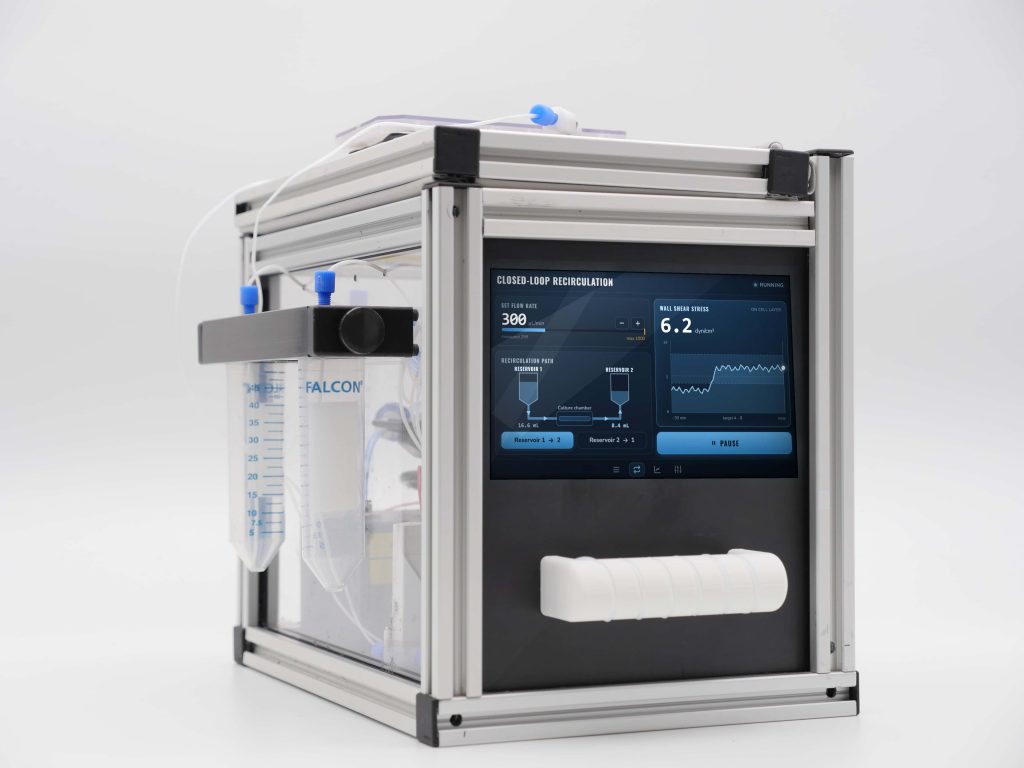
Organ-on-Chip Perfusion Platform
Recirculate your medium, hold the shear stress over six lines.Conditioned medium in the loop for days or weeks.
Held there for the whole culture, with no pulse.
Chips or well plates, driven together.
Exposure, rinse and cleaning, in one sequence.
A multi-well plate, a commercial chip or a device from your own lab is perfused at the wall shear stress you set, on six lines side by side, from one batch of medium recirculated for days or weeks.
Features & Benefits
From one perfused model to a dataset
A microphysiological model stops being a demonstration the day it has to produce numbers, and numbers mean replicates. At that point the setup starts limiting the experiment. One pump drives one sample, so six samples means six pumps, six sets of tubing and six things that can go wrong overnight.
The medium arithmetic surprises most people. At 10 µL/min a single sample gets through 14.4 mL of medium in a day, so six samples over two weeks is around 1.2 L on a single pass, and the expensive part of that volume, the growth factors, was never consumed. What the tissue itself secretes leaves with it, diluted below what the cells or the assay can pick up. The options differ in how they handle that.
Several syringe pumps. One pump, one line, so the shelf grows with the experiment. A syringe carries a fixed volume, so a run of days means refills, and each refill stops the flow and opens a way in for air. Nothing returns to the reservoir: every millilitre passes once and goes to waste.
A multichannel peristaltic pump. The honest baseline for recirculation, since it draws from a bottle for as long as the run lasts. Rollers squeeze the tubing to move the liquid, so the flow reaches the sample as a train of pulses and the wall shear stress on a barrier rises and falls with every roller that passes. The pulse rate is tied to the flow rate, so the low rates a barrier model tolerates are where the pulsation is worst. The tubing is a consumable under mechanical fatigue as well, so the rate on day ten sits off the one you set on day one.
A rocker or a gravity plate. Many samples to analyse, nothing to connect, and the reason many groups never buy a pump. The flow is a by-product of tilt: bidirectional, rising and falling through each rock, with the tilt angle and the interval as the only handles. The shear swings, and there is no value you can set it to or report.
A circuit you build yourself. Published protocols describe how, down to the milled fluidic board, the return valves and the control software. It works, and in parts it is cheap. What it costs is the months to build and characterise it, and the fact that the record of what it did is whatever your own script happened to write.
A platform built around the circuit. Air pressure moves the medium, so no moving part pushes it and the flow arrives smooth. One circuit carries a single recirculating medium to six samples in parallel. You set the wall shear stress your model calls for, and the platform holds it there, measuring what flows and correcting itself as the run proceeds. The sequence, the cleaning steps and the run record come with the instrument.
Perfuse six samples from one circulating medium.
Six lines run in parallel from a single circuit, driven together, so the perfusion is uniform across all six. What sits at the end of each one is yours to decide: six separate microfluidic chips, or six inputs on a single multi-well plate. A study that used to take four runs on two devices can then be laid out in one, and every sample in it saw the same perfusion. The medium circulates, which is what makes the volume manageable at that count: your tissues share one batch, and what they release stays in circulation with them. Where a model needs its own separate medium, the platform can be configured with several independent lines instead, and we size that with you.
Keep what your tissue secretes.
The medium-to-cell ratio in a perfused model sits far from the ratio in the body, and a single-pass circuit makes it worse: autocrine and paracrine factors are carried away as fast as they appear, too dilute to act on the cells and often too dilute for the assay you wanted to run. A closed circuit changes that. The medium returns to the reservoir and comes back, unidirectional at the sample, so the flow never reverses on the cells. That direction is part of the cue: an endothelium reads which way the flow goes as well as how hard it pushes, and a flow that swings back and forth aligns cells differently from one that holds its direction. Conditioned medium accumulates instead of being pushed to waste, and the same batch keeps going round for days or weeks. Recirculation also decides what medium you can afford to work in. A defined medium carrying growth factors, or patient serum, is out of reach when every millilitre passes once; it becomes workable over a two-week culture when the same batch circulates. For a vascular or barrier model held for weeks, the tissue then sits in a signalling environment it built for itself.
Put your barrier under the shear stress you chose.
Wall shear stress is what an endothelium or an epithelial barrier actually reads, so it is the number the experiment turns on. You set it on the platform, and holding it is the harder half, since flow drifts as tubing warms and as a reservoir level moves. The platform measures what is actually flowing and corrects itself, so the shear stays at the value you chose from the first hour of a culture to the last. No moving part pushes the medium either, so the flow arrives smooth and free of the pulsing a roller or a plunger adds.
Load a small volume or a large one.
The reservoir’s volume has no bearing on the shear stress your cells feel. A 2 mL aliquot of a compound solution reaches your samples at the same shear stress as a litre of culture medium, and swapping one reservoir for another changes nothing in the settings. That matters at both ends of the same study: expensive reagents belong in small aliquots close to the samples, while a long perfusion run gets through volume. It also means a dose or a washout can be a reservoir change, with the same shear stress before it and after.
Keep a multi-week loop clean.
Air pressure moves the medium, so no moving part pushes it and no pump head sits in the liquid. In a closed loop that counts for more than in a single-pass line, because whatever gets into the medium comes back round with it, again and again, for as long as the run lasts. The platform runs a cleaning step at the end of a study, so what circulated for two weeks is cleared out and the next experiment starts on a clean circuit.
Start it from the front panel, and follow it as it runs.
A touchscreen on the platform sets the perfusion and builds the sequence, so a run starts with no computer to connect first and no script to maintain. Build the sequence once, store it on the platform, recall it for the next study, or load a pre-defined one. An initialization step brings the platform up before anything reaches your samples, and a cleaning step clears the circuit at the end so the next study starts clean. While the run proceeds, the data is plotted as it is acquired, so a glance tells you the perfusion is still doing what you asked. A trigger signal lines the run up with a microscope, so an acquisition lands at a point in the sequence you chose.
Reproducible perfusion across a study.
Perfused models have an inter-laboratory reproducibility problem, and part of it is instrumental rather than biological. In a review of the published literature, 55% of the articles disagreed with each other on how a given biomarker responds to flow, and only 3% characterised the magnitude of the flow they applied at all. A shear stress that is set, held and recorded takes that variable out of the argument. The protocol expertise stays yours; what changes is that the perfusion your samples received is a number you can put in a methods section and another lab can reproduce.
A record that goes in a qualification file.
As a run proceeds, the platform logs its full history, every value it held and every step it ran, with a timestamp. That log is a 21 CFR Part 11-compliant record, meeting the FDA rule for electronic records and audit trails. For a safety group or a facility running assays for other people, the shear stress your models received becomes documented, auditable data. That weighs more now than it did: as regulators open the door to data from non-animal methods, a model is judged on whether it is fit for purpose, and the perfusion history is part of that file.
Application
Replicates of one model at the scale of a study
The core use. A validated model, six samples perfused in parallel from one circuit and driven together, so one condition comes out of a single run with six replicates rather than being assembled from several. A time course fits the same layout: take one sample out at each point while the rest keep running. The samples share one circulating medium, which suits a study where a common medium is part of the design; where each sample needs its own, the platform can be configured with several independent lines.
A vascular or barrier model on recirculated conditioned medium
A perfused endothelium or an epithelial barrier held for weeks, with unidirectional flow at the sample and the factors it secretes staying in circulation. The questions this opens are about the signalling environment the tissue builds for itself: barrier integrity followed over time, remodelling under a shear stress you set and hold, and the effect of conditioned medium that was allowed to accumulate.
Two tissues sharing one circulating medium
A shared circuit carries what one tissue secretes to another, which is how organ-organ crosstalk is studied. A gut model upstream of a liver model is the canonical arrangement. The platform supplies the circulation and the flow control; the scaling between the tissues, and what that circulation represents physiologically, stays an experimental design question.
Continuous perfusion of a multi-well plate
For a group that works in plates and does not want to move its model into chips. The platform drives liquid through tubing to whatever sits at the end of it, so a multi-well plate is perfused on the same terms as a chip, with the six lines reaching six inputs on the plate and the culture kept under continuous medium renewal instead of manual medium changes.
| Elvebio Organ-on-Chip Perfusion Platform |
|---|
| Parallel perfusion and recirculation |
| Up to six lines perfused in parallel from one recirculating medium. |
| Unidirectional recirculation, so the flow direction at your sample does not reverse. |
| Compatible with a multi-well plate, a commercial chip, or a device you build yourself. |
| Flow control |
| Flow rate accuracy: down to 5% of the measured value, for aqueous solutions. |
| Response time: down to 40 ms. |
| Flow rate ranges available from 7 nL/min to 40 mL/min, chosen for your protocol. |
| Fluids |
| Aqueous and biological media: culture medium, buffers, compound solutions. |
| Reservoirs from about 1 mL to several litres, and larger with adapted reservoirs. |
| Automated steps |
| Initialization step to bring the platform up before a run. |
| Rinse between two circulating solutions. |
| Cleaning step at the end of a run. |
| Gas supply |
| On-board pressure source, or your own supply. |
| Supply: 1.5 bar up to 10 bar; non-corrosive, non-explosive, dry, oil-free gas (air, N2, Ar, CO2). |
| Control and records |
| Front-panel touchscreen: set the perfusion, and build, store and recall run sequences on the platform, or load pre-defined ones, with no computer required. |
| Trigger line for synchronising with a microscope. |
| Full timestamped history log to a 21 CFR Part 11-compliant record. |
| Run data exportable. |
Frequently Asked Questions
The Elvebio Organ-on-Chip Perfusion Platform is an automated perfusion and recirculation system for organ-on-chip and other microphysiological systems. It circulates culture medium through six lines in parallel, holds the wall shear stress you set on your device, and returns the medium to its reservoir so the same batch keeps circulating instead of passing once. In practice, that means several samples perfused together on one circuit, the conditioned medium staying in circulation with them, and a timestamped record of the shear stress the run applied.
Six, in parallel, from one recirculating medium, and the six lines are driven together so the perfusion across them is uniform. What sits at the end of each line is your choice: six separate microfluidic chips, or six inputs on one multi-well plate. That is the standard configuration of the Elvebio Organ-on-Chip Perfusion Platform, and it is what turns a single-device demonstration into a repeatable, reproducible barrier or secretion result. Two other routes exist where a study needs them: several independent lines, so a sample can have its own separate medium, or a sequential configuration where the solution circulating through the samples is changed during the run. Tell us how many samples you need and whether they can share a medium, and we will confirm the configuration with you.
Yes. The Elvebio Organ-on-Chip Perfusion Platform drives liquid through tubing to whatever sits at the end of it, so it perfuses a commercial organ-on-chip, a multi-well plate or another substrate, or a device you make in your own lab. Nothing in the platform assumes a particular consumable, which means the model you already validated does not have to be rebuilt around somebody’s cartridge. Send us your device’s connections, its internal volume and the shear stress you are aiming for, and we will confirm the accessories it needs.
Through a closed recirculation loop, and yes, the flow at your sample stays unidirectional. The Elvebio Organ-on-Chip Perfusion Platform pushes medium from its reservoir, through your samples, and back to the reservoir, so one batch keeps circulating for the length of the run, whether that is a few days or several weeks. The direction the cells experience does not reverse, which matters for an endothelium or a barrier that responds to the direction of flow as much as to its magnitude. Recirculation is what makes a long perfusion affordable, and it is also what keeps secreted factors in the circuit.
Far less than a single-pass setup, and that gap is the reason recirculation exists. The arithmetic on a single pass is unforgiving: at 10 µL/min one sample gets through 14.4 mL a day, so six samples over two weeks is around 1.2 L, most of it pushed to waste with its growth factors unconsumed. On the Elvebio Organ-on-Chip Perfusion Platform the medium returns to its reservoir and circulates again, so one batch carries a run of days or weeks: what you load is what the run uses, and you replace it when the biology asks for it rather than when the pump has emptied it. Reservoir sizing is part of the configuration: tell us the shear stress you are aiming for and your run length and we will size it with you.
You set it directly. On the Elvebio Organ-on-Chip Perfusion Platform you enter the wall shear stress your model calls for, and the platform delivers it on your device and holds it there, as tubing warms and as a reservoir level moves. Because air pressure moves the medium, the shear your cells read carries no pulse, which is what separates it from a roller or a plunger driving the same value. The six lines are driven together, so identical devices on the array see the same shear. Send us your device geometry, the shear stress you are aiming for and the number of samples, and we will go through the configuration with you before you order.
A standard run circulates one medium. Where a protocol needs more, a sequential configuration of the Elvebio Organ-on-Chip Perfusion Platform holds several solutions and puts them into circulation one after another, so an exposure, a washout and a recovery phase run as one sequence with nobody opening the incubator between them. A rinse step then clears the line between two solutions, so each one reaches your samples through a clean path and carry-over stops being a plausible explanation for a result. The cleaning step at the end of a run is standard either way, and it clears the circuit so the next study starts on a clean platform. Tell us which solutions your protocol has to circulate and we will confirm the configuration.
Yes, and that is what building the sequence up front is for. You set the perfusion and the sequence on the front-panel touchscreen, store it, and start it, and the Elvebio Organ-on-Chip Perfusion Platform then proceeds on its own, plotting the data as it goes so you can see at a glance that the shear stress on your cells is still holding. A recirculating circuit also means the run is not counting down a syringe, so nobody has to come in overnight to refill one: the medium your samples share is the batch you loaded.
Both recirculate. What reaches the cells differs. A peristaltic pump moves liquid by squeezing tubing, so the flow arrives as pulses and the wall shear stress rises and falls with each roller, worst at the low flow rates a barrier model tolerates, and the tubing fatigues over a multi-week run so the rate drifts from the one you set. The Elvebio Organ-on-Chip Perfusion Platform moves the medium with air pressure, so no moving part pushes the liquid, the flow is smooth, and the shear stress on your cells stays at the value you set for the length of the run. Nothing in the liquid path fatigues under rollers, and there is no recalibration to plan around.
The count of things you maintain, and the record you end up with. Six pumps means six flow settings, six reservoirs, six sets of tubing and six logs to reconcile afterwards, and the medium volume grows with the count. The Elvebio Organ-on-Chip Perfusion Platform runs the six lines from one circuit and one interface, driven together so the perfusion across them is uniform, with one batch of medium circulating and one timestamped record covering the whole run, which is what a reviewer or an auditor asks to see. It also removes the arithmetic that makes high-throughput perfusion expensive, since one batch circulates for all six samples.
Yes. The Elvebio Organ-on-Chip Perfusion Platform logs the full history of a run, every value it held and every step it ran, with timestamps, to a record that meets 21 CFR Part 11, the FDA rule for electronic records and audit trails. For a pharmaceutical safety group, or a laboratory running microphysiological system assays for other people, the shear stress each model received becomes traceable and audit-ready, which counts in a qualification file alongside the biological endpoint. You export the run data yourself, and how you store and back it up fits into your own data-integrity workflow.
Contact us through the form and tell us about your study: the model and device you perfuse, the wall shear stress you are aiming for, how many samples you need in one run, whether they can share a circulating medium, and how long the run has to last. We will match an Elvebio Organ-on-Chip Perfusion Platform configuration and its accessories to your setup, and answer setup questions before you buy.

 Job
Job Collaborations
 Customer
 Other
Other