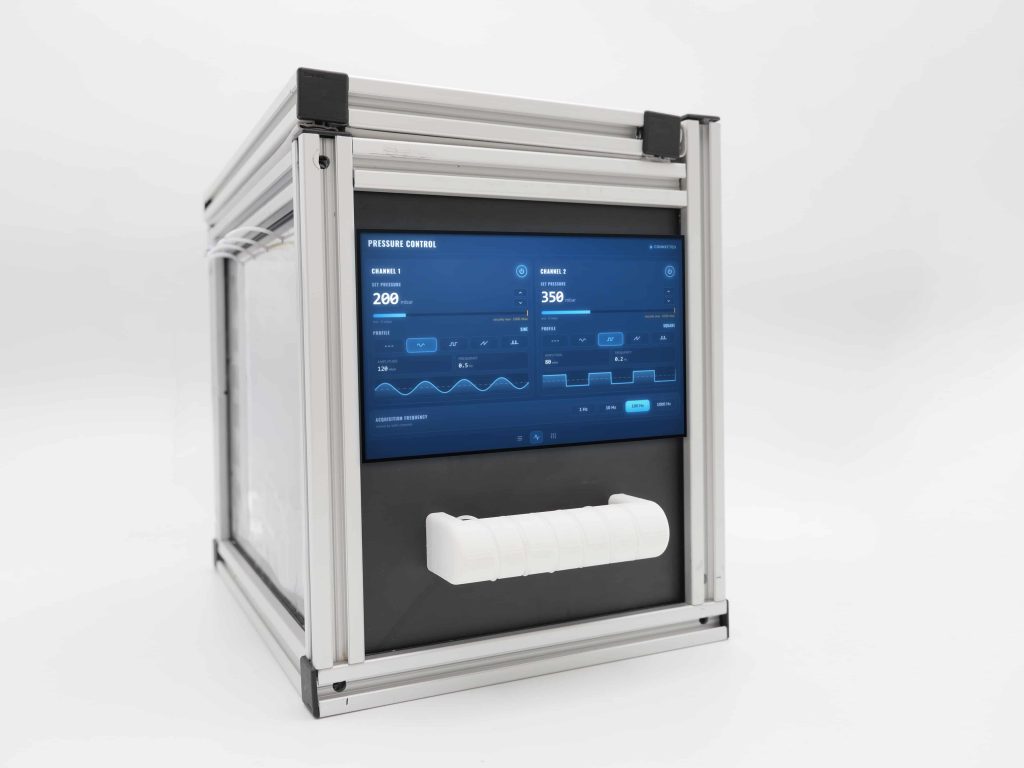
Cyclic Stretch Platform
A defined, repeatable mechanical strain, applied automatically.A steady hold or a repeating cycle, on your profile.
Set the pressure and hold it, run after run.
Up to four independent channels, side by side.
Any membrane device; no fluidics to plumb.
Cells grown on a flexible membrane feel a defined mechanical strain when a programmed pressure or vacuum deflects that membrane, steady or cycling, across one to four independent channels, with no liquid in the control path.
Features & Benefits
Pressure-driven control for cell stretching
Many cells spend their working life under mechanical load. A blood vessel is stretched with every heartbeat, an airway with every breath, a tendon with every step. Grow those cells flat and static in a dish and that mechanical stimulation is gone, and with it part of the phenotype you are studying. Adding the strain back is the straightforward part. The harder part is making that strain a defined, repeatable number, and it is where much of the field’s effort goes. That means the same amplitude across the cells, the same value run to run, and one you can still image and put on record. A few routes are open at the bench, and they differ in how well they manage it.
Static culture. Where most cells start. No strain reaches them, so a mechanically driven phenotype — alignment along a strain axis, matrix production, a stretch-dependent signalling state — drifts away from what the tissue does in the body. Anything you want to conclude about load has to come from putting it back.
Motor-driven stretchers. A motor or actuator clamps the membrane, or a silicone chamber, at its edges and pulls, usually along one axis. It applies a real, set strain, which is why it is a common route. The trade-offs are mechanical: moving parts in the load path that can wear over a long cyclic run, and a single drive that tends to impose one strain on everything it moves, so several amplitudes at once means several instruments.
Pressure-driven membrane deformation. Air does the work. A programmed pressure, or a vacuum, deflects the flexible membrane the cells grow on, so nothing mechanical touches the sample. One interface drives one to four independent channels, each on its own amplitude and frequency, and the same line can push the membrane out or draw it back — a static hold, a cycle, or a profile you upload. The strain that produces depends on the membrane you use, so you characterise your device once, then command the pressure that gives your target strain and hold it, run after run.
Set a defined strain, and hold it.
Mechanotransduction depends on how much the cells are strained, so the amplitude has to be a number you set, not an accident of the setup. A pressure controller deflects the membrane by a defined amount and holds that pressure steady from the first cycle. The strain your cells feel follows the pressure and the membrane, so once you know that relationship for your device, you command the pressure that gives your target strain and it stays there across the run.
Precision the cells can feel.
The strain your cells feel tracks the pressure, so an unstable pressure is an unstable strain on the cells. Overshoot on a step, and a transient over-strain can detach a monolayer or trigger a stress response you never intended. Let the pressure drift over a long run, and the strain wanders from the value you set, so your dose-response rests on a number that has already moved. Let it ripple cycle to cycle, and that variation surfaces as scatter you would read as biology. Precision removes all three: the platform holds pressure to within 0.005% of full scale and responds in about ten milliseconds, so the strain stays equal to the number you set across a run of hours or days.
From a steady hold to a physiological rhythm.
A held stretch and a repeating cycle answer different questions. Hold a constant stretch over hours and you can follow how cells adapt to a sustained load, reorganising their cytoskeleton or building extracellular matrix while the strain stays fixed. Run a repeating cycle and you reproduce the rhythm a tissue lives under: an airway stretches with breathing near 0.2 Hz, a vessel or a cardiomyocyte with a heartbeat around 1 Hz, an intestinal wall on a slow peristaltic cycle. You program that profile once, a static hold, a cycle at the frequency your model needs, or a custom waveform, and the fast response reproduces it cycle after cycle.
Stretch several conditions in parallel.
One to four independent channels run from a single interface, so you can drive several membranes at once, a different amplitude or frequency on each to build a dose of strain, or the same profile across many chambers for replicates in one experiment. A screen of mechanical conditions then comes out of a single run instead of one after another.
No liquid in the loop.
The platform acts on air, or a non-corrosive, non-explosive gas like nitrogen or argon, so nothing it drives is ever wetted. It delivers both positive pressure and vacuum, so it can stretch a membrane by pushing it out or drawing it back, whichever way your device produces its strain. There is no flow to set up, no sensor to prime, no dead volume: you connect the pneumatic line to your device and stretch. When your model also needs fresh medium under flow, a pressure-driven perfusion system runs alongside it, so the stretch and the perfusion stay on separate, controlled lines.
Reproducible mechanobiology.
Mechanobiology has a reputation for results that move between benches, and the mechanical setup is often part of the cause: a strain applied by hand, a load that drifted, a condition that shifted from one run to the next. A programmed pressure profile takes that variable out. Set an amplitude and a frequency today and you get the same next week, whoever launched the run, so the strain becomes the thing you are testing rather than a source of scatter. That counts for more as tissue models move toward standardised, animal-free methods, where another lab has to reproduce the result.
Drive it from a touchscreen, and run it on its own.
A touchscreen on the front panel drives the platform directly, so setting a pressure, an amplitude, or a frequency takes a few taps, with no computer to connect first. You build a loading sequence there, a warm-up, a block of cycling, a rest period, store it on the platform, and recall it whenever the experiment calls for it — or load a pre-defined one. You program the stretch profile once and it proceeds on its own, so a long cyclic-strain experiment runs overnight and across days without someone at the bench. A trigger lines the stretch up with a microscope, so acquisition lands at a chosen, held phase — at rest, or at a strain you pause and hold — where the membrane sits still and the focal plane holds. A membrane imaged while it actively deflects carries the cells out of focus, so a fixed phase is the practical route.
A traceable record for regulated work.
As a run proceeds, the platform logs its full mechanical history, every pressure and every cycle it applied, with a timestamp. That log is a 21 CFR Part 11-compliant record, meeting the FDA rule for electronic records and audit trails, so what the platform did to your cells is captured, traceable, and holds up to review. For a pharmaceutical or industrial lab working under GxP, the mechanical dose becomes documented, auditable data, timestamped by the instrument and ready for a safety file, which weighs there as much as the biological endpoint.
Application
Cyclic stretch in a lung or airway model
Airway and alveolar epithelium is stretched with every breath, and that motion shapes how the tissue develops, repairs, and responds to injury. On a flexible membrane, a programmed pressure reproduces the breathing cycle at a physiological amplitude and rate, so bronchial or alveolar cells are cultured under the deformation they meet in the lung. It fits inflammation, barrier-integrity, and inhaled-exposure work where the mechanical cue changes the result.
Vascular and cardiac strain
Endothelial cells, vascular smooth muscle, and cardiomyocytes all live under cyclic deformation from the pulse. Reproducing that strain on a membrane lets you follow how vascular cells remodel under a physiological or a hypertensive load, or how cardiomyocytes mature and organise once they are cyclically stretched. The amplitude and frequency you set on the platform stand in for a resting rate, exercise, or a disease state.
Musculoskeletal load: tendon, bone, cartilage, muscle
Few tissues are as mechanically driven as the musculoskeletal ones. Tenocytes, osteoblasts, chondrocytes, and skeletal-muscle cells all read mechanical strain as an instruction to build, align, or differentiate. A controlled cyclic stretch reproduces that load in culture, so you can study matrix production, cell alignment along the strain axis, or the response to an exercise-like regime, at a strain and a frequency you set.
Peristalsis in a gut model
The intestinal wall is under constant rhythmic deformation from peristalsis, and that motion influences epithelial function and the behaviour of the microbiome at the surface. A membrane driven on a slow, repeating cycle brings that mechanical context to an intestinal model, alongside whatever chemical or microbial challenge the experiment adds.
Strain as a stem-cell fate cue
Mechanical strain is a lineage signal: it acts through pathways such as YAP/TAZ and can push stem or progenitor cells toward one fate over another. A defined, repeatable stretch turns mechanics into an experimental input in a differentiation protocol, a set amplitude and frequency held over days, so you can ask what the strain alone changes.
| Elvebio Cyclic Stretch Platform | |||||
|---|---|---|---|---|---|
| Channels and pressure | |||||
| One to four independent pressure channels, each set on its own. | |||||
| Channel pressure range | 0 to 200 mbar (0 to 2.9 psi) |
0 to 2,000 mbar (0 to 29 psi) |
0 to 8,000 mbar (0 to 116 psi) |
−900 to +1,000 mbar (−13 to 14.5 psi) |
−900 to +6,000 mbar (−13 to 87 psi) |
| Positive pressure and vacuum, to stretch a membrane by pushing it out or drawing it back. | |||||
| Stability and speed | |||||
| Pressure stability | down to 0.005% of full scale (piezoelectric pressure control). | ||||
| Response time | down to 10 ms (to 5% of setpoint). Settling time: down to about 50 ms (to 95%). | ||||
| Minimum pressure increment | 0.006% of full scale. | ||||
| Gas supply | |||||
| 1.5 bar (or maximum pressure + 0.5 bar) up to 10 bar; non-corrosive, non-explosive, dry, oil-free gas (air, N2, Ar, CO2). | |||||
| Actuation and control | |||||
| Input profiles | static hold, ramp, sine, triangle, square, and custom. | ||||
| Front-panel touchscreen | set the pressure, amplitude, and frequency, and build, store, and recall loading sequences on the platform, or load pre-defined ones, with no computer required. | ||||
| Trigger line for synchronising stretch with a microscope. | |||||
| Full mechanical-history log, every pressure and cycle with a timestamp, to a 21 CFR Part 11-compliant record. | |||||
Frequently Asked Questions
The Elvebio Cyclic Stretch Platform is a pressure-control system for mechanobiology. It applies a controlled, programmable pneumatic pressure to a flexible membrane, so the cells growing on it are stretched by a defined amount, steady or cycling. It drives the mechanical deformation, on one to four independent channels from a single interface, so a mechanically realistic culture becomes a set of numbers you control.
Because many cells behave differently under load than in a static dish. Cells from the vessel wall, the airway, the gut, tendon, bone, or the heart normally live under cyclic deformation, and that strain shapes their phenotype, their alignment, and their gene expression. A flat, static culture removes it, and with it part of the biology. The Elvebio Cyclic Stretch Platform adds a defined mechanical strain back, so the model reflects the mechanical environment the tissue actually experiences.
All three. You can hold a sustained static strain, run a cyclic stretch at a frequency you choose, or upload a custom pressure profile for a more complex loading pattern. Because the Elvebio Cyclic Stretch Platform controls the pressure directly and responds quickly, the profile you program is the profile your membrane follows, cycle after cycle.
The Elvebio Cyclic Stretch Platform sets the pressure; the strain follows from that pressure together with your membrane’s geometry and stiffness. So the practical route is to characterise the pressure–strain relationship for your device once, for example by tracking marker displacement under the microscope as you step the pressure, then command the pressure that gives your target strain. From then on the platform holds that pressure, so the strain stays at the value you set across the run. This keeps the strain a defined, reportable number rather than a guess.
One to four, independently. Each of the one-to-four pressure channels is set on its own, so you can apply a different amplitude or frequency to each membrane, a strain dose across four conditions, or the same profile to several chambers to run replicates together. Comparing mechanical conditions side by side then takes one experiment instead of several.
The Elvebio Cyclic Stretch Platform drives the pressure, so it works with any device built around a deformable membrane, a commercial stretch chip or plate, or one you make yourself, as long as it takes a pneumatic connection. Because it supplies both positive pressure and vacuum, it fits a device that stretches by pushing and one that stretches by suction. Tell us how your device is actuated (positive pressure, vacuum, the port it uses) and we will confirm the configuration and the accessories you need.
Yes. The Elvebio Cyclic Stretch Platform is built to control pressure for membrane stretch, but the same pressure can drive perfusion too. Connect one channel to a sealed medium reservoir, and the pressure pushes fresh medium through your device on its own line, while the stretch runs on another channel. The platform still touches only gas: the medium stays in its reservoir and tubing, never in the instrument. To set this up, contact us and we will help you configure the reservoir, tubing, and channels for your model.
Yes. You set the run up from the touchscreen on the platform, build a loading sequence and store it, or load a pre-defined one, then start it with no computer to connect. The Elvebio Cyclic Stretch Platform runs the profile on its own, so a multi-day cyclic-stretch experiment does not need someone at the bench. A trigger can line the stretch up with a microscope, so an image is captured at a chosen, held phase — at rest, or at a strain you pause and hold, where the membrane sits still and stays in focus — and the pressure history is recorded with it, which keeps every image tied to a known mechanical state. As it runs, the platform logs the full pressure history to a 21 CFR Part 11-compliant record, so every image ties back to a documented, auditable mechanical state.
Yes. The Elvebio Cyclic Stretch Platform logs the full mechanical history of every run, each pressure and cycle it applied, with timestamps, to a record that meets 21 CFR Part 11, the FDA rule for electronic records and audit trails. For a pharmaceutical or industrial lab, the mechanical exposure your cells received is then traceable and audit-ready, which counts for a safety or validation file as much as the biological result. The platform controls and records the mechanical dose; how you store and back up the exported records fits into your own data-integrity workflow.
The Elvebio Cyclic Stretch Platform never contacts your medium, it acts on air or another gas, so the instrument itself stays outside the sterile path. The only parts to keep sterile are your membrane device and its culture medium, which you prepare as you would for any culture. Sterility is a property of your device and your handling, not of the pressure line.
Contact us through the form and tell us your tissue model, the membrane device you use, and the strain amplitude and frequency you are aiming for. We will help you match the Elvebio Cyclic Stretch Platform configuration and accessories to your mechanobiology setup, and answer setup questions before you buy.



 Job
Job Collaborations
 Customer
 Other
Other