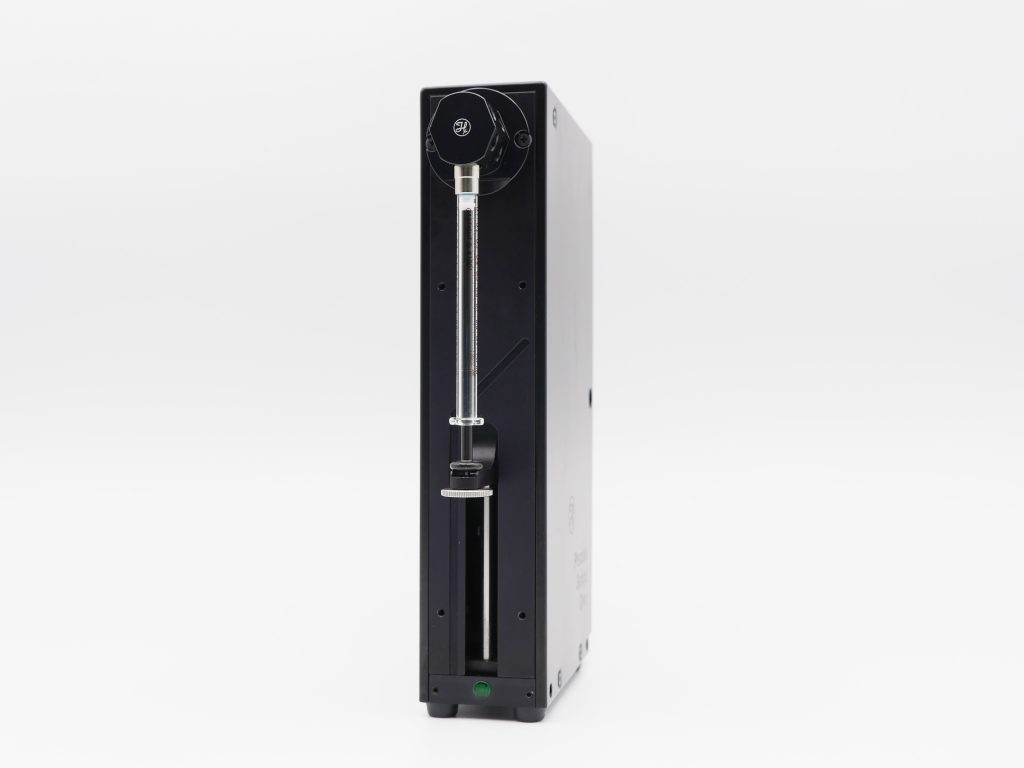
Volume Dispensing and Aspiration System
The volume you set is the volume that leaves the syringe.±1 µL on a full 100 µL stroke, run after run.
Displacement sets the volume, whatever the viscosity.
Draws liquid back and routes it, with no reconnection.
250 nL with a 25 µL syringe, eleven sizes to 50 mL.
Dilution series, metered sampling and repeat reagent additions all work from a volume set by the plunger travel, down to 250 nL, unchanged from a buffer to a viscous polymer stock.
Features & Benefits
How a metered volume gets delivered today
A dilution series. A standard addition. A fixed reagent volume into two hundred vials, twice a week. In each of them the number that has to hold up is the delivered volume, and each route below reaches it differently.
The hand pipette. The baseline, and it holds up where the tip is comfortably full. At 10 µL the volume varies by as much as 5.9% from one draw to the next. A dilution series leans on its smallest transfers. So the concentrations at the bottom of the curve are the least certain. Repeating the series costs a morning and a volume of standard you may not have.
The repeating pipette. Quicker when the same reagent volume goes into a long row of vials. The volume comes in fixed increments of the tip, so your target has to fit what the tip offers. And it stays hand-held, so someone is there for every vial, the scatter follows whoever is holding it, and no step can be timed.
A bench diluter or dispenser. Built for one job: it draws from a diluent line and a sample line, and delivers into the vessel in front of it. Reaching a third liquid, taking a metered sample back out, or timing a step inside a longer sequence all sit outside what it does.
A rig built in the lab. A stepper, a lead screw and a syringe will move a plunger, and for one fixed step that is often enough. No valve to route a dilution series, no stored sequence to hand to a colleague, and no report when the plunger jams against a blocked line.
Pressure-driven flow control. Gas pressure on a sealed reservoir gives a smooth, continuous flow, and nothing touches the liquid. It reacts in milliseconds and feeds from a reservoir of any size. The delivered volume is the flow integrated over time, so knowing it takes a sensor in the line. That sensor adds internal volume, which does not shrink with your target, so the smallest dispenses lose the most.
A volumetric syringe pump. The volume leaving the syringe is set by its cross-section and the plunger travel. It does not depend on the liquid’s viscosity or density, and nothing in the line has to be measured. Tolerance improves with the fraction of the stroke you use, so a given target sits higher in a smaller syringe’s stroke. The smallest syringe in the range holds 25 µL, and that sets the lower limit. The plunger runs backwards under the same control, so a metered volume can be drawn back out as well as delivered. A valve head on the instrument routes each step of the sequence. It needs no compressed gas and no flow sensor.
Know the volume before you dispense it
The volume you write in your methods section should be the volume the vessel received. A syringe of known cross-section, on a plunger that advances a known distance, gives you that number from geometry alone. There is no flow sensor in the line, and none is needed. The same geometry sets the flow rate, cross-sectional area times plunger speed. At full stroke the accuracy is ±1% on every syringe, and dispense-to-dispense stability is 0.20% or better, reaching 0.05% on the larger ones.
Viscosity does not enter the calculation, so a glycerol solution and a buffer leave the same volume behind. Nor does the resistance downstream: a longer line, a narrower chip, a filter part-way through its life, the displaced volume is the same. What changes is the pressure the circuit demands, and that gets spent along the tubing, the valve and the chip.
Work below one microlitre
Spiking a labelled tracer. Adding an inhibitor to a small well. Placing a droplet at a chip inlet. Below a microlitre the delivered volume sets the final concentration, and the concentration is the experiment. The smallest volume you can dispense is 250 nL. Take the smallest syringe that puts your target volume high in its stroke, because at a full stroke the accuracy is ±1%. Eleven sizes run from 25 µL to 50 mL, so a standard preparation and a 50 mL rinse both have a syringe that fits.
Sample, dilute, deliver, from one instrument
A preparation that moves across several positions can be built two ways. Pressure-driven, it takes a controller, a distribution valve and a flow sensor in line. On a syringe pump the valve head sits on the instrument and no flow sensor is needed, so one unit covers the path. A distribution head carries up to eight ports. Draw diluent from a reservoir on one port and deliver to seven destinations. Or draw a sample from a chip outlet and place it in a vial. The valve turns 120° in 250 ms, so a multi-port sequence spends its time dispensing.
Withdrawal works under the same control as delivery. A known volume can be pulled out of a reactor, a fraction collector or a chip outlet, then put somewhere else.
Catch a clog before it costs you the run
A partial blockage announces itself late, usually in the results. Because the pump sets the delivery and not the pressure, pressure is the free variable, and that makes it the informative one. Put an inline pressure sensor after the valve and read it with a sensor reader. At a constant flow rate, a rising pressure means the resistance rose. A clog. A kinked line. A valve on the wrong port. A filter loading up. The software logs and displays the trace while the sequence runs, so you see the change as it happens. That matters most with a viscous liquid or a narrow chip inlet, where the pressure the circuit demands is already high.
Prepare a batch without standing over it
A set of preparations done one at a time is a morning gone. Build the sequence once and run it the same way again. Aspirate, switch ports, dispense, repeat with a loop. A saved sequence comes back with one command.
Application
Dilution series and standard addition
A calibration curve is limited by its smallest transfers, whether the points come one from the next or each from the stock. On our syringe pump the aliquot and the diluent leave the same syringe, so a systematic error cancels in the dilution ratio. A distribution valve head reaches the diluent, the stock and the row of vials without a reconnection. Run the series from a saved sequence and the same volumes land in the same order, whoever starts it. Standard additions work the same way, with the added volume known in advance.
Metered aspiration and sampling
Following a reaction, a culture or a chip outlet over time means taking a known volume at known moments. Metered withdrawal is the step that usually stays manual, so a time course becomes a person with a pipette and a timer. That caps the number of points, and it puts the overnight ones out of reach. Our syringe pump withdraws under the same control it delivers. A set volume can be taken from a reactor, a chip outlet, a well or a fraction. The valve head then routes it to a vial, an analyser or a second reagent line. Programme the timing once and every point carries the same nominal volume as the one before it, including the 3 a.m. one.
Repeat reagent additions
Two hundred vials, the same volume of reagent in each, twice a week. The throughput is capped by how long one person can stay accurate, and the scatter changes with who is doing it. On a sealed vessel or a chip inlet there is also nothing to check afterwards. Our syringe pump replays a saved sequence, delivering the same nominal volume into a closed circuit, with no flow sensor in the line to calibrate first. This suits the case where the receiving side is sealed and the volume has to be known from the mechanism alone. A chip inlet, a capped vial, a closed reaction vessel.
Viscous, volatile and non-Newtonian liquids
A hydrogel precursor, a polymer stock, a glycerol solution, an oil, an organic solvent. You want the volume you asked for, the same as you get with a buffer. Where the command-to-volume relationship has to be established for each liquid, and re-established when the temperature moves, every new formulation costs a calibration. Displacement sidesteps that. On our syringe pump the volume follows the plunger whatever the liquid is doing. The pressure the circuit demands does rise with viscosity, so the syringe and valve combination is chosen for the liquid. And a volatile solvent behaves better in a closed path of glass and fluoropolymer than in an open one. The two parts of a formulation can be metered in a fixed ratio from one syringe, which is how a print material gets loaded. Extrusion during a print is a flow-rate question, and our flow rate control page covers it.
Conductive gel on an electrode array
An electrode array is only as good as the contact at each site, and that contact depends on how much conductive gel reaches it. Too little leaves the impedance high, too much bridges to the neighbouring site. Filling dozens of wells by hand is slow, and the amount varies with whoever does it. Our syringe pump delivers the same volume to each well from a saved sequence, and the gel’s viscosity does not change what the plunger displaces. The valve head refills the syringe from a reservoir between wells.
Small and precious samples
A patient-derived sample, an isotope-labelled standard, a single-cell lysate. You have what you have, and whatever stays behind in a vessel or a priming volume is gone. Here the syringe is the container. Load 25 µL and our syringe pump delivers it in metered fractions, then draws back what remains. Because the plunger reverses under control, a sample that has been through a chip can be recovered and not pushed to waste.
| PSD- Microfluidic Syringe Pump | |
|---|---|
| Syringes and volume | |
| Syringe volumes | 25, 50, 100, 250, 500 µL and 1, 2.5, 5, 10, 25, 50 mL. |
| Stroke length | 60 mm. |
| Full-stroke time | 2 s to 100 min. |
| Delivered-volume resolution | 48,000 steps per stroke. |
| Accuracy and stability | |
| Volume accuracy | ±1% at full stroke on every syringe. |
| Dispense-to-dispense stability | down to 0.05% at full stroke. |
| Minimum volume increment | 0.002% of the syringe volume, one motor step. |
| Valve and routing | |
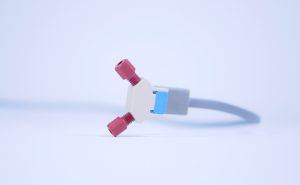
| Valve heads | distribution heads with up to eight ports, and two- or three-port heads for simpler paths. |
| Valve drive | stepper motor with optical encoder, 250 ms per 120° of rotation. |
| Fittings ¼”-28. Nominal fluid path diameter 1.524 mm. | |
| Fluids and materials | |
| Wetted materials | borosilicate glass, PTFE, PFA, CTFE and ceramic, with a PTFE or UHMW-PE plunger tip. |
| Valve materials | CTFE, PTFE, ETFE, ceramic. |
| Software and control | |
| Elveflow Smart Interface (ESI), supported from version 3.11; licence included. | |
| Communication | USB, RS-232, RS-485 or CAN. |
| Saved sequences on the module; ramps, loops, flow-rate change during a stroke, backlash compensation; stall and overload reported over the serial link. | |
| Physical and electrical | |
| 24 VDC, external power supply included. Delivered set: pump with casing, power supply, cable set and ESI licence. | |
| Operating conditions | 15 to 40 °C, 20 to 95% relative humidity, non-condensing. |
| Accuracy and stability figures measured with deionised water at 22 °C. | |
Frequently Asked Questions
The Elveflow PSD is a syringe pump for research and instrument work, used to deliver, withdraw and route known volumes of liquid. A motor advances a plunger of known cross-section by a known distance, so the delivered volume comes from the geometry of the syringe. At full stroke that holds to ±1% accuracy, with no flow sensor in the line. Eleven syringe sizes from 25 µL to 50 mL, and a valve head with up to eight ports, cover dispensing, aspiration and distribution on one instrument.
You order the Elveflow PSD with the syringe size and the valve head your application needs. The licence to drive it from the Elveflow Smart Interface comes with it. We confirm that combination against your volumes before you order.
Pick the smallest syringe that puts your target volume high in its stroke. Accuracy on the Elveflow PSD improves with the fraction of stroke you use: a 100 µL syringe holds ±1% at 30% of stroke and above, and widens to ±4% below 5% of stroke. So a 50 µL target is better served by a 100 µL syringe than by a 1 mL one, even though both reach it. Eleven sizes run from 25 µL to 50 mL. Tell us your smallest and largest routine volume, and we will name the syringe, or the pair of syringes, that covers the range.
250 nL, using the 25 µL syringe at one percent of its stroke. The Elveflow PSD delivers that volume from plunger displacement alone, with nothing measured in the line. The accuracy there is ±5%. At a full stroke it is ±1%. Below a microlitre the 25 µL syringe is already the smallest in the range, so that wider tolerance is what you work with. Tell us your target volume and we will say whether it holds for your protocol.
You set a volume, and the Elveflow PSD converts it to plunger travel using the syringe’s cross-section. There is no flow sensor in the line to read or to calibrate, so the number is known before the liquid moves. At full stroke the accuracy is ±1% on every syringe, and dispense-to-dispense stability is 0.20% or better. Accuracy is the gap between the volume you asked for and the average delivered. Stability is how little that volume moves from one dispense to the next. A series of replicates rests on the second.
Yes. The Elveflow PSD runs its plunger backwards under the same control it runs forwards, so it withdraws a metered volume as readily as it delivers one. Add a distribution valve head of up to eight ports and a whole sequence runs from one syringe: draw a set volume from a reactor, a well or a chip outlet, switch ports, then place it in a vial or send it to an analyser. Sampling and dilution workflows therefore live on a single instrument.
Yes, and the error arithmetic is why you would want to. A dilution series compounds its own error: what the first step gets wrong, every later step carries, and the small-volume steps contribute the most. The Elveflow PSD draws diluent and sample through the same displacement mechanism, so both legs of a step share one geometry. It holds ±1% accuracy at full stroke, with nothing to recalibrate between steps. A distribution valve head puts the diluent reservoir, the stock and the receiving vials within reach of one syringe. Write the series once as a saved sequence and it repeats the same way, whoever launches it.
Yes, and displacement is why. Viscosity changes the pressure the circuit demands. It does not change the volume the plunger displaces, so the Elveflow PSD delivers the same nominal volume for a glycerol solution as for a buffer. The syringe and valve combination does have to be specified for the liquid, since a thicker liquid asks more of the whole path. And a volatile solvent is better off in this pump’s closed path of borosilicate glass, PTFE, PFA and ceramic than in an open dispense.
The plunger returns to refill, and delivery pauses while it does. Inside a dispensing sequence that is simply one of the steps: the Elveflow PSD aspirates from a reservoir port on the valve head, then goes back to delivering, and the whole cycle sits in one saved sequence. The volume you get between refills is the syringe volume. That is one more reason to size the syringe around the total your protocol needs and not around the single dispense. Where a run genuinely cannot pause, pressure-driven flow control from a large reservoir is the better answer, and we will tell you so.
The flow rate comes from the plunger speed and the syringe cross-section, so no flow sensor is involved in setting it or holding it. You set it in the software, and the Elveflow PSD holds it when the resistance downstream changes. At low rates the plunger advances in discrete motor steps. There are 48,000 of them across a full stroke, so delivery arrives in small increments. A smaller syringe makes those increments smaller. In soft tubing the circuit also has to be pressurised before anything appears at the far end, which puts a settling time between the command and the delivery. Where a smooth low flow rate held for hours is the real requirement, a pressure controller is the better instrument. Our flow rate control page covers the cases where a syringe pump is the right one.
The pump does not set a pressure. It advances a plunger, and the pressure that appears is whatever the circuit demands to accept that flow, spent along the tubing, the valve and the chip. There is a ceiling, and it is the lowest of three things: what the drive can push, what the syringe can take, and what the valve head is rated for. It falls as the syringe gets larger, because the same force spreads over a bigger plunger. We publish no single maximum figure for the Elveflow PSD, because the ceiling belongs to the configuration and not to the instrument. Tell us your syringe, valve head and circuit, and we will confirm it for that combination.
The wetted path of the Elveflow PSD is borosilicate glass, PTFE, PFA, CTFE, UHMW-PE and ceramic, a deliberately inert set. Cleaning is a rinse sequence the pump runs itself, since it can aspirate. Draw solvent through one port of the valve head and dispense to waste through another, repeated as a stored loop. Carryover between samples comes down with nobody standing over it.
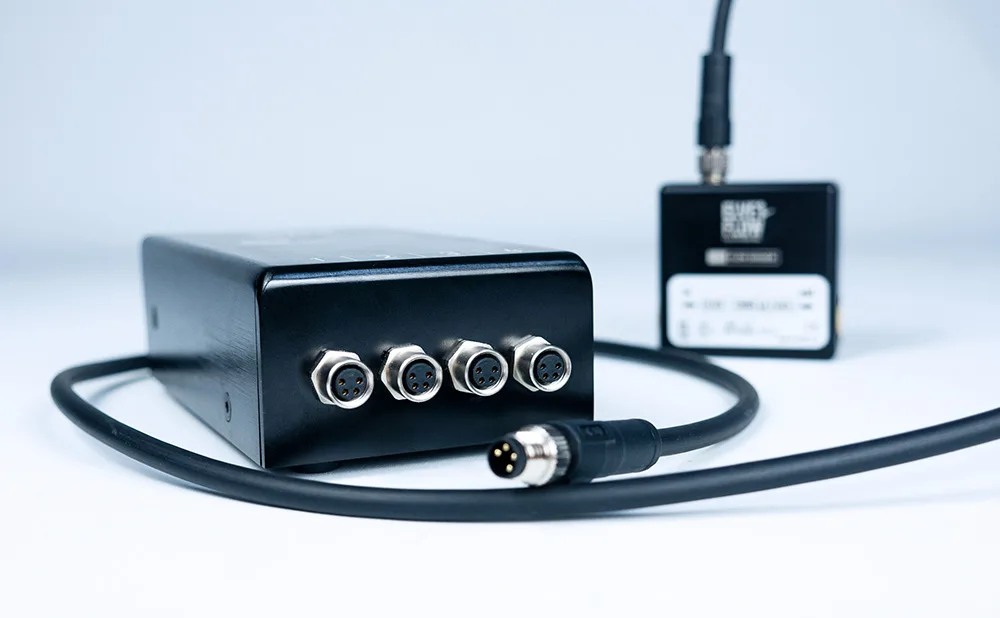
Yes, and on a syringe pump pressure is the right thing to watch. Because the Elveflow PSD sets the delivery and not the pressure, pressure is the free variable and it carries the diagnostic information: at a constant rate, a rising pressure means the resistance rose. Put an Elveflow MPS pressure sensor inline after the valve and read it with the MSR sensor reader, and the software logs and displays the trace live. A partial clog, a kinked line, a valve on the wrong port or a loading filter shows up as it happens.
Yes. Each Elveflow PSD drives one line, and several run on one link, so samples can be prepared in parallel. A saved sequence comes back with one command. Sequences are built from aspirate and dispense steps, valve moves, loops, ramps and rate changes made part-way through a stroke. The pump flags a stall or an overload in its status, so a sequence that polls it can stop on the fault.
The Elveflow Smart Interface drives the Elveflow PSD, from version 3.11 onwards, and the licence comes with the pump. The interface builds and stores sequences, logs every delivered volume with a timestamp, and shows an inline pressure reading alongside it when an MPS sensor is fitted. If you would rather drive the pump from your own code, it accepts commands directly over RS-232, RS-485 or CAN.
It comes down to which quantity your protocol is written around. If you need a known volume delivered or withdrawn, and you want that number to come from the mechanism, the Elveflow PSD syringe pump is the fit. It aspirates as controllably as it dispenses. If you need a flow rate held smoothly and immediately for hours, from a reservoir of any size, the Elveflow OB1 pressure controller is the fit. It stays our default recommendation for that work. Plenty of setups run both, one for the volumes and one for the flow. Send us your protocol and we will tell you which one belongs on the quote.
Contact us through the form and tell us the volumes you dispense, the liquids you use, and whether you need to aspirate. We will come back with the syringe size, the valve head and the sensor configuration that fit, and a quote for the Elveflow PSD built around them.



 Job
Job Collaborations
 Customer
 Other
Other