Flow Sensor for Cell Culture Perfusion
Know the flow your cells received, and reproduce the run.Readings repeatable to 0.25% of the value.
An alert on cell debris, matrix or pinched tubing.
When the reading drifts, or between two solutions.
Rated for a CO2 incubator, with no line running out.
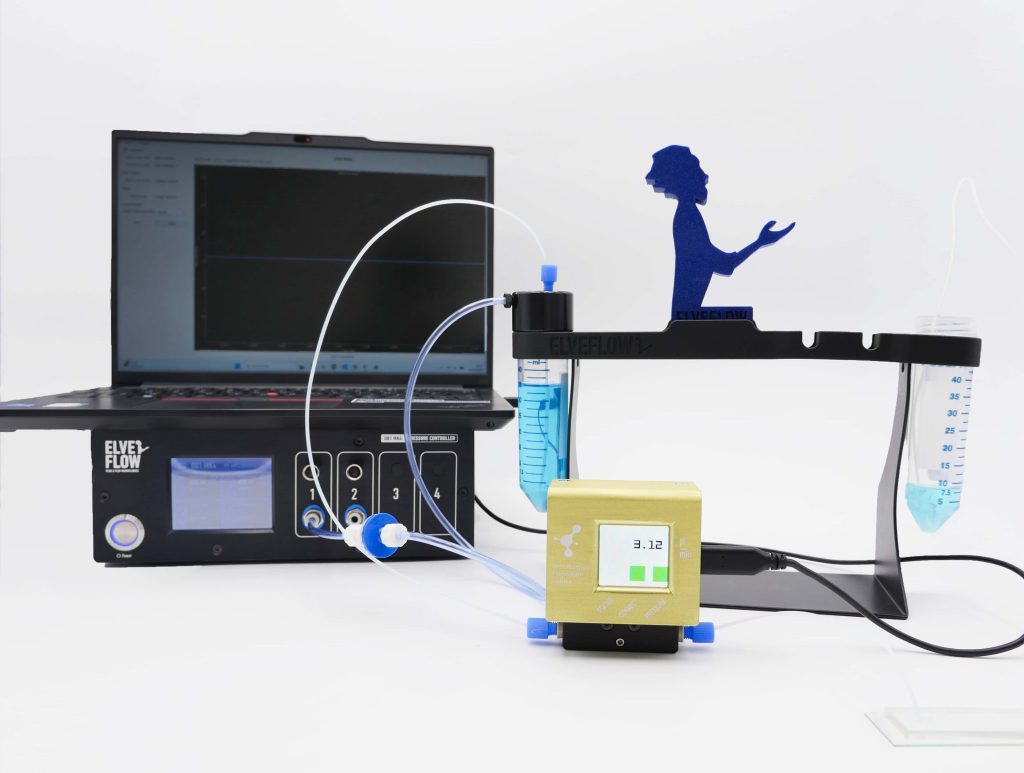
Inline flow measurement reports what a cell culture receives, at rates from 1 µL/min to 1 mL/min, and holds that rate steady through the run when paired with our pressure controller.
Features & Benefits
How a perfusion flow rate gets checked today
A perfused culture is set at the pump and judged at the cells. Between the two sits a line whose resistance nobody measures. Serum protein and cell debris settle at the smallest cross-sections and raise that resistance. The medium warms toward 37 °C and its viscosity falls, so the same driving pressure moves more of it. A reservoir level drops and takes hydrostatic head with it. The setpoint stays where you left it, and the wall shear stress on the monolayer does not.
That gap is also a reproducibility problem. A culture whose delivered flow was never measured cannot be repeated. The shear stress and the medium renewal rate the cells met are unknown, to the laboratory that ran it and to anyone reading it. The routes below differ in what they can tell you, and when.
No measurement at all. The pump’s setpoint stands as the record of what the culture received. It costs nothing, and it holds up for as long as nothing in the line changes. When something does change, the methods section still carries the number you asked for. The cells met something else. Nothing in the run announces that gap, so the first sign is in the biology: a monolayer that detaches, a barrier that leaks, an organoid that matures more slowly than the last batch.
A balance under the outlet. Weighing what leaves the chip over a timed interval gives a true volumetric rate, traceable to a mass standard, so a sensor gets checked against it. The measurement comes afterwards, and only at the far end of the line. Evaporation from an open vessel lands inside it. The vessel also has to stay on the balance for the whole interval, and nothing reaches you while the cells are under flow.
Thermal sensing. A heated element in the flow path reads how quickly the liquid carries the heat away. The reading is continuous and it arrives during the run. The element sits in the medium. Over a long culture, serum protein adsorbs onto the channel wall and cells attach to it, so the heat leaves differently and the reading drifts with nothing on the display to say so. The remedy is regular cleaning, planned into a run that was meant to proceed on its own.
Optical sensing, outside the fluid. The measurement is taken through the tubing wall, so nothing touches the medium and the instrument adds no sterility question of its own. That answers the long-culture objection head on, and groups building microphysiological platforms have gone this way for that reason. What it asks in return is optical access to a defined length of the line, and a calibration that belongs to the tubing as much as to the medium.
Differential pressure, with the flow path in a cartridge. A microchannel of known resistance sits inside the cartridge. In the laminar regime the flow rate through it is the pressure difference divided by that resistance, so two pressure readings give the rate with no heat entering the medium. A blockage shows up as a rising ratio of pressure to flow, and the alert reads that ratio. A reading that starts to drift is reported as it happens. The wetted part is a cartridge that snaps out, so what fouls is a consumable and what stays is the base. The element is in the medium, as it is on the thermal route. Here the fouled part snaps out, and the sensor tells you when.
Know the shear your cells were under, hour by hour.
Wall shear stress on a monolayer follows the flow rate, and few perfusion setups record it. The sensor sits in the line and reads what passes it, so the shear the cells met becomes a measured quantity. Over a long culture that turns a setting into a history: what the tissue received in hour three, and in hour two hundred, side by side. Another laboratory can then aim at the same measured number, on its own cells and its own chip.
Detect a blockage before the culture pays for it.
A partial blockage is the failure mode a perfused culture loses days to. It builds slowly, it does not stop the pump, and the display keeps reading whatever it was told. What the cells see is a falling medium renewal rate: nutrient and oxygen delivery drops, metabolic waste accumulates, and the wall shear stress falls below the value the model was designed for. A monolayer can detach, a barrier can lose integrity, and an organoid can shift phenotype before anything on the instrument looks wrong. The sensor reads the flow rate and the line pressure together, so the resistance downstream of it is a live quantity. A line that starts to restrict is visible as it happens, and the alert is raised on the sensor itself.
Keep the culture comparable from its first day to its last.
A sensing element in a biological medium fouls. Serum protein adsorbs onto it and cells attach. A reading that stops is obvious. A reading that drifts gives no sign of itself, so the dose goes into the record as held while it moves, and the day-one and day-twenty points stop being comparable. Two things are done about that here. The flow path sits in a cartridge that snaps out of the base, so the fouled surface is replaced without tools and the culture keeps running on a clean one. And the sensor reports a reading that begins to move, so the swap happens when the data asks for it.
Perfuse a fragile model with nothing to calculate first.
Holding a low flow rate from a pressure source usually means adding restriction to the line, and choosing an inner diameter and a length to match your target rate. That is a calculation with tubing tables in it, and it comes back at every new flow target. The restriction is inside the cartridge, so there is nothing to choose: the perfusion line is the reservoir, the sensor, your chip and the tubing between them. One part fewer in contact with the medium, one fewer place for a bubble to lodge, and no sizing step between unpacking the sensor and the first culture.
Hold the shear you designed, with no loop to tune.
Measuring a flow rate and holding it are two steps. The second one usually means choosing feedback parameters and testing them on a live culture. Easy Flow Control, written for this sensor, closes that loop with our OB1 pressure controller and needs no tuning. You enter the flow rate, and the pressure is adjusted to hold it as the chip loads up and the medium warms. The cells therefore stay under the wall shear stress the model was designed for, from the first hour of the culture to the last.
Application
Multi-day organ-on-chip perfusion
The central case. A perfused chip held for days, with the delivered rate read in line and recorded for the length of the run. It answers the question a reviewer asks about a barrier or a vascular model. Did the endothelium see the wall shear stress the design called for in every hour of the culture, or only in the hour the setup was checked.
Medium recirculation over a long culture
A closed loop moves the same batch of medium for days or weeks, so the cells condition their own medium while the parts that wear sit in the loop. Reading the rate at the sample says whether the circuit still renews that medium at the rate it did at the start. A restriction building up is visible before the culture feels it.
Dose and washout timing in drug work
Exposure is a concentration and a duration, and the duration depends on how quickly a solution reaches the cells and how quickly it leaves. A reading that arrives continuously puts the arrival and the clearance on a timebase, so a dose-response curve rests on a measured exposure time. The same timing then becomes checkable from one chip and one cell batch to the next.
Exposure protocols in toxicity testing
A repeated-dose or chronic protocol states a concentration multiplied by a time. The concentration is prepared, and the time is usually assumed. Measuring the delivered flow across the whole exposure turns the second half of that product into a recorded quantity. That matters most when the endpoint is a slow loss of viability or a shift in phenotype.
Organoid perfusion and vascularised models
An organoid matured under continuous medium renewal needs a low, steady rate: too little and the core becomes hypoxic, too much and the shear strips cells from the surface. It is also the model least able to signal that the rate has moved. An inline reading and a blockage alert cover the two failures that end these cultures. Cartridge choice depends on the rate a protocol runs at, and we go through that with you.
Qualifying the pump already in the laboratory
The sensor sits downstream of whatever pushes the liquid, so it also reads a pump you already own. A syringe pump at a low set rate, a peristaltic pump on a recirculating loop: each has a delivered rate, and the sensor reads it. A facility that signs off on other people’s cultures can then put a shear figure on each protocol instead of a dial position.
| Galileo | ||
|---|---|---|
| Measuring ranges and cartridges | ||
| Measuring range | 1 µL/min to 1 mL/min, over two cartridges | |
| GFS1 | GFS2 | |
| Cartridge range(1) | 1 to 40 µL/min | 25 µL/min to 1 mL/min |
| Other ranges on request | ||
| Snap-in cartridge carrying the flow path, exchanged without tools | ||
| Internal volume | 11 µL and 18 µL, on the cartridges the measurements below were taken with | |
| Wetted materials | PEEK, PFPE, ETFE, FSIL, stainless steel | |
| Fluidic connections | ¼”-28 female UNF | |
| Measurement | ||
| Calibration medium | Pure water at 25 °C | |
| Accuracy | 2% of the measured value | |
| Precision | below 0.01% of full scale | |
| Repeatability | below 0.25% of the measured value | |
| Response time(2) | τ95 below 20 ms to a pressure step | |
| Data rate | 200 Hz | |
| Flow direction | bi-directional, positive and negative | |
| Pressure measurement range | 0–3 bar absolute | |
| Temperature correction factor(3) | below 0.05% of the measured value per °C | |
| Alerts and display | ||
| Clogging alert on the instrument | ||
| LCD screen on the instrument, for live flow-rate reading | ||
| Operating conditions | ||
| Operating temperature | 10–40 °C | |
| Operating absolute pressure | 0–4 bar | |
| Warm-up | 15 min | |
| CO2 incubator compatibility | yes | |
| Control and power | ||
| 5 V DC supply, USB-C | ||
| UART interface for integration into another instrument | ||
| Physical | ||
| Base | 150 g, 70 × 65 × 35 mm | |
| Cartridge | 40 g, 60 × 49 × 17 mm | |
(1) The internal resistance scales with viscosity, so the measuring range shifts for a culture medium and shifts again as that medium warms to 37 °C.
(2) The response time is the time to reach 95% of a new value after a pressure step.
(3) The temperature correction is relative to the 25 °C calibration.
Funding & Acknowledgment
The development of this microfluidic flow sensor has received funding from the European Union’s Horizon research and innovation program under HORIZON-EIC-2022-TRANSITION-01, grant agreement no. 101113098 (GALILEO).



Frequently Asked Questions
It measures the liquid flow rate passing through it, and it sits in the line between whatever pushes the liquid and the chip or chamber holding your cells. The Galileo flow sensor comes in two parts: a base that stays mounted, and a snap-in cartridge carrying the flow path. A known restriction inside the cartridge produces a pressure difference, the sensor reads it, and the flow rate follows. You get an alert when the line blocks, and a wetted path you replace between experiments. It was developed by the Microfluidics Innovation Center and is supplied by Elveflow.
Yes. The Galileo flow sensor is rated for a CO2 incubator and for an ambient between 10 and 40 °C. It sits next to the chip, so the line between the reading and the cells stays short and the medium is not cooled and re-warmed on its way to them. The sensor then reads at the same temperature the cells sit at, and its LCD screen puts the live rate where the culture is. Temperature still shows up in the reading, and the instrument carries a correction for it: below 0.05% of the measured value per degree, relative to a calibration made at 25 °C. Let it warm up before relying on the first numbers.
The calibration is made with pure water at 25 °C, and the measuring range for any other liquid follows that liquid’s viscosity, so a medium thicker than water shifts the range. The wetted materials are PEEK, PFPE, ETFE, FSIL and stainless steel, which is the list to check your medium, your serum and your reagents against. The Galileo flow sensor also carries a temperature correction, below 0.05% of the measured value per degree, which counts for a culture held at 37 °C. Send us the liquid and the rate you work at, and we will confirm which cartridge range fits.
By watching what the pressure and the flow do together, which the Galileo flow sensor reads directly. The sensor reads the flow rate and the line pressure together, and their ratio is the resistance of everything downstream of it. A rising ratio is the blockage signature. At a fixed pressure the flow falls; under closed-loop control the pressure climbs to hold the flow. The alert fires on the ratio, so no threshold has to be set. Locating it is then a short list: the chip first, since that is where the smallest cross-sections are, and where cell debris and matrix collect, then the connectors, then the tubing, then the cartridge. Swapping the cartridge is a two-second test in itself. If the alert clears with a fresh one, the blockage was in the flow path. If it does not, it is downstream in your device.
The flow path is a cartridge, so the part your solutions touch is the part you exchange between two experiments. Its internal volume is small, 11 µL and 18 µL on the cartridges the specifications were measured on, so little liquid is held between runs to begin with. Where two solutions must not meet, a fresh cartridge separates them outright. The wetted materials are listed above, so a rinse can be chosen to match your chemistry. A distribution valve upstream gives another route: switch to a rinse solution and flush the path in place, with nothing to disconnect. Our MUX Distribution does that switching, and there are several ways to plumb it into a perfusion line. Tell us how your protocol treats the flow path between cultures and we will confirm the handling with you.
Two steps normally stand between a pressure source and a steady flow rate on your chip, and this sensor removes both. First, holding a low flow rate from a pressure source means adding restriction to the line. Sizing it is a calculation on tubing inner diameter and length, and it comes back at every new flow target. The Galileo flow sensor carries that restriction inside the cartridge, so the perfusion line is the reservoir, the sensor, your device and the tubing between them. Second, measuring a rate and holding it are two different things, and the second usually means picking feedback parameters and trying them on a live culture. Easy Flow Control was written for this sensor: paired with our OB1 pressure controller, it takes the flow rate you enter and adjusts the pressure to hold it, with no parameters to set. You set the rate your model needs, and as a chip narrows or the medium warms, the reading moves first and the pressure follows.
It disturbs it while it passes, because a differential-pressure measurement reads the liquid in front of it and a gas plug does not behave like the medium. A single bubble crossing the cartridge shows up as a short excursion in the trace, and that shape is worth learning to recognise. On a long culture, our bubble remover takes the air out upstream of the sensor, before it reaches either the reading or the cells. One bubble across a monolayer can strip cells in seconds, so a line kept free of air protects the culture as much as the measurement.
Yes, up to 3 bar absolute. The Galileo flow sensor measures pressure in order to work out the flow rate, so the pressure is available as a reading in its own right. On a perfused device the pressure reports the state of the line, and that line runs from your reservoir to your cells. A slow climb at a constant flow rate is a restriction forming, usually protein or cell debris at the chip. A sudden drop is a disconnection or a leak. Flow is read in both directions, so backflow into the chip shows up as a negative rate and not as a stopped line. Reading both together separates a chip that is loading up from a pump that has stopped delivering.
Yes, and not only the pump. The Galileo flow sensor sits downstream of whatever moves the liquid, so it reads the delivered rate of the syringe pump or the peristaltic pump already in your line. Set 50 µL/min, and read what arrives at the chip. Put it in series with a flow sensor you already own and you read the two side by side. Used this way it is a test bench for the rest of the line: a laboratory that qualifies a colleague’s line, or that inherits a protocol carrying a number, can put a measurement behind it.
The interfaces are open for it. The Galileo flow sensor runs on 5 V DC over USB-C and carries a UART interface. The two parts are compact enough to sit inside a housing: 70 × 65 × 35 mm for the base, 60 × 49 × 17 mm for the cartridge. What an integration needs beyond that depends on the instrument it goes into, and we work through those cases one at a time.
Contact us through the form with the flow rate your protocol runs at. We will come back with the cartridge range that fits, the accessories the line needs, and our pressure controller to hold that rate while the Galileo flow sensor reads it.




 Job
Job Collaborations
 Customer
 Other
Other