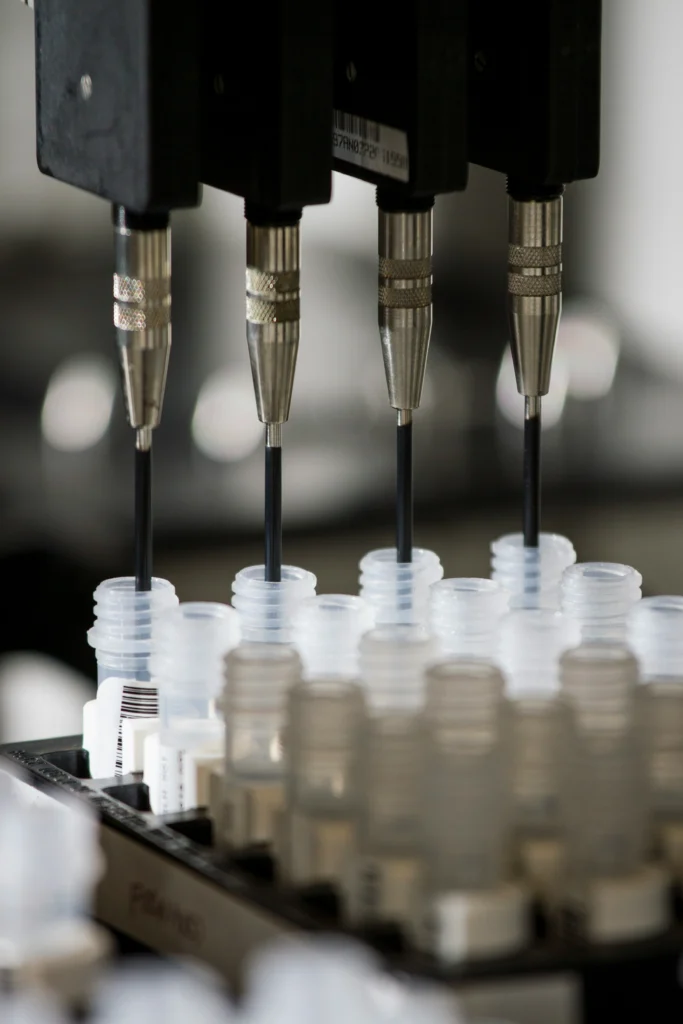
Automated Sampling Solution
Experimental setup for Automated Sampling Solution for Continuous Analysis with microfluidic solutions for faster, more precise results.Reduce costs and contamination, minimize waste and improve product quality
Analyse and collect multiple data points in an automated way
Monitor and control your production process
Experimental microfluidic setup for automated sampling, ensuring faster and more precise results for Continuous Analysis.
Features & Benefits
Controlling reaction kinetics is crucial for time-sensitive processes that evolve rapidly. Whether for a deeper understanding of reaction dynamics or for automatic termination upon reaching target conditions, continuous monitoring can be the key to success.
Elveflow presents a setup tailored for sampling processes, enabling users to extract small liquid volumes from a reactor, transport them to an analyzer, and ultimately collect them in individual vials.
The setup is highly versatile and can be customized to meet specific user requirements. Users can adjust parameters such as the number and volume of collection vials, the number of samples analyzed or collected, and other aspects of the process. Our experts are available to assess feasibility and recommend the optimal configuration to achieve your goals.
Thanks to the versatility of the instruments, and the upgradability of our range, the process can evolve along with your requirements, and can thus be used for both the prototyping and the final solution.
Bioprocess Monitoring in Cell Culture
Continuous monitoring of bioproducts in the pharmaceutical, biotech, and food industries is essential for optimizing bacterial or mammalian cell cultures. These cells are cultivated for the production of monoclonal antibodies, and enzymes or studied for fundamental research, disease modeling, and drug testing.
- Key Parameters Monitored: pH, dissolved oxygen (DO), by-products, and metabolites.
- Analytical Devices: HPLC (High-Performance Liquid Chromatography), Mass Spectrometry (MS), Spectophotometry.
This continuous monitoring prevents overgrowth and toxic by-product accumulation, enables real-time optimization of culture conditions, and reduces human intervention, minimizing the risk of contamination.
Chemical Reaction Kinetics in Chemistry
In pharmaceutical synthesis and material science, understanding reaction kinetics in continuous-flow reactors is essential for optimizing product yield and minimizing waste. For example, chemical catalysis reactions, cross-linking study, and chemical thermodynamics processes, which govern energy changes and equilibrium states, are reactions that benefit from continuous monitoring. Real-time analysis ensures precise control over these processes, enhancing efficiency, selectivity, and reproducibility while reducing by-product formation.
- Key Parameters Monitored: Concentration of reactants/intermediates/products, viscosity, color, temperature, and pressure.
- Analytical Devices: UV-Vis Spectroscopy, NMR (Nuclear Magnetic Resonance): Identifies structural changes in molecules, GC-MS (Gas Chromatography-Mass Spectrometry), FTIR (Fourier Transform InfraRed Spectroscopy).
Continuous monitoring helps determine reaction completion points, enables immediate process adjustments in continuous production, and minimizes material waste by preventing the overuse of reactants.
Environmental Water Quality Monitoring
Real-time water analysis ensures continuous monitoring of lakes, rivers, industrial discharge, and drinking water facilities to detect contaminants and maintain water quality.
- Key Parameters Monitored: Heavy metal contamination, pH, organic compounds, and microbial load.
- Analytical Devices: ICP-MS (Inductively Coupled Plasma Mass Spectrometry), TOC Analyzer (Total Organic Carbon), Ion Chromatography
Ensuring compliance with environmental regulations, real-time water analysis provides early warnings for contamination events, allowing for swift corrective actions. By continuously monitoring water quality, industries can proactively manage pollutants and minimize their environmental footprint, contributing to sustainable resource management.
Drug Development and Pharmaceutical Manufacturing
Continuous analysis in small-molecule drug synthesis or biologics production ensures that every batch meets stringent regulatory standards, maintaining product consistency and quality.
- Key Parameters Monitored: Drug purity, API (Active Pharmaceutical Ingredient) stability, size, and impurity profiling.
- Analytical Devices: LC-MS (Liquid Chromatography-Mass Spectrometry), Raman Spectroscopy, DLS (Dynamic Light Scattering)
Real-time monitoring in drug synthesis and biologics production reduces batch-to-batch variability, ensuring consistent product quality. By optimizing conditions throughout the manufacturing process, it improves production efficiency and minimizes waste. Additionally, continuous data documentation enhances regulatory compliance, providing accurate records that meet industry standards and streamline quality control.
Petrochemical and Refinery Process Control
In the petrochemical industry, crude oil distillation, catalytic cracking, and polymerization reactions are monitored online to ensure process efficiency, product consistency, and operational safety.
- Key Parameters Monitored: Hydrocarbon composition, sulfur content, viscosity, and molecular weight distribution.
- Analytical Devices: Gas Chromatography (GC), FTIR (Fourier Transform Infrared Spectroscopy), Raman Spectroscopy..
Preventing production inefficiencies and equipment fouling, continuous monitoring in petrochemical processes ensures smooth operations and maximized output. It also helps industries adhere to fuel quality regulations, avoiding costly penalties through strict composition control. By enabling early detection of potential failures, real-time data analysis minimizes downtime and enhances overall refinery efficiency.
Biomedical Research and Point-of-Care Diagnostics
Automated high-throughput sampling enables real-time blood or saliva analysis, allowing for the rapid detection of disease biomarkers in clinical research and point-of-care diagnostics.
- Key Parameters Monitored: Glucose levels, antigen levels, inflammatory markers, and genetic material.
- Analytical Device: Lab-on-a-Chip, ELISA (Enzyme-Linked Immunosorbent Assay), Electrochemical Sensors
High-throughput automated sampling accelerates diagnostics for diseases like diabetes and cancer, providing faster and more reliable results. By minimizing manual handling, it reduces the risk of errors and contamination, ensuring greater accuracy in biomarker detection. Continuous monitoring of patient biomarkers also supports personalized medicine, enabling tailored treatments and early intervention for improved health outcomes.
We provide a full set of instruments to quickly and efficiently optimize your sampling work flow. One of the possible configurations is shown in the following setup:
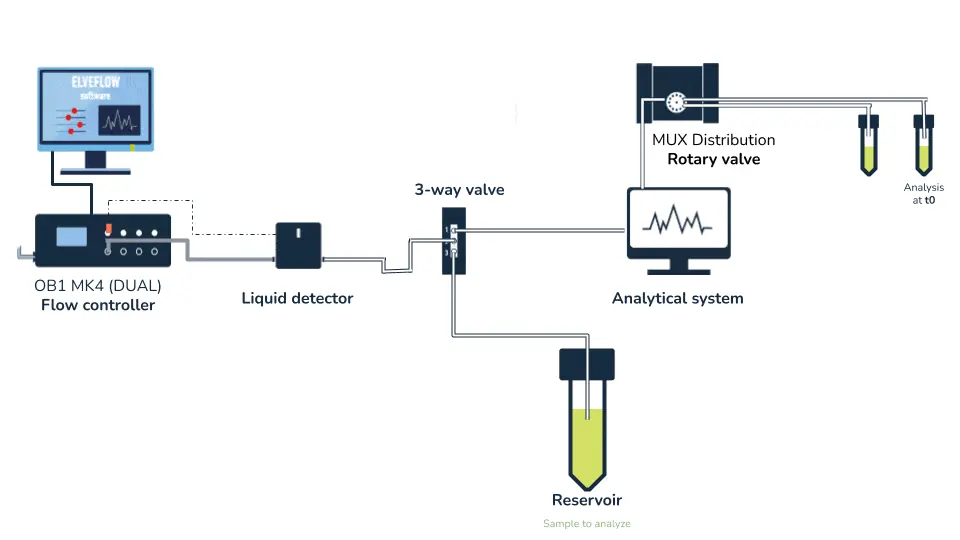
The system includes:
- OB1 Flow Controller dual
- Microfluidic bubble / liquid detector
- MUX Wire and 3-way valve
- MUX Distribution valve
- Several pressure-tight reservoirs
- All the necessary fittings to connect to your system
- ESI Software
- Software development tools and communication protocols
- User guides
What you should have from your end:
- Analytical system: for example a spectrometer or chromatography system
- The sample to analyze
For your convenience, the sample volume can be easily adjusted by choosing the appropriate length and diameter of tubing between the liquid detector and the 3-way valve.
System operation
The automated sampling at a desired time happens in the following steps:
- By applying negative pressure (vacuum), the liquid goes from the reactor to the liquid detector
- When the liquid detector is reached by the liquid front, the valve position is switched and positive pressure is applied
- Due to the effect of positive pressure, the liquid then goes toward the analyzer of your choice, and later to the collection vial (if necessary).
- These steps can be repeated as many times as necessary to eventually get complete information on the evolution of the process over time.
- The rotary valve of the MUX Distribution can be switched in order to collect the analyzed samples in different vials. These samples are then easily available in individual vials for further analysis.
This process can be automated thanks to the sequence generator of Elveflow’s ESI control software.
Frequently Asked Questions
If you want to sequentially analyze different samples, we recommend adding a second MUX Distribution valve in between the 3-way valve and the reservoirs. It is then possible to select one sample out of a maximum of 12 samples.
We do not recommend the use of the MUX Distribution with solutions containing suspended particles. We advise you to filter your solutions with a 10 µm filter when using a MUX Distribution valve. With the exception of the MUX Distribution valve, all the others are compatible with the solutions containing suspended particles.
All kinds of reservoirs are compatible with our OB1 pressure controller. From 800 µL to several liters, explore our full range of reservoirs, all compatible with the Elveflow ecosystem and choose the one that fits your needs the best. You don’t find the volume that would correspond to your needs, contact our expert for more information.
The instruments presented in the setup are compatible with our Software Development Kit. Our package allows developers to integrate Elveflow systems into their own control programs. Those libraries enable fast and easy integration of our instruments to your lab project. We provide the following libraries free of charge (with documentation and example codes): C++ library, Python library, MATLAB library, LabVIEW library.
The system presented in this use case requires a computer to run. However, all the different instruments are available in their advanced version with improved automation capabilities. This Advanced range would be perfect for this specific need as the main module of the range, the Control Center, is a dedicated PLC (programmable logic controller). You can program and save microfluidic instructions on the control center and then run experiments without a PC. Everything is then controlled by the control center. The Pressure Controller, the Rotavalve Distribution and the Valve Hub will complete the collection of the Advanced modules needed for this use case. Contact our experts at Elveflow to get more information on the capabilities of this range!


 Job
Job Collaborations
 Customer
 Other
Other