The temperature influence
Most materials expand with increasing temperatures, and films and glass photolithographic masks are no exception to that rule. The dimensions of all masks in use today change with changing temperatures. The expansion is determined by CT, the thermal expansion coefficient. CT is a basic characteristic of a material; it is expressed in millimeters per meter per degree centigrade.
A film photolithographic mask adapts to changes in temperature within a few minutes but temperatures of < -20 deg C and > 60 deg C will cause damages to the film. Always put the film photolithographic mask at room temperature before use (keep in mind that a constant temperature around 21 deg C is perfect). A Soda Lime photolithographic mask is 2x more stable than a film photo-mask and a quartz photolithographic mask will not move with temperature.
A turnkey offer to fabricate your su-8 mold and pdms chips
The humidity influence
Polyester film absorbs water and thus expands with increasing relative humidity. The expansion is determined by the CRH (relative humidity expansion coefficient). CRH is expressed in µm per meter per % change in relative humidity. If the CRH of a material is 1, one meter of that material will expand 1µm when the relative humidity increases by 1 %. Likewise, the material will shrink as the relative humidity decreases.
A film photolithographic mask adapts to changes in temperature humidity within a few hours and a humidity of 70% will cause irreversible changes. A Soda Lime photolithographic mask will NOT change with humidity, and neither will a Quartz photolithography mask.
Please note: Humidity distribution in a room is rarely homogenous – that means it can change from area to area, and from corner to corner. It is vital if you are trying to control the humidity environment to ensure that airflow is constant throughout the WHOLE room. Because humidity is probably the hardest of these 4 factors to control adequately – and also has the biggest influence on dimensional changes – glass photolithographic masks would always be the recommended product if you need to control the accuracy of the mask to critical dimensions.
Influence of the mechanical tension
The expansion is determined by the elasticity modulus, which is typical of the material. If the tension does not exceed a certain value, all changes will be reversible. In general, if the photolithographic mask is subjected to only limited mechanical tensions, no irreversible dimensional changes will occur.
However, photolithographic masks do suffer from mechanical tensions induced by some contact exposure equipment and the vacuum applied in the printer. The dimensional changes will be limited when the vacuum is gently built up all over the surface of the photolithographic mask. When a film is secured by a very strong vacuum, that vacuum may hold the film, preventing it from changing size in response to changes in temperature or humidity. Although the temperature of the film changes, the size should remain constant for as long as the vacuum is applied. Once the vacuum is released, the film size will change instantly.
Influence of aging
The size of silver halide masks may change with aging. Over time, there is a tendency for the film to change back to the initial size it was prior to processing. These changes can take several months, and are relatively small, but this gives another reason why it is critical to control and maintain the processing conditions.
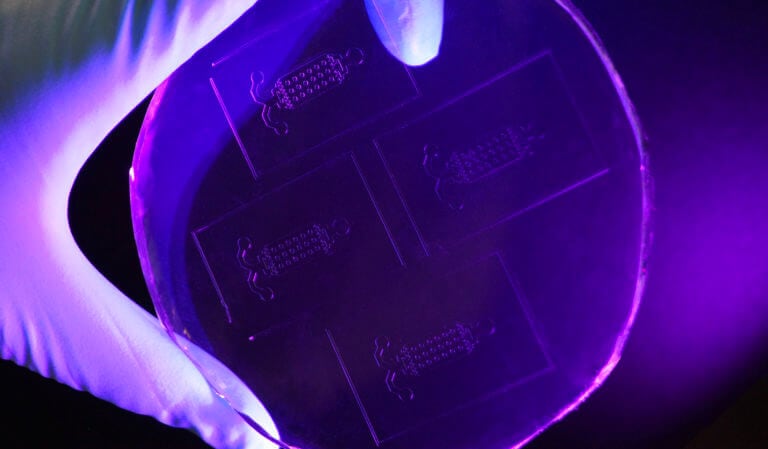
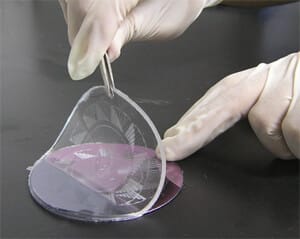
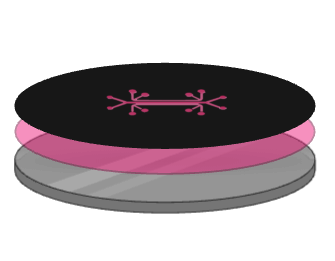
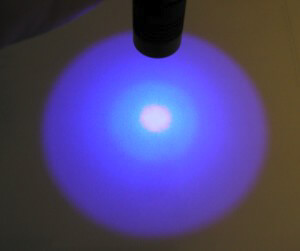
 There are several ways to imprint a pattern on a photoresist. It’s possible to directly write on the photoresist with a microfabrication tool such as a laser for example but the most used method is to imprint the pattern thanks to a photolithography process. The exposure aim is to activate a photoactive component (PAC) inside the resin in some particular parts. This activation will change the local solubility proprieties of the resin that will become soluble or not in a developer. The photoresist is called positive if the exposed parts are developed and negative if it’s the non-exposed ones (like SU-8).






 Job
 Collaborations
 Customer
 Other